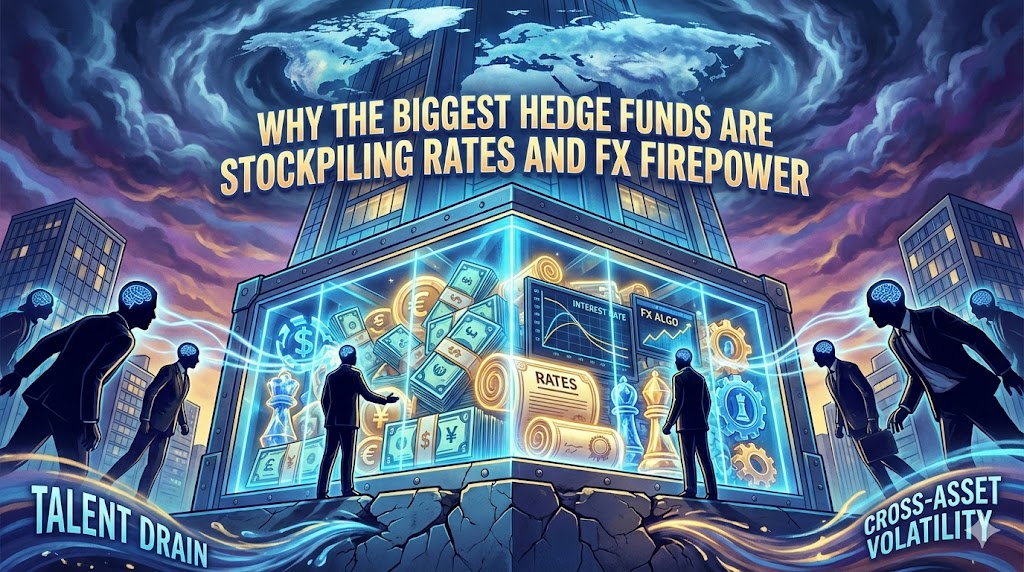
(HedgeCo.Net) One of the most important—and least publicly discussed—stories shaping the largest U.S. hedge funds in early 2026 is not a specific trade, but a staffing arms race: macro talent is being hoovered up across the industry, with an emphasis on rates, FX, and cross-asset volatility expertise.
The reason is straightforward. The macro environment has become structurally tradable again.
For years, central bank dominance compressed volatility, flattened opportunity sets, and reduced the payoff to discretionary macro. That era has ended. In 2026, rate path uncertainty, geopolitical shocks, and commodity-linked inflation bursts are producing repeated dislocations—exactly the conditions where skilled macro managers can generate uncorrelated returns.
Hedge fund recruiting reflects this shift.
Hiring signals: banks are losing their best macro operators
Financial News London reported that Jain Global hired Jiujiu Xiong, a senior Barclays managing director with deep rates options expertise, to strengthen its macro portfolio management team. The story matters not just because Jain Global is adding talent, but because it illustrates the broader pattern: hedge funds are actively recruiting seasoned rates and macro specialists as the value of that skillset rises.
The “why now” is crucial. If markets are entering a higher-vol regime with more frequent rate repricings, then rates options, volatility surfaces, and macro hedging become central. The biggest hedge funds want that capacity in-house because it affects everything: position sizing, hedging costs, tail risk, and cross-asset correlation behavior.
Macro is becoming a core sleeve inside multi-strats
The largest U.S. hedge funds aren’t becoming macro funds. They are becoming macro-aware platforms, where macro pods are integrated into the same risk architecture that houses equities, credit, and systematic strategies.
This is one reason multi-strategy structures are so powerful in 2026. Macro pods don’t just “make money” in isolation. They provide:
- Hedges that reduce portfolio-level drawdowns
- Signals that inform other books (e.g., how rates moves reshape equity factor leadership)
- Liquidity trades that monetize policy events and commodity shocks
- Volatility overlays that stabilize exposure around major catalysts
Reuters’ depiction of January’s volatility-driven hedge fund gains underscores the opportunity set that macro sleeves feed on. When geopolitical events and policy uncertainty move rates, FX, and commodities in sharp bursts, the payoff to macro flexibility increases.
Rates are the new center of gravity
The macro trade of 2026 isn’t one-directional “rates down” or “rates up.” It’s that the rate regime is unstable. Investors are continually repricing growth, inflation, and policy credibility.
That instability is fertile ground for:
- Curve trades (2s/10s dynamics, front-end vs back-end repricing)
- Options positioning around event risk
- Cross-market relative value (U.S. vs Europe vs Asia rate path divergences)
- FX expressions linked to yield differentials and capital flow shifts
In this environment, macro teams with deep derivatives expertise are increasingly valuable. That’s why a rates options specialist hire—like the one highlighted at Jain Global—signals more than a single firm’s staffing decision. It reflects a structural view: macro volatility is not fading, so the skillset is being priced like a scarce asset.
The platform advantage: macro as portfolio insurance that can also earn
The biggest U.S. hedge funds want macro pods for the same reason institutions want hedge funds in the first place: uncorrelated returns.
January’s results showed that many hedge funds performed well amid volatility. But the more important takeaway is that volatility itself is now a recurring feature. In a market where shocks propagate quickly—rates to equities to credit to commodities—macro pods can both hedge and profit.
This is not theoretical.
When energy spikes (like the natural gas surge Reuters highlighted), macro funds can express views across commodities and inflation-linked rates, while equity pods trade second-order effects. A platform with strong macro and strong equities has a wider opportunity set than a single-strategy fund.
A new style balance: discretionary + systematic
Another macro trend inside the largest firms is the blending of discretionary expertise with systematic tooling. Even discretionary macro teams now rely on sophisticated analytics: scenario modeling, risk decomposition, options greeks at portfolio level, and rapid stress testing.
Meanwhile, systematic macro approaches—trend, carry, volatility control—remain important. But 2026 is reinforcing the value of human judgment around regime shifts, especially when policy signals are ambiguous and correlations behave nonlinearly.
Reuters’ observation that quant funds collectively declined in January while other hedge fund styles gained highlights this tension. It’s not that systematic tools are obsolete. It’s that macro regimes can break models—and discretionary flexibility becomes a premium.
What allocators should ask in 2026
If you’re underwriting large hedge fund exposure in 2026, the macro talent story changes the due diligence checklist. Key questions include:
- How integrated is macro risk into the broader platform?
Is macro a silo, or does it actively shape portfolio hedging and risk budgeting? - What is the firm’s volatility framework?
Does the fund monetize volatility through options and convexity, or does it mainly avoid volatility? - How does the firm manage crowding and correlation spikes?
Macro shocks can cause simultaneous drawdowns across books. The best platforms manage that with dynamic risk controls. - Is macro talent deep or concentrated?
One star PM can’t carry a platform. Robust macro capacity means depth across rates, FX, commodities, and volatility.
Bottom line: the macro talent war is one of the clearest “today” stories at the largest hedge funds because it’s both a response to the current market and a bet on what 2026 will remain: event-driven, volatile, and cross-asset. The biggest firms are building macro capability not as a niche allocation—but as a structural advantage.