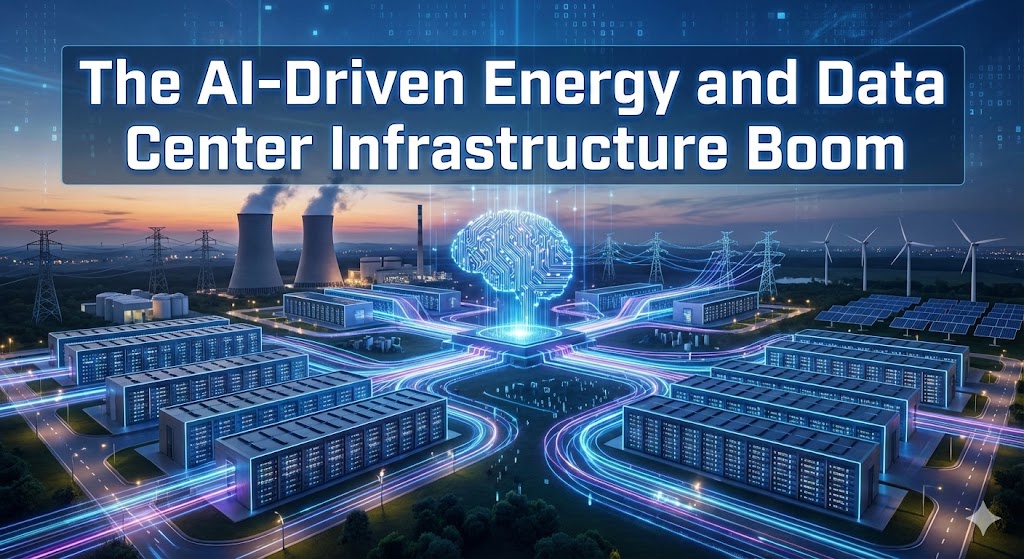
(HedgeCo.Net) The artificial intelligence boom is no longer a story about software alone. By 2026, it has become one of the most capital-intensive infrastructure buildouts in modern economic history, reshaping energy markets, real assets, and long-duration investment strategies across the United States.
At the center of this transformation sits an extraordinary fact: U.S. data center development is expanding at roughly 25% annually, driven almost entirely by AI workloads. Large-language models, inference engines, and real-time AI services demand orders of magnitude more computing power than traditional cloud applications. That compute intensity is colliding with an energy system that was never designed for this scale or load profile.
For investors, the implications are profound. AI is pulling forward decades of infrastructure spending into a compressed time horizon — and the beneficiaries extend far beyond chipmakers and cloud providers.
Energy Demand Is Becoming the Binding Constraint
Historically, data centers were optimized around connectivity, real estate, and cooling efficiency. Energy was a manageable input. That equation has flipped.
Modern AI data centers consume five to ten times the power of legacy facilities. Hyperscale campuses now rival small cities in electricity demand, with some single-site projects requiring hundreds of megawatts of dedicated capacity. In key markets such as Northern Virginia, Texas, Arizona, and the Midwest, grid congestion is already delaying new deployments.
This has created a new investment reality: AI compute demand is growing faster than energy supply.
Utilities, independent power producers, and infrastructure investors are racing to close that gap. Capital is flowing into power generation, transmission upgrades, on-site generation, and energy storage solutions at a pace not seen since the post-war industrial buildout.
Power Generation: From Baseload to Strategic Asset
One of the most striking shifts has been the renewed interest in baseload power. Intermittent renewables alone cannot support 24/7 AI workloads with tight latency and uptime requirements. As a result, investors are re-evaluating assets that provide consistent, dispatchable energy.
Natural gas remains a near-term winner, particularly gas-fired plants paired with long-term offtake agreements from data center operators. But the longer-dated bet is nuclear.
Small modular reactors (SMRs), once viewed as speculative, are increasingly seen as a credible solution for AI-driven power demand. Their appeal lies in predictable output, carbon-free generation, and the ability to colocate with large industrial consumers. While timelines remain uncertain, capital is positioning early, anticipating regulatory and political tailwinds.
Transmission and Grid Modernization
Generation alone is not enough. The U.S. transmission grid — aging, fragmented, and underinvested — is becoming a critical bottleneck.
AI data centers are often built where land and tax incentives are favorable, not where power is abundant. That mismatch is driving massive investment into high-voltage transmission lines, substations, and grid-balancing technologies. Private capital is stepping in where public funding has lagged, attracted by regulated returns and inflation-linked cash flows.
For infrastructure funds, transmission assets offer something rare in 2026: long duration, predictable revenue, and structural demand growth tied directly to AI adoption.
Battery Storage and Load Management
Battery storage has moved from optional to essential. AI workloads create spiky, unpredictable demand patterns that strain local grids. On-site battery systems help smooth those loads, reduce peak pricing exposure, and improve resilience.
Investors are increasingly viewing battery storage not as a renewable adjunct, but as a standalone infrastructure class tied to data center economics. Returns are driven by capacity payments, arbitrage opportunities, and long-term service contracts with hyperscalers.
The Creative Destruction Risk
Despite the optimism, analysts warn that the AI infrastructure trade is not without risk. Overbuilding, technological obsolescence, and shifting compute architectures could strand capital if demand projections prove overly aggressive.
Not all data centers will be created equal. Facilities built for today’s GPUs may be ill-suited for tomorrow’s architectures. Power assets tied to speculative projects could face utilization risk.
In 2026, manager selection and project underwriting matter more than ever. The winners will be investors who treat AI infrastructure not as a hype trade, but as a disciplined, long-cycle capital allocation challenge.