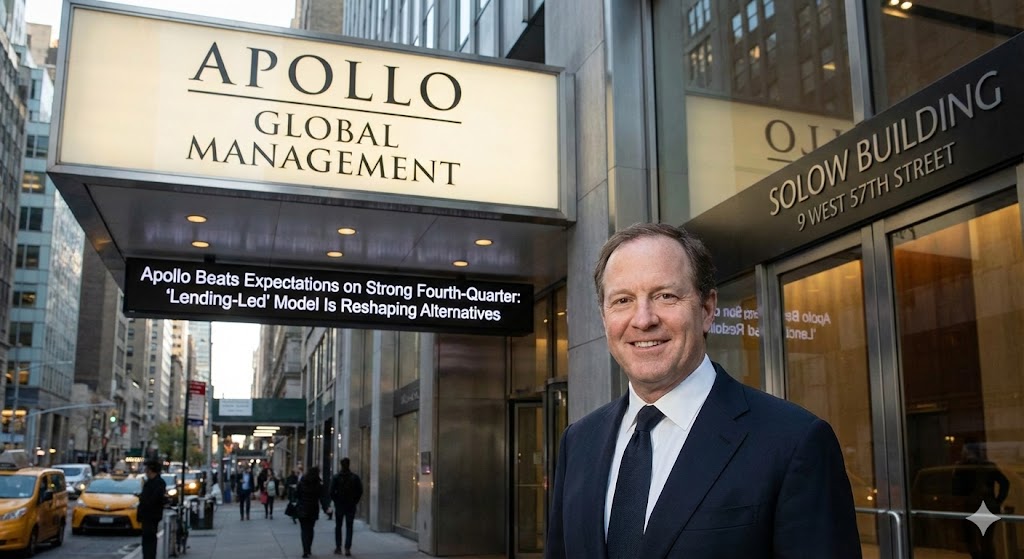
(HedgeCo.Net) Apollo Global Management’s fourth-quarter results did more than clear the bar—they reinforced a strategic reality that has quietly become the most important story inside large alternative asset managers: the center of gravity has shifted from episodic private-equity realizations to repeatable, high-velocity credit origination and retirement-driven balance-sheet scale. In a quarter when market narratives were dominated by AI-linked volatility and renewed anxiety around software exposure in private credit, Apollo delivered a clean counterpoint—strong earnings, record origination, and assets under management nearing $1 trillion—while emphasizing that its software exposure is relatively small.
The headline numbers: a quarter that beat the Street—and capped a record year
Apollo reported Adjusted Net Income (ANI) of $2.47 per share for 4Q 2025, ahead of analysts’ expectations (Reuters cited a $2.05 consensus). The quarter was also notable for the composition of earnings: Fee Related Earnings (FRE) of $690 million and Spread Related Earnings (SRE) of $865 million, together producing $1.555 billion of “fee + spread” earnings in the quarter.
On a full-year basis, Apollo reported FRE of $2.528 billion, SRE of $3.361 billion, and ANI of $5.195 billion—a profile that underscores how the firm increasingly behaves less like a traditional private-equity house and more like a diversified, capital-solutions platform anchored by lending and retirement.
Just as importantly, Apollo’s scale continued to expand: total AUM ended 2025 at $938 billion, with fee-generating AUM of $709 billion. That puts Apollo within striking distance of its widely discussed $1 trillion milestone—an emblem not only of size, but also of distribution power and product breadth.
The engine behind the beat: record origination and a “manufacturing line” for credit
If there was one metric that explained the quarter, it was origination. Apollo reported $97 billion of origination in 4Q 2025 and $309 billion for the full year. That pace matters because origination is not just “deal flow”—it is the upstream feedstock for multiple revenue lines:
- Management fees on growing credit and hybrid strategies
- Transaction and advisory fees tied to structuring and deployment
- Spread-related earnings generated through the retirement-services complex (where Apollo’s balance-sheet and reinsurance ecosystem can convert spreads into durable earnings over time)
Apollo’s results presentation also showed $42 billion in quarterly inflows and $228 billion for the year, reinforcing that the origination machine was matched by fundraising momentum. Reuters similarly highlighted that the earnings strength was “buoyed by strong debt origination and fresh client inflows.”
The key strategic point: origination makes Apollo less dependent on the public markets’ mood. In a classic private-equity model, realizations can slow dramatically when IPO windows close or M&A multiples compress. Apollo’s quarter suggests a different rhythm—one where credit deployment, refinancing, and structured solutions can keep compounding even in choppier tape.
Why this matters now: the market is repricing “AI risk,” and private credit is in the blast radius
A big subtext to the quarter was investor concern about how AI disruption could ripple through software business models and, by extension, software-backed private credit portfolios. That theme has been hitting both sentiment and share prices across the alternatives complex, with investors hunting for concentrations they don’t fully understand.
Apollo moved quickly to address that fear. Reuters reported Apollo’s software exposure was under 2%, and CEO Marc Rowan argued that markets were overreacting and that dislocations can create opportunity at more reasonable valuations. Barron’s echoed the point, noting Apollo’s emphasis on low software exposure alongside the earnings beat and record origination.
This matters because the “AI risk” narrative has a habit of becoming a blunt instrument: once it captures headlines, it can temporarily override fundamentals and trigger generalized selling across alternative managers. Apollo’s message was essentially: we’re not ignoring the risk—but we’re not structurally overexposed, and we can be selective buyers if valuations reset.
The business mix story: Apollo’s earnings are increasingly “two-stream”
Apollo’s disclosure structure highlights what sophisticated allocators already see in the firm’s evolution: Apollo has built a two-stream model that blends:
- FRE (fee-related) — the classic asset-management annuity from managing client capital
- SRE (spread-related) — a second annuity tied to retirement services and balance-sheet economics (an area where Apollo has invested heavily through Athene)
In 4Q 2025, SRE ($865 million) exceeded FRE ($690 million), and for the full year, SRE ($3.361 billion) similarly exceeded FRE ($2.528 billion). That isn’t a minor accounting detail; it changes how investors should think about sensitivity to fundraising cycles, market levels, and realization environments.
This structure also partially explains why Apollo can speak about growth with a different tone than peers that are more tightly tethered to private-equity exits. Reuters noted Apollo has “strategically delayed private equity deals amid high interest rates” and has emphasized it does not need buoyant equity markets to perform in 2026. In other words: when the PE calendar slows, the credit-and-retirement engine can keep running.
Wealth and retirement distribution: the Apollo–Schroders partnership is a signal, not just a headline
Alongside the earnings release, Apollo announced a partnership with Schroders aimed at building wealth and retirement investment products, with an initial product expected later in 2026 and a U.S. Collective Investment Trust planned for the second quarter.
At first glance, this might read like standard industry “distribution news.” But strategically, it’s a continuation of a megatrend: alternatives firms are building scalable conduits into affluent and retirement channels, because that is where multi-year net inflows can be most durable.
Schroders framed private markets expansion as a priority, and the partnership reflects the logic of pairing a global traditional manager’s reach with an alternatives specialist’s product shelf. For Apollo, the broader implication is simple: if the firm wants to cross (and then live beyond) $1 trillion in AUM, wealth platforms and retirement structures are not optional—they are the runway.
What to watch next: 2026 is shaping up as a stress test of underwriting discipline
Apollo’s strong quarter doesn’t remove the macro questions hanging over private credit and leveraged finance—it simply clarifies where Apollo is placing its bets. The firm’s record origination and inflows suggest confidence in demand for capital solutions, but the next phase of the cycle will likely test three things:
- Credit selection and workout capacity as the market differentiates between top-tier underwriting and “tourist capital” that chased yield
- Funding and liquidity plumbing across private credit vehicles, especially if market volatility persists
- Pricing power in fees and spreads as more mega-managers compete for the same wealth distribution shelves
Apollo’s earnings beat, record origination, and “low software exposure” narrative positions it well for that environment—particularly if 2026 becomes a year when scale, sourcing, and structuring expertise matter more than beta.
The bigger takeaway is that Apollo is making a claim about what the next era of alternative investing looks like: not simply a buyout shop waiting for exits, but a high-throughput financial-services manufacturer—originating, structuring, and distributing credit and retirement solutions at industrial scale. This quarter made that case with numbers, not slogans.
Apollo coverage and related reporting