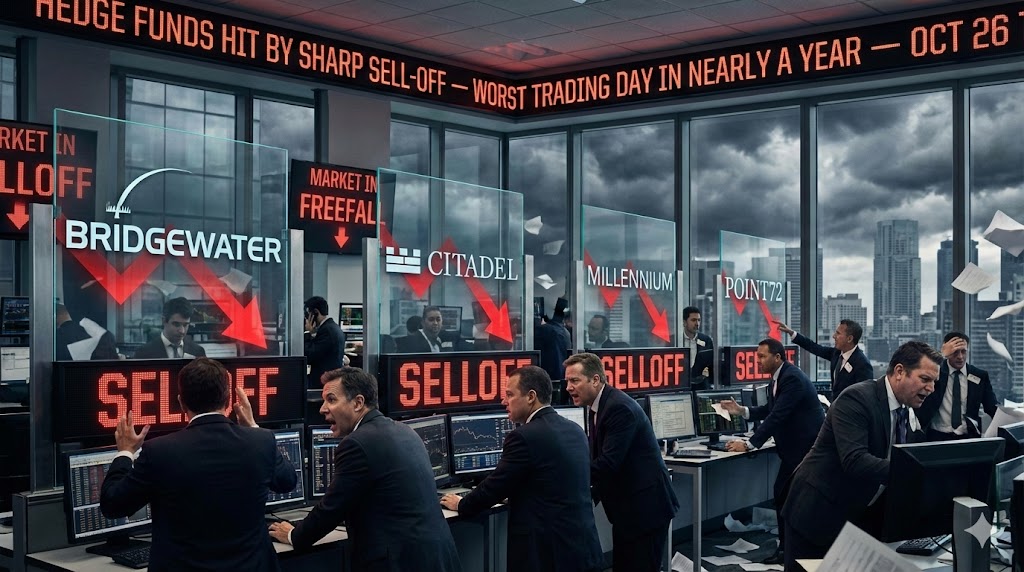
(HedgeCo.Net) Global hedge funds just experienced their most punishing single-day drawdown in almost a year, a sudden jolt that cut across strategies, geographies, and asset classes. According to research from Goldman Sachs, the losses were driven by a rapid sell-off in technology stocks combined with an abrupt shift toward risk-off positioning, creating a cascade that rippled through systematic, multi-strategy, and discretionary portfolios alike.
For an industry that entered 2026 confident in diversification, dispersion, and the return of volatility as an alpha generator, the episode was a reminder of a less comfortable truth: when positioning becomes crowded and correlations spike, even the most sophisticated hedge-fund architectures can be caught leaning the same way at the same time.
This was not a slow grind lower or a macro shock telegraphed weeks in advance. It was a fast, violent repricing — the kind of day risk managers remember long after the P&L numbers fade.
A market built for volatility — undone by correlation
Hedge funds have spent the better part of the last two years repositioning themselves for exactly the environment investors believed they were entering: higher rates, greater macro uncertainty, and persistent cross-asset volatility. Multi-strategy platforms, in particular, marketed themselves as structurally advantaged — able to rotate risk dynamically, balance exposures across pods, and monetize dispersion rather than directional beta.
Yet the sell-off exposed a vulnerability that runs beneath that narrative.
When technology stocks rolled over sharply, the move did not stay neatly contained within a single sector or factor. Losses in mega-cap growth quickly spilled into related trades: semiconductors, AI-linked infrastructure names, software adjacencies, and volatility products that had been positioned for continued range-bound markets rather than a sharp downside break.
Systematic strategies — including trend-following, volatility-control, and risk-parity frameworks — responded not with nuance, but with math. As volatility spiked and correlations converged, models triggered de-risking signals nearly simultaneously. That mechanical selling pressure compounded discretionary risk-off moves from human portfolio managers, creating a feedback loop that accelerated losses rather than dampening them.
In short, diversification failed when it was needed most, not because it was ill-designed, but because too many strategies were optimized for similar regimes.
Technology as the epicenter — and the accelerant
At the center of the drawdown was technology — not just as a sector, but as a web of interconnected exposures embedded across hedge-fund portfolios.
Over the past several years, technology has ceased to be a siloed equity allocation. It has become a macro factor, a credit factor, a volatility factor, and increasingly, a private-markets factor. AI-related narratives in particular have pulled capital into overlapping expressions: public equities, convertibles, structured credit, options, and long-dated growth assumptions embedded in valuation models.
When selling pressure emerged, it did not discriminate between “core tech,” AI infrastructure, or peripheral beneficiaries. The market repriced the entire complex in one motion, forcing hedge funds to confront how deeply technology beta had seeped into ostensibly diversified books.
This mattered most for systematic and multi-strategy funds, where individual pods or sleeves may have appeared uncorrelated in isolation, but were ultimately linked through shared factor exposures. A long semiconductor basket in one sleeve, a volatility-selling strategy in another, and a relative-value trade anchored to tech benchmarks can all break the same way when liquidity thins.
Goldman Sachs’ research highlighted that the speed of the sell-off was as damaging as its magnitude. Rapid price moves reduce the effectiveness of intraday risk controls, leaving funds reacting rather than anticipating.
Why this day stood out — even in a volatile year
Hedge funds have endured difficult days before. What made this episode notable was not just the losses, but how broadly synchronized they were.
Over the past year, dispersion had generally worked in hedge funds’ favor. Equity long-short managers benefited from single-name differentiation. Macro funds found opportunities in rates and FX volatility. Event-driven strategies capitalized on idiosyncratic deal dynamics.
This day was different.
Losses were recorded across:
- Systematic trend and volatility strategies, as models flipped from risk-on to risk-off in unison
- Multi-strategy platforms, where multiple pods lost money simultaneously
- Equity long-short funds, particularly those with net exposure to growth and technology
- Relative-value strategies, caught in widening spreads and declining liquidity
According to Goldman Sachs, the breadth of drawdowns marked the worst daily performance for hedge funds in nearly a year — a stark reversal from the industry’s generally resilient showing through much of the recent volatility cycle.
For allocators, the takeaway was uncomfortable: the industry’s defensive architecture did not fully deliver on its promise when stress arrived abruptly rather than gradually.
The hidden role of positioning and leverage
One reason the sell-off proved so destabilizing lies in positioning.
Coming into the episode, many hedge funds were not aggressively levered in absolute terms. But they were concentrated in similar expressions of risk, particularly around technology-linked growth themes and volatility assumptions.
Systematic funds, for example, had increased exposure as volatility compressed in prior weeks. Multi-strategy platforms had allocated capital toward strategies that historically perform well in choppy but not collapsing markets. Volatility sellers, emboldened by months of contained ranges, had been collecting premium.
When markets broke lower, those trades unwound simultaneously.
Leverage — even modest leverage — amplifies these dynamics. As losses mount, margin requirements rise, forcing funds to reduce positions. That selling pressure feeds back into the market, pushing prices lower and triggering further risk reductions.
This is not a failure of discipline; it is the logical outcome of tightly coupled systems responding to the same signals at the same time.
A reminder of the limits of “all-weather” claims
In recent years, hedge-fund marketing has leaned heavily on the idea of all-weather performance. Multi-strategy giants, in particular, have positioned themselves as portfolios of portfolios — diversified, dynamic, and resilient.
The sell-off does not invalidate that model. But it does underscore its limits.
No structure can fully insulate against a sudden, correlation-driven shock, especially one rooted in the same growth narratives that have dominated capital allocation across public and private markets. When the underlying assumptions are shared — about rates, growth durability, or technological adoption — diversification can compress when it is needed most.
For hedge-fund managers, the episode is likely to prompt renewed scrutiny of:
- Factor overlap across pods and sleeves
- Sensitivity to volatility regime shifts
- Liquidity assumptions under stress
- The speed at which risk systems react versus the speed of market moves
For investors, it raises questions about how hedge funds should be evaluated: not just on average returns, but on tail-day behavior.
What this means for 2026 performance expectations
Despite the severity of the drawdown, it would be a mistake to view the episode as a structural indictment of hedge funds. Instead, it is better understood as a stress test — one that revealed pressure points in portfolio construction and risk management.
Volatility remains elevated relative to the ultra-low regimes of the past decade. Dispersion across regions, sectors, and balance sheets is still wide. Macro uncertainty is not receding. In that sense, the environment remains fertile for hedge-fund alpha.
But the sell-off suggests that returns in 2026 may be less smooth and more episodic than many investors expect. Strong months may be punctuated by sharp, sudden drawdowns — particularly when markets transition between regimes rather than trending gradually.
Funds that can truly differentiate exposures, manage liquidity dynamically, and avoid over-reliance on consensus trades are likely to emerge stronger. Those that lean too heavily on the same crowded expressions may find volatility less forgiving than advertised.
Lessons for allocators: beyond headline returns
For institutional allocators, the day offers several important lessons.
First, headline hedge-fund indices mask internal variation. While aggregate performance suffered, dispersion between managers was still meaningful. Some funds navigated the sell-off with limited damage, while others bore the brunt of forced de-risking.
Second, portfolio construction at the allocator level matters as much as it does within funds. Allocators heavily tilted toward similar hedge-fund styles — particularly systematic and multi-strategy platforms — may discover that diversification across managers does not guarantee diversification across risk.
Third, communication and transparency during stress events are critical. Managers who can clearly articulate what happened, why it happened, and how portfolios are positioned going forward will inspire more confidence than those who hide behind generic explanations.
The broader market signal: fragility beneath the surface
Beyond hedge funds themselves, the sell-off carries a broader market signal.
It suggests that beneath recent calm, markets remain fragile, particularly where positioning has built up around popular narratives like AI, growth resilience, and volatility compression. When those narratives are challenged — even briefly — the unwind can be swift and disorderly.
For policymakers and regulators, episodes like this reinforce the importance of monitoring leverage, liquidity, and cross-market linkages. For market participants, they serve as a reminder that risk does not disappear simply because it has been mathematically optimized.
A painful day — but not an existential one
The worst trading day in nearly a year will linger in hedge-fund memory, not because it signals the end of the industry’s relevance, but because it highlights the evolving nature of risk in modern markets.
Hedge funds remain central actors in the global financial system — providers of liquidity, absorbers of volatility, and, at times, amplifiers of stress. This episode showed all three roles in action.
The challenge for the industry now is not to promise immunity from days like this, but to demonstrate learning, adaptation, and discipline in their aftermath. In a market defined by sudden shifts and crowded trades, resilience will be measured not by the absence of losses, but by how quickly and intelligently managers respond when the tide turns.
If anything, the sell-off reaffirmed a core truth of hedge-fund investing: alpha is not earned in calm waters alone. It is forged in moments when assumptions break, correlations spike, and risk management is tested in real time.