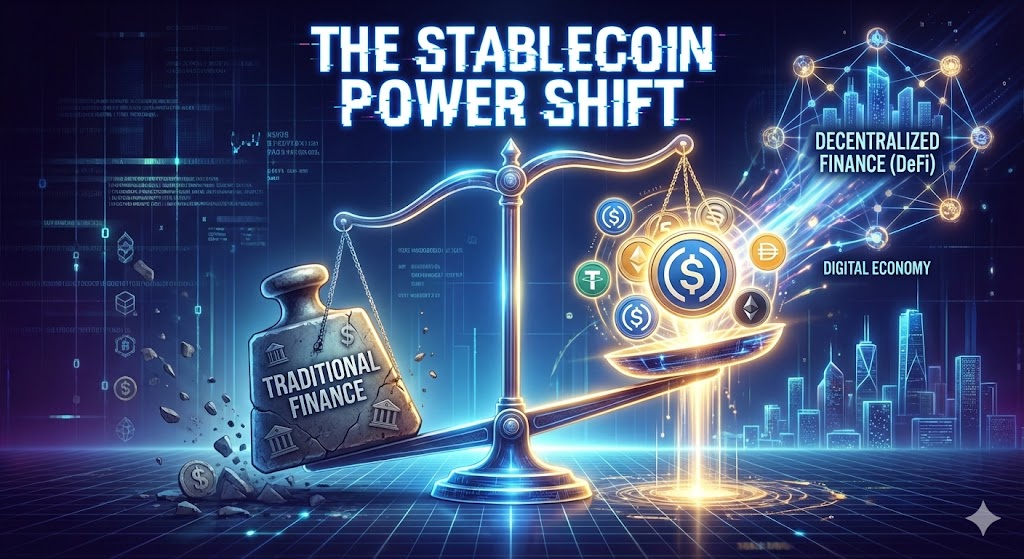
(HedgeCo.Net) For years, stablecoins were framed as the “boring” part of crypto—important, but not exciting. In 2026, that framing is obsolete. Stablecoins are becoming the core settlement layer connecting exchanges, onchain markets, cross-border payments, and tokenized finance. And the biggest firms are now competing on two dimensions at once: circulating scale and regulatory acceptability.
Recent reporting highlights a key metric shift: Circle’s USDC is growing faster than Tether’s USDT for a second consecutive year, driven in part by demand for “regulated digital dollars.” At the same time, Tether remains the largest stablecoin by market cap—meaning the market is not “flipping” overnight; it is diversifying.
What the data is telling the market
CoinDesk reported that USDC outpaced USDT growth again, reflecting rising institutional preference for stablecoin structures perceived as more compatible with regulated finance. That doesn’t erase USDT’s dominance; it reframes the race.
In practical terms, stablecoins are starting to segment like credit markets:
- A “core” product used by conservative institutions and regulated venues
- A “global liquidity” product optimized for scale, accessibility, and market ubiquity
- A long tail of niche issuers and regional products
For the largest crypto firms, the key question becomes: which stablecoin is the default settlement asset for the next wave of tokenization and payments?
Circle’s strategy: from stablecoin issuer to infrastructure provider
Circle is leaning hard into the “stablecoins-as-internet-money-infrastructure” narrative. In a recent Circle report/press release, the company highlighted growth in its Cross-Chain Transfer Protocol (CCTP) and its Circle Payments Network (CPN), positioning USDC not merely as a token but as a transfer and settlement standard across multiple chains and payment corridors.
If stablecoins are money, then protocols like CCTP are the pipes—reducing friction in cross-chain movement and making USDC more useful at scale.

Exchanges, market makers, and large trading firms live and die by settlement efficiency:
- collateral mobility
- margining and risk
- cross-venue arbitrage
- cross-border transfers
- treasury management

- institutional onboarding
- compliance partnerships
- payment integrations
- tokenization pilots
That’s why stablecoins are no longer a side story—they’re the base layer for the entire business stack.
Tether’s enduring advantage: distribution and ubiquity
Even as USDC growth accelerates, USDT remains the dominant settlement asset on many global venues and in many international corridors. Market structure inertia is real: liquidity begets liquidity. USDT is deeply embedded in trading pairs, derivatives collateral practices, and user habits.
That’s why the story isn’t “USDC replaces USDT.” The story is: stablecoins are becoming a two- (or three-) pole world, and the biggest firms must support multiple standards without compromising risk controls.
The regulatory undertow: stablecoins as policy flashpoint
Stablecoins sit at the intersection of banking, payments, securities, and consumer protection. That makes them a natural focal point in market-structure legislation debates. And we are already seeing how proposed rules can implicate stablecoin mechanics such as rewards and customer incentives—one of the issues raised in the Coinbase legislative dispute.
As policymakers look to formalize guardrails, the advantage shifts toward stablecoin ecosystems that can demonstrate transparency, resilient reserves, and operational controls that align with supervisory expectations.
What this means for 2026: the “rails race”
The next stage of stablecoins is less about market cap league tables and more about:
- network integration (wallets, exchanges, payment processors)
- settlement tooling (cross-chain transfer, programmability, APIs)
- compliance interoperability (how stablecoins interface with KYC/AML frameworks)
- institutional acceptability (bank partnerships, corporate treasury use cases)
Circle is trying to win the “regulated rails” lane. Tether is defending the “global liquidity” lane. The biggest exchanges and fintech partners will likely support both—while preferentially routing certain flows based on regulatory context and counterparty requirements.
What to watch next
- Whether USDC’s faster growth translates into increased dominance in institutional venues and tokenization pilots
- New payment corridors and network integrations (especially in high-remittance regions)
- Stablecoin policy language in U.S. and international frameworks—and how it treats rewards, disclosures, and reserve composition
- The emergence of “stablecoin-as-a-service” stacks where issuers provide APIs, compliance tooling, and treasury solutions—not just tokens
Bottom line: in 2026, stablecoins are no longer the plumbing nobody talks about. They’re the strategic high ground—and the biggest crypto firms are building their next decade on who controls the rails.