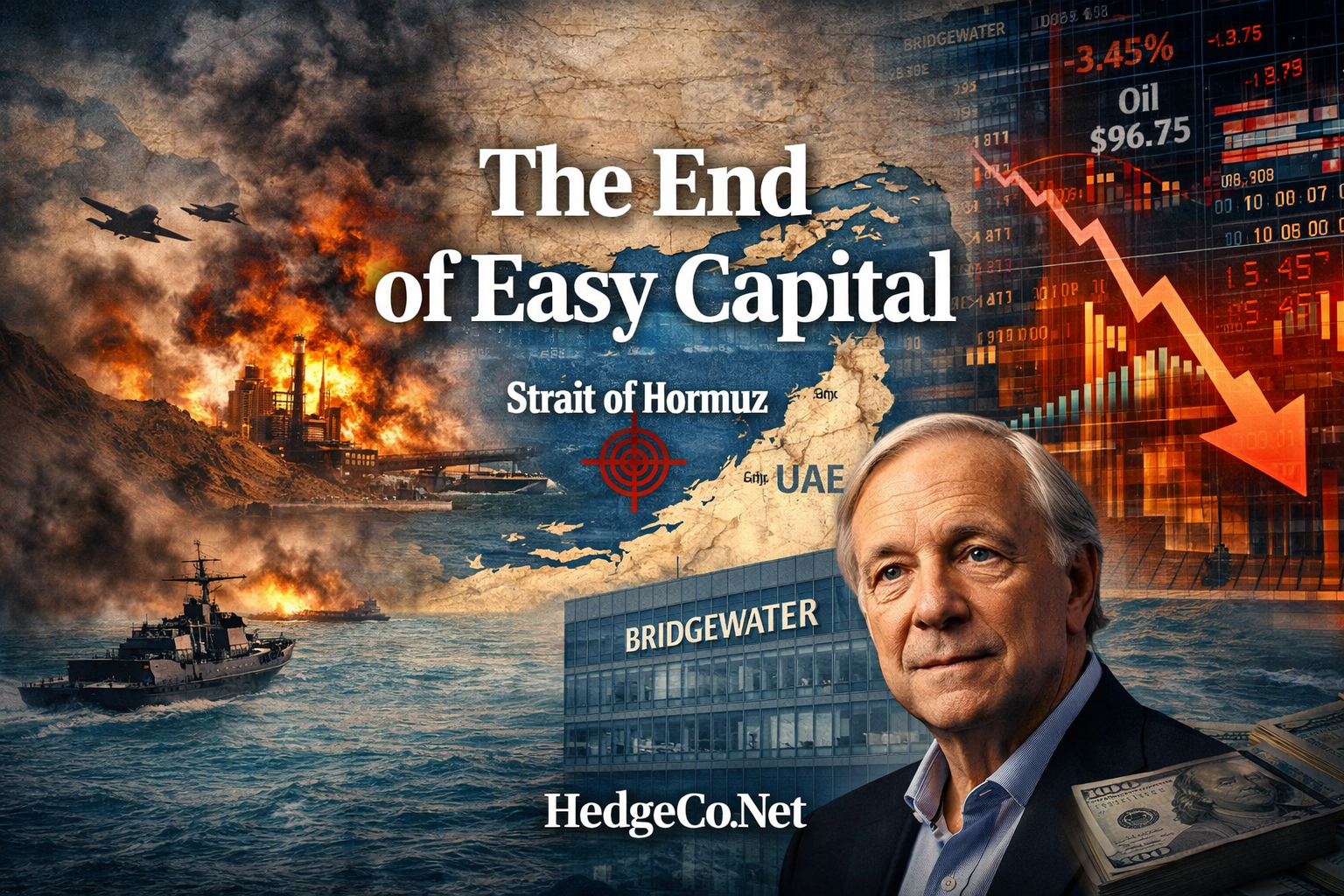
(HedgeCo.Net) Ray Dalio, founder of Bridgewater Associates, is once again sounding the alarm on a structural shift that could redefine global capital markets. In a series of recent posts and interviews—including commentary on the All-In Podcast—Dalio warned that the world is entering what he calls a “capital war,” a period marked not by traditional military confrontation alone, but by a fragmentation of financial systems, capital flows, and economic alliances.
At the center of this thesis lies a powerful and increasingly visible dynamic: the breakdown of global capital mobility. For decades, investors operated in an environment defined by relatively free movement of capital, deep liquidity pools, and integrated financial systems. Today, those assumptions are being challenged by geopolitical tensions, regulatory fragmentation, and the reordering of global trade alliances.
Nowhere is this shift more evident than in the growing strain within private credit markets—a sector that has flourished in the post-Global Financial Crisis era but now faces its first true systemic test.
I. The Rise of the “Capital War” Framework
Dalio’s concept of a “capital war” builds on his long-standing framework of historical cycles, in which economic, political, and geopolitical forces converge to reshape global order. In his view, capital is increasingly being weaponized—used strategically by nations to protect domestic interests, restrict adversaries, and secure critical resources.
This manifests in several key ways:
- Capital Controls and Restrictions: Governments are increasingly limiting cross-border investments in strategic sectors such as energy, technology, and infrastructure.
- Sanctions and Financial Fragmentation: Financial systems are being divided along geopolitical lines, particularly between Western economies and emerging power blocs.
- Currency Realignment: Nations are exploring alternatives to dollar-based systems, reducing reliance on traditional reserve structures.
The implications for investors are profound. What was once a globally interconnected capital marketplace is gradually becoming segmented, with liquidity pools tied more closely to political alignment than pure economic opportunity.
II. The Strait of Hormuz: A Critical Flashpoint
A key risk highlighted by Dalio is the vulnerability of critical global chokepoints—particularly the Strait of Hormuz. This narrow passage handles roughly one-fifth of the world’s oil supply, making it one of the most strategically important transit routes on the planet.
Escalating tensions in the region—ranging from military skirmishes to tanker disruptions—have already begun to inject volatility into global energy markets. But the broader concern extends beyond oil prices.
Disruptions in the Strait of Hormuz could trigger:
- Energy Price Shocks: Rapid spikes in oil and gas prices, feeding into inflation.
- Supply Chain Disruptions: Increased costs and delays across global trade networks.
- Liquidity Contraction: Capital flight from risk assets into safe havens.
These dynamics create a cascading effect across financial markets, tightening liquidity precisely at a time when many sectors—particularly private credit—depend on stable funding conditions.
III. Private Credit: From Golden Age to Stress Test
Over the past decade, private credit has emerged as one of the fastest-growing segments of the alternative investment universe. As traditional banks retreated from middle-market lending following the Global Financial Crisis, asset managers stepped in to fill the void.
Firms such as Blackstone, Apollo Global Management, Ares Management, and Blue Owl Capital built massive direct-lending platforms, offering investors attractive yields and floating-rate protection in a low-interest-rate environment.
Key drivers of the private credit boom included:
- Search for Yield: Institutional investors sought alternatives to low-yielding public fixed income.
- Bank Retrenchment: Regulatory changes reduced bank lending capacity.
- Structural Advantages: Illiquidity premiums and customized financing solutions.
By 2026, private credit had evolved into a multi-trillion-dollar asset class, deeply embedded in corporate financing ecosystems.
However, the very factors that fueled its growth are now contributing to its vulnerability.
IV. Liquidity Mismatch and Structural Fragility
The core risk in private credit lies in its structural illiquidity. Unlike publicly traded bonds, private loans cannot be easily bought or sold in secondary markets. This creates a fundamental mismatch when paired with investor vehicles that offer periodic liquidity.
In stable conditions, this mismatch is manageable. But in times of stress, it can become a critical fault line.Recent developments—such as redemption restrictions in various private credit funds—highlight this growing tension. When investors seek to exit en masse, managers are often forced to limit withdrawals, creating a feedback loop of declining confidence.
This is where Dalio’s “capital war” framework becomes particularly relevant. As global capital flows become more constrained:
- Refinancing Becomes More Difficult: Borrowers face higher costs and fewer financing options.
- Default Risk Increases: Especially among leveraged middle-market companies.
- Investor Confidence Erodes: Leading to redemption pressures and liquidity strain.
In essence, the fragmentation of global capital markets directly amplifies the inherent vulnerabilities of private credit structures.
V. The End of “Easy Capital”
For much of the past decade, capital was abundant, cheap, and globally mobile. This environment allowed private credit to thrive, with borrowers able to refinance easily and investors confident in steady income streams.
That era is now ending. Several structural shifts are contributing to the tightening of capital:
- Higher Interest Rates: Increasing the cost of borrowing.
- Geopolitical Risk Premiums: Investors demanding higher returns for uncertainty.
- Regulatory Scrutiny: Increased oversight of non-bank lending.
- Capital Repatriation: Nations prioritizing domestic investment.
The result is a more competitive and constrained capital environment—one in which not all borrowers will have access to funding. This scarcity is at the heart of the “capital war.”
VI. Winners and Losers in a Fragmented System
As capital becomes more selective, the dispersion between winners and losers is likely to widen dramatically.
Potential Winners:
- Mega-Scale Managers: Firms like KKR and Brookfield Asset Management with global reach and diversified funding sources.
- Sovereign-Aligned Capital: Investors with strong ties to government-backed institutions.
- Energy and Infrastructure Assets: Benefiting from geopolitical prioritization.
Potential Losers:
- Highly Leveraged Borrowers: Particularly in cyclical industries.
- Smaller Credit Funds: With limited access to stable capital bases.
- Liquidity-Sensitive Vehicles: Facing redemption pressures.
This bifurcation reflects a broader trend toward consolidation and scale within the alternative investment industry.
VII. The Role of AI and Data in Capital Allocation
Interestingly, the “capital war” is not being fought solely through traditional financial mechanisms. Technology—particularly artificial intelligence—is playing an increasingly central role in how capital is allocated.
Firms are leveraging AI-driven models to:
- Identify early signs of credit stress.
- Optimize portfolio construction under uncertain conditions.
- Navigate fragmented markets with greater precision.
This trend aligns with broader industry shifts toward data-driven investing, as seen in the rise of quantitative macro strategies and machine-learning platforms.
VIII. Strategic Implications for Investors
For institutional allocators, the emergence of a “capital war” demands a fundamental reassessment of portfolio construction.
Key considerations include:
- Liquidity Management: Ensuring sufficient access to cash and liquid assets.
- Geopolitical Risk Analysis: Incorporating political factors into investment decisions.
- Manager Selection: Prioritizing scale, experience, and risk management capabilities.
- Diversification Across Capital Pools: Avoiding overexposure to any single region or funding source.
In this environment, traditional assumptions about diversification and risk may no longer hold.
IX. A Structural Shift, Not a Cyclical Event
Perhaps the most important takeaway from Dalio’s warning is that the “capital war” is not a temporary phenomenon. It represents a structural shift in how global markets operate.
Just as the post-World War II era was defined by increasing globalization and capital integration, the current period may be defined by fragmentation and competition.
This transition will not occur overnight, but its effects are already being felt across:
- Energy markets
- Credit markets
- Currency systems
- Investment flows
For investors, the challenge lies in adapting to a world where capital is no longer neutral, but strategic.
X. Conclusion: Navigating the New Capital Regime
The concept of a “capital war” captures a fundamental transformation in global finance. As geopolitical tensions rise and capital flows become more constrained, the implications for private credit—and the broader alternative investment landscape—are profound. What was once an era of abundant liquidity is giving way to one of scarcity and selectivity.
For private credit markets, this represents both a risk and an opportunity. While structural vulnerabilities may be exposed, disciplined managers with strong capital bases and risk controls could emerge stronger.
For investors, the message is clear: the rules of the game are changing. In the years ahead, success will depend not just on identifying attractive returns, but on understanding the deeper forces shaping the flow of capital itself. Because in this new era, capital is no longer just an input—it is a battleground.