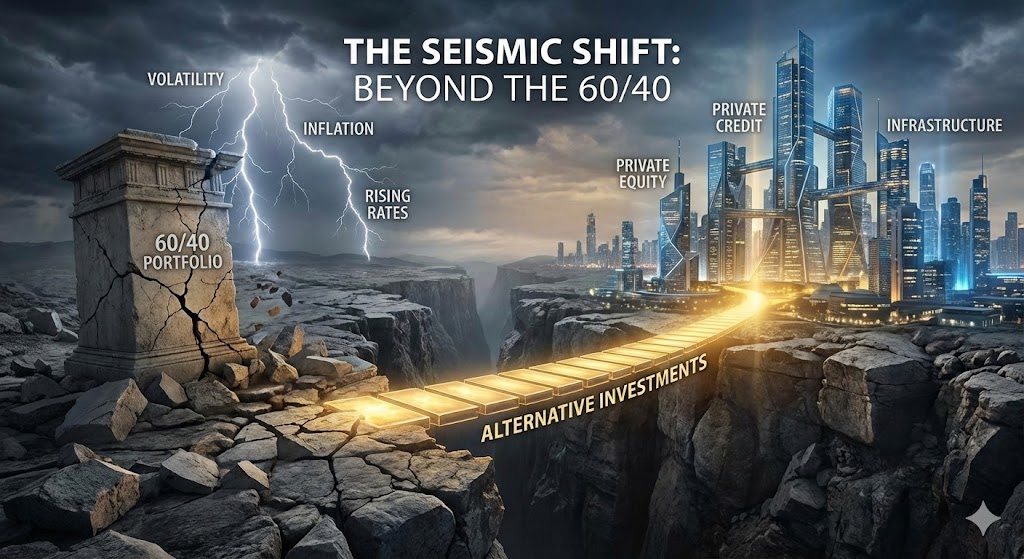
(HedgeCo.Net) HedgeCo Insights team: The investment landscape is undergoing a seismic shift. The traditional 60/40 portfolio—once the bedrock of wealth management—is showing strain in an era of heightened market volatility, persistent inflation, and rising interest rates. Global equities delivered robust returns in 2025, but market concentration has climbed to extreme levels, while credit spreads have tightened to the lowest ranges seen in years. This new reality has exposed the limitations of conventional strategies and intensified demand for a more durable, diversified approach.
Alternative investments—once the exclusive domain of institutions and the ultra-wealthy—are moving into the mainstream as a strategic necessity for a much broader range of portfolios. From private equity and private credit to infrastructure and hedge funds, alternatives offer the potential for differentiated return streams, enhanced diversification, and access to unique growth opportunities that are increasingly scarce in public markets.
This white paper from HedgeCo Insights outlines the key trends, regulatory shifts, and emerging opportunities reshaping alternatives in 2026 and beyond. We examine the transformative impact of artificial intelligence (AI) on private markets, the growing quest for portfolio durability, the implications of democratized access, and the evolving regulatory frameworks setting the stage for the industry’s next chapter. The message is clear: understanding and integrating alternatives is becoming essential to building resilient, future-proof portfolios.
Theme 1: The AI Revolution and Its Impact on Alternatives
The rapid advancement of artificial intelligence is not just a technological phenomenon—it is a powerful economic force creating a new wave of investment opportunities, particularly across private markets. The next phase of the AI revolution will be defined by solving real-world bottlenecks, especially in power and energy, and by the widespread deployment of AI applications across industries.
The Insatiable Demand for Power
AI’s growth is producing unprecedented demand for data centers and computational capacity. That surge is straining aging electricity grids and exposing the reality that digital growth is now constrained by physical infrastructure. In the U.S., projections increasingly point to a power shortfall by 2029, exacerbated by multi-year backlogs in transmission projects and shortages of critical components and skilled labor.
For investors, this creates a long-duration thesis centered on infrastructure and real assets, including:
• Power generation
• Transmission and distribution networks
• Grid modernization
• Energy efficiency and cooling technologies
AI is effectively transforming energy and infrastructure from “defensive real assets” into strategic growth platforms.
AI Applications: The Next Growth Frontier
Beyond infrastructure, the true value of AI will be unlocked through application. AI-enabled enterprise software, vertical-specific AI solutions, and the development of agentic AI are poised to create an enormous addressable market in the years ahead.
Critically, much of this innovation is unfolding inside private markets—making venture capital and private equity central vehicles for investors seeking exposure to the next leg of AI-driven growth. Early evidence suggests AI-forward companies are already outpacing peers on both revenue growth and margin expansion, reinforcing the case for targeted private-market access.
Theme 2: The Quest for Portfolio Durability
In today’s market, genuine diversification has become harder to find. A “tech-plus” complex now represents a dominant share of U.S. equity market value, and the traditional role of bonds as a stabilizer has weakened as stock-bond correlations periodically turn positive in inflation-sensitive regimes.
This environment is pushing allocators toward differentiated, less-correlated return streams—precisely where alternatives can play a powerful role.
Diversifying the Diversifiers
To build real portfolio durability, investors are increasingly “diversifying the diversifiers” by broadening alternatives beyond the standard playbook and emphasizing strategies with distinct drivers of return.
Key building blocks include:
• Core Private Equity
Core private equity remains a return engine, but the emphasis has shifted toward geographic and sector diversification. Certain regions—including Europe, India, and Japan—are increasingly viewed as fertile ground for differentiated opportunity sets.
• Hedge Funds
Hedge funds are experiencing a renewed moment in high-dispersion, high-volatility markets. After a decade of muted outcomes in the 2010s, the post-2020 environment has been materially more supportive for alpha generation. In 2025, hedge funds delivered strong gains in aggregate and attracted meaningful inflows—particularly from family offices and private banks seeking strategies with lower beta and higher adaptability.
Strategies frequently favored in this regime include:
• Equity Market Neutral
• Quant Multi-Strategy
• Global Macro
• Infrastructure
Infrastructure offers stable, inflation-sensitive cash flows—now reinforced by AI-driven demand for power and digital capacity. Digital infrastructure, renewable energy, grid buildout, and broader energy-transition assets remain central focus areas.
• Private Credit
With banks facing tighter regulatory constraints and balancing-sheet limits, private credit continues to expand as a core financing channel for the real economy. Direct lending, asset-based finance, and specialty credit remain particularly important as borrowers seek flexible, private solutions.
The Convergence of Discretionary and Quant Strategies
One of the most important developments inside hedge funds is the convergence of discretionary and quantitative approaches.
Discretionary managers are increasingly embedding quantitative tools—AI, alternative data, and systematic signal capture—into research and decision-making. Meanwhile, quantitative firms are incorporating discretionary insights to improve model robustness and context awareness.
This convergence is driven by the pursuit of greater capacity and new sources of alpha. AI is also expanding analyst bandwidth, allowing coverage universes to grow without sacrificing depth. Investors are responding: adoption of AI across investment workflows is rising rapidly, including applications in hedge fund research, manager due diligence, and risk monitoring.
Theme 3: The Democratization of Alternative Investments
Perhaps the most significant transformation in the alternatives landscape is the democratization of access. What was once reserved for institutions is increasingly opening to a broader base of individual investors.
This shift is being powered by three forces:
• Regulatory evolution
• Technology-driven distribution
• Rising investor demand for diversification and differentiated return sources
A New Era of Accessibility
Regulators across regions are adapting frameworks to expand access—while attempting to preserve investor protections.
Notable developments include:
• Europe’s ELTIF 2.0 reforms, aimed at simplifying fund rules and lowering minimums
• Expansion of the U.S. accredited investor definition to include credential-based sophistication
• Growth of fractional ownership frameworks in certain jurisdictions, lowering entry barriers for real estate, private credit, and other private assets
Democratization is not simply a distribution trend—it is a structural change in capital formation. Individual investors represent a vast pool of potential assets that can be mobilized toward innovation, infrastructure, and growth in the real economy.
The Rise of Evergreen and Semi-Liquid Funds
A major enabler of retail participation is the growth of evergreen fund structures. Unlike traditional closed-end drawdown funds, evergreen and semi-liquid vehicles are designed to offer:
• More frequent subscriptions
• Periodic (limited) redemption windows
• Increased reporting transparency
• Operational features more suited to wealth channels
These structures are rapidly becoming preferred vehicles for private equity, private credit, and hybrid alternative strategies—particularly in private banking and registered wealth segments.
Technology as the Distribution Engine
Technology is playing a pivotal role by reducing friction in onboarding, improving transparency, and delivering real-time reporting that historically existed only in institutional channels.
However, the expansion of access also introduces challenges. Without proper investor education, retail investors can misunderstand timelines, liquidity constraints, and return patterns in private markets. Alternatives are not designed for short-term trading. Liquidity is constrained by design, and exits often depend on IPO markets, trade sales, or secondary transactions.
In this new era, investor education becomes essential—not optional.
Market Performance and Outlook
Recent performance reinforces allocator interest heading into 2026.
Hedge funds, in particular, have experienced a notable resurgence. After years of lower returns and limited alpha in the 2010s, post-2020 conditions—higher dispersion, lower correlations, and sustained volatility—have been more supportive for active strategies. In 2025, hedge funds generated significant dollar gains for investors and recorded their strongest inflows in years, with family offices and private banks leading demand.
Private equity returns were more muted, but deal activity improved in 2025 and the outlook for exits and distributions is strengthening as interest rates ease and financing conditions normalize.
Private credit continued to deliver attractive income-oriented returns, especially in direct lending and asset-based finance. While isolated defaults and restructurings made headlines, broad default rates remained relatively contained and fundraising remained firm.
Looking ahead, expectations center on:
• Improved exit activity
• Higher distributions
• Continued product expansion across wealth channels
• Sustained demand for private-market solutions as portfolio construction evolves
The Regulatory Landscape in 2026
The regulatory environment is evolving quickly. While the broader trend supports expanded access and innovation, regulators remain focused on investor protection, transparency, and systemic risk.
Key regulatory focus areas in 2026 include:
• Digital Assets
Regulation of crypto, stablecoins, and digital-asset intermediaries remains a priority, centered on market integrity and investor protection.
• Tokenization
As tokenization of real-world assets accelerates, regulators are working to balance innovation with safeguards—particularly around custody, disclosures, and liquidity expectations.
• ESG Disclosures
Global standards continue to develop, and disclosure requirements are becoming more standardized—though timelines and enforcement vary by region.
In the U.S., regulators remain generally pro-market while maintaining strong investor-protection priorities—especially as new products reach broader retail audiences. In Europe, policymakers are also focused on mobilizing household savings into long-term investments, suggesting ongoing policy and tax discussions throughout 2026.
Opportunities and Risks
The outlook for alternatives is broadly constructive, but the opportunity set comes with meaningful risks.
Illiquidity remains central. Many alternative investments require long holding periods and offer limited redemption flexibility. Investors must align allocations with liquidity needs and time horizons.
Valuations can be stretched in certain segments, making manager selection and underwriting discipline especially important.
Dispersion of returns is significant. Differences between top- and bottom-quartile managers can be wide, reinforcing the importance of due diligence, portfolio construction, and active oversight.
Over-allocation is a real risk. Alternatives can strengthen resilience, but they must be integrated thoughtfully into a broader framework balancing growth, income, risk, and liquidity. Rebalancing matters.
Fees also require careful scrutiny. Alternative fee structures are often higher than traditional asset classes, and investors must ensure net-of-fee outcomes justify the cost.
The HedgeCo.Net Advantage:
Navigating the rapidly evolving alternatives landscape requires expertise, access, and infrastructure. HedgeCo.net is positioned at the forefront of this new frontier—equipping investors with tools, resources, and intelligence designed for a more complex allocation environment.
HedgeCo.net delivers:
• Curated access to top-tier alternative investment opportunities
• Institutional-grade due diligence standards
• A streamlined, technology-forward investor experience
• Actionable insights through HedgeCo Insights—tracking the trends shaping private markets in real time
Conclusion
The alternative investment landscape in 2026 is defined by structural change. The convergence of technology, regulatory evolution, and shifting investor demand is creating a new paradigm for portfolio construction and capital formation.
From AI’s infrastructure-driven investment wave to the democratization of private markets, the trends reshaping alternatives are not cyclical—they are foundational.
But opportunity comes with responsibility. Success in alternatives requires disciplined portfolio design, rigorous due diligence, thoughtful liquidity management, and a long-term mindset. Manager selection and risk monitoring are more critical than ever.
HedgeCo.net remains committed to helping investors navigate this new frontier with confidence—through access, expertise, and a commitment to transparency. The future of investing is being built now, and alternatives are becoming core to how durable portfolios are constructed.