
(HedgeCo.Net) For most of modern financial history, alternative investments have lived behind a velvet rope. Private equity, private credit, infrastructure, and many hedge-fund-like strategies were built for institutions and ultra-wealthy families—investors who could tolerate illiquidity, complex fee structures, and long periods without clean price discovery. That separation wasn’t merely cultural; it was structural. Retirement systems were designed around daily liquidity, public-market transparency, and standardized benchmarks.
Today, that old architecture is starting to crack in a meaningful way.
The biggest story in alternative investments right now is the accelerating push to embed private markets—particularly private equity and private credit—inside U.S. retirement plans. A new wave of partnerships is attempting to make private assets a functional component of 401(k) allocations, not just a “satellite” option for high-net-worth clients. The latest move, involving Blackstone, Apollo, and Ares working with OneDigital, signals something larger than a product launch: it marks a new competitive era where the next trillion dollars of growth may come from mainstream retirement savers rather than pensions and sovereign wealth funds.
This shift is not a single headline—it’s a regime change. And it’s colliding with other forces reshaping the alternatives ecosystem: private credit’s first large-scale liquidity stress, rising scrutiny of leverage and embedded risk (including in CLO markets), and an intense battle among mega-managers to control distribution. Together, these dynamics are redefining how capital flows into alternative strategies—and how the industry will be regulated, packaged, and judged.
Why this moment matters: alternatives stop being “optional” and start being “default”
Alternative asset managers have spent years talking about “democratization.” But most efforts, in practice, were aimed at wealth channels: interval funds, private REITs, feeder structures, evergreen vehicles, and semi-liquid solutions built for advisory platforms. That widened the audience, but it didn’t truly break into the core of the American retirement engine.
The 401(k) system is different. It is scale distribution in its purest form: recurring flows, default allocations, automatic contributions, and long holding periods. If private markets can be packaged in a way that fits plan constraints—fees, fiduciary oversight, and liquidity rules—the addressable market expands dramatically.
That is what makes the OneDigital partnership so strategically significant. It’s not merely three big names co-branding a product suite; it’s an attempt to build a “pipe” into retirement portfolios, where private markets can be blended into professionally managed allocations rather than sold as a niche add-on.
The competitive implications are immediate. The Partners Group—a firm long viewed as an early pioneer in bringing private markets to wealthy individuals—is now facing intensifying pressure as mega-managers race into the same space with deeper resources, broader product shelves, and stronger distribution leverage.
This is what “retailization” looks like when it becomes real: not a marketing slogan, but a full-scale land grab for the most durable capital in finance.
The distribution war: why the biggest firms are positioned to win
The push into retirement is not happening evenly across the alternatives landscape. It favors scale—especially platforms that can offer multiple private-market sleeves, build risk-managed blends, and handle the operational complexity of valuation, reporting, and liquidity engineering.
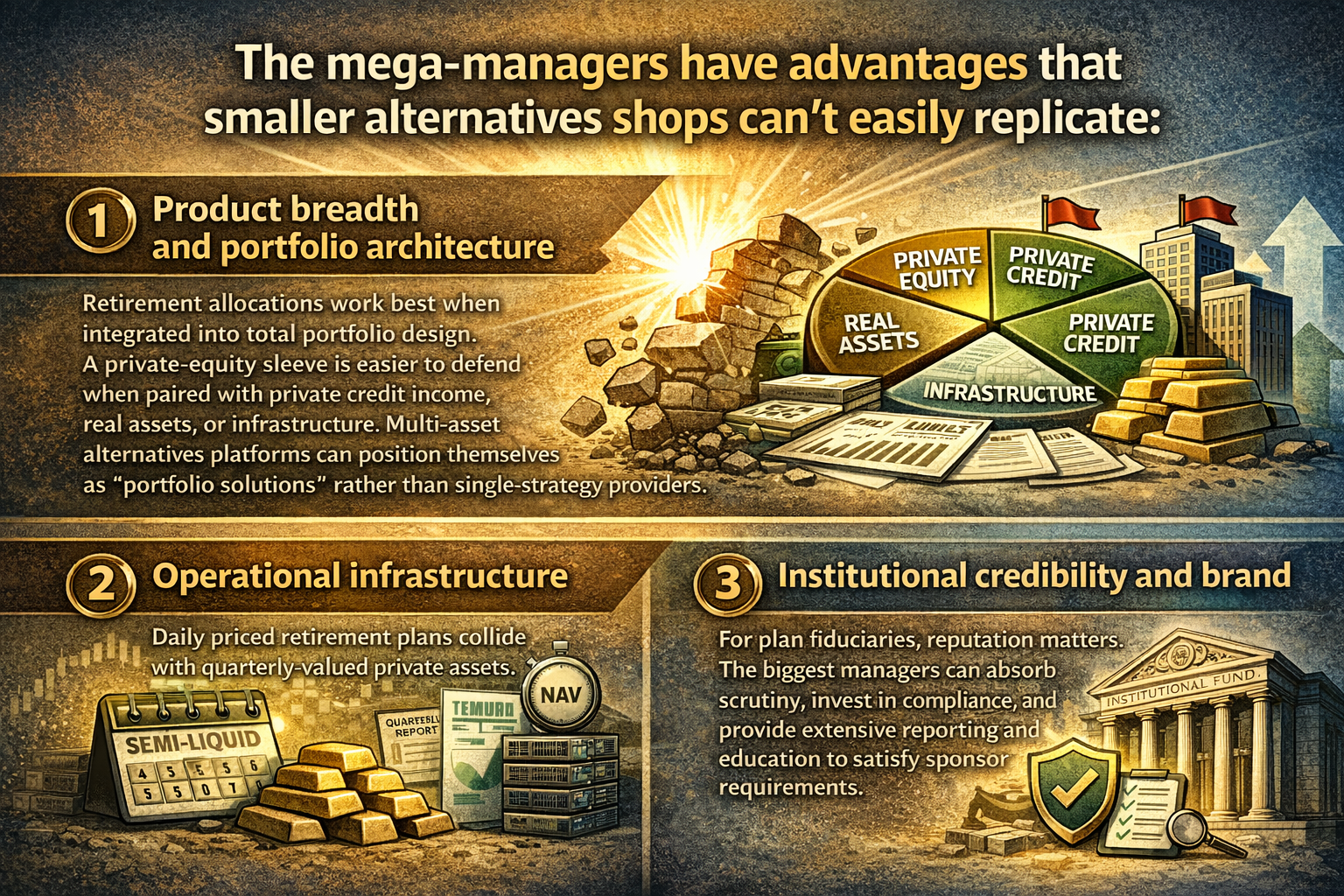
The mega-managers have advantages that smaller alternatives shops can’t easily replicate:
1) Product breadth and portfolio architecture
Retirement allocations work best when integrated into total portfolio design. A private-equity sleeve is easier to defend when paired with private credit income, real assets, or infrastructure. Multi-asset alternatives platforms can position themselves as “portfolio solutions” rather than single-strategy providers.
2) Operational infrastructure
Daily priced retirement plans collide with quarterly-valued private assets. Bridging that requires specialized fund structures, careful cash management, transparent valuation policies, and strong controls. The firms that already run large semi-liquid products have a head start.
3) Institutional credibility and brand
For plan fiduciaries, reputation matters. The biggest managers can absorb scrutiny, invest in compliance, and provide extensive reporting and education to satisfy sponsor requirements.
That’s one reason the OneDigital collaboration is important: it places alternatives inside an advice-and-plan-management wrapper that can translate private-market exposure into retirement-plan language—allocation policy, risk controls, participant outcomes.
The uncomfortable tension: retirement liquidity vs. private-market reality
The biggest question is not whether private markets can improve long-term returns. The question is whether they can be made compatible with retirement-plan mechanics without importing hidden fragility into the system.
Private markets are structurally illiquid. Even the best-designed evergreen vehicles rely on queues, gates, or managed redemption programs during stress. That’s not necessarily a flaw—it’s part of the asset class—yet it becomes a governance issue when offered to a mass market accustomed to daily liquidity.
This matters now because parts of private credit are already encountering meaningful withdrawal pressure. Reports of investor outflows—particularly from some of the largest private credit vehicles—have become a central narrative in early 2026, highlighting the difference between “yield product” marketing and real-world credit-cycle behavior.
The industry response is clear: managers are trying to refine structures, tighten underwriting, and emphasize that liquidity must be managed—not promised. But in the retirement context, the stakes rise. A product designed for a high-net-worth investor with a financial advisor is not the same as an allocation embedded in target-date strategies or plan defaults.
That is why regulators, fiduciaries, and plan sponsors are watching this closely. The challenge is not simply to offer access—it’s to offer access that survives a downturn without forcing disorderly asset sales, harming participants, or triggering political backlash.
The shadow story underneath: credit complexity is rising
As alternatives move closer to the center of household finance, the “plumbing” of private credit and structured credit becomes more consequential.
A related development today is the growing debate around risk and return in the CLO ecosystem—one of the most important funding channels for leveraged loans and a popular destination for insurance capital. A Reuters Breakingviews analysis argues that the “special sauce” that made CLOs particularly attractive—especially to insurers—may be losing its punch as spreads compress and credit quality concerns rise.
This matters for alternatives for two reasons:
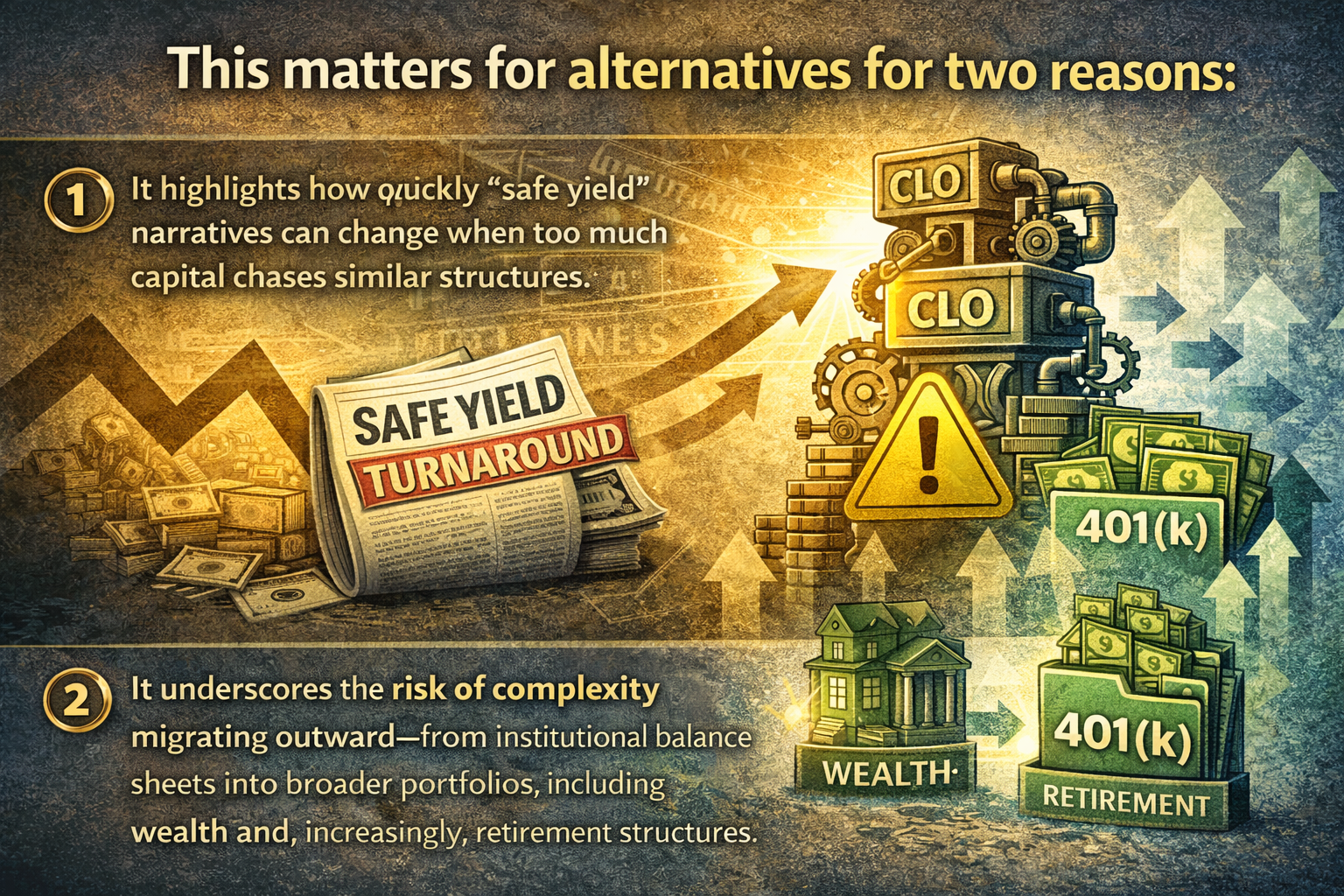
- It highlights how quickly “safe yield” narratives can change when too much capital chases similar structures.
- It underscores the risk of complexity migrating outward—from institutional balance sheets into broader portfolios, including wealth and, increasingly, retirement structures.
If private credit is going to become a mainstream retirement allocation, the industry will need to communicate risk with more precision than it has historically used in marketing. Yield alone is not a sufficient story. Investors—and fiduciaries—will demand clarity on underwriting standards, leverage, default sensitivity, and the real mechanics of liquidity.
Not just private equity: infrastructure and real assets are riding the same wave
The retirement push is happening in parallel with renewed momentum in real assets and infrastructure, driven by the long-duration nature of the liabilities retirement savers face.
Today’s The Wall Street Journal reporting on a major infrastructure fundraise by Hamilton Lane—including both fund commitments and co-investment capital—shows continued investor appetite for infrastructure strategies spanning data centers, energy, and logistics.
Infrastructure is especially relevant in the retirement conversation because it is often framed as “real return” exposure with potential inflation sensitivity—exactly the kind of long-horizon allocation story that resonates with retirement savers. The question will be how those exposures are packaged and priced, and whether performance holds up once more capital floods the category.
The family office signal: big allocators are still leaning into alternatives
Even outside retirement plans, the allocation trend remains strong among wealthy investors. New commentary around the latest J.P. Morgan Private Bank Global Family Office reporting emphasizes that many family offices continue to allocate heavily to alternatives—often including real estate and hedge funds—as they navigate inflation uncertainty and geopolitical risk.
This is important context: the “retail wall” is breaking at the same time that traditional alternatives customers still want the exposure. That combination—existing institutional and wealth demand plus a potential retirement channel—creates the conditions for a distribution supercycle.
But supercycles come with pressure points: crowding, fee compression, and heightened scrutiny.
Winners, losers, and what to watch next
If private markets truly move into 401(k)s at scale, the consequences will extend far beyond fundraising headlines.
Likely winners

- Mega-managers with multi-asset shelves and distribution reach: They can build blended solutions, absorb operational burdens, and outspend rivals on education and compliance.
- Retirement intermediaries and advisers who control plan design and model portfolios, effectively becoming “allocators” to private markets.
- Select specialist firms that can plug into platforms via co-investments, secondaries, or niche capabilities—particularly where large managers want differentiated deal flow.
Likely losers:
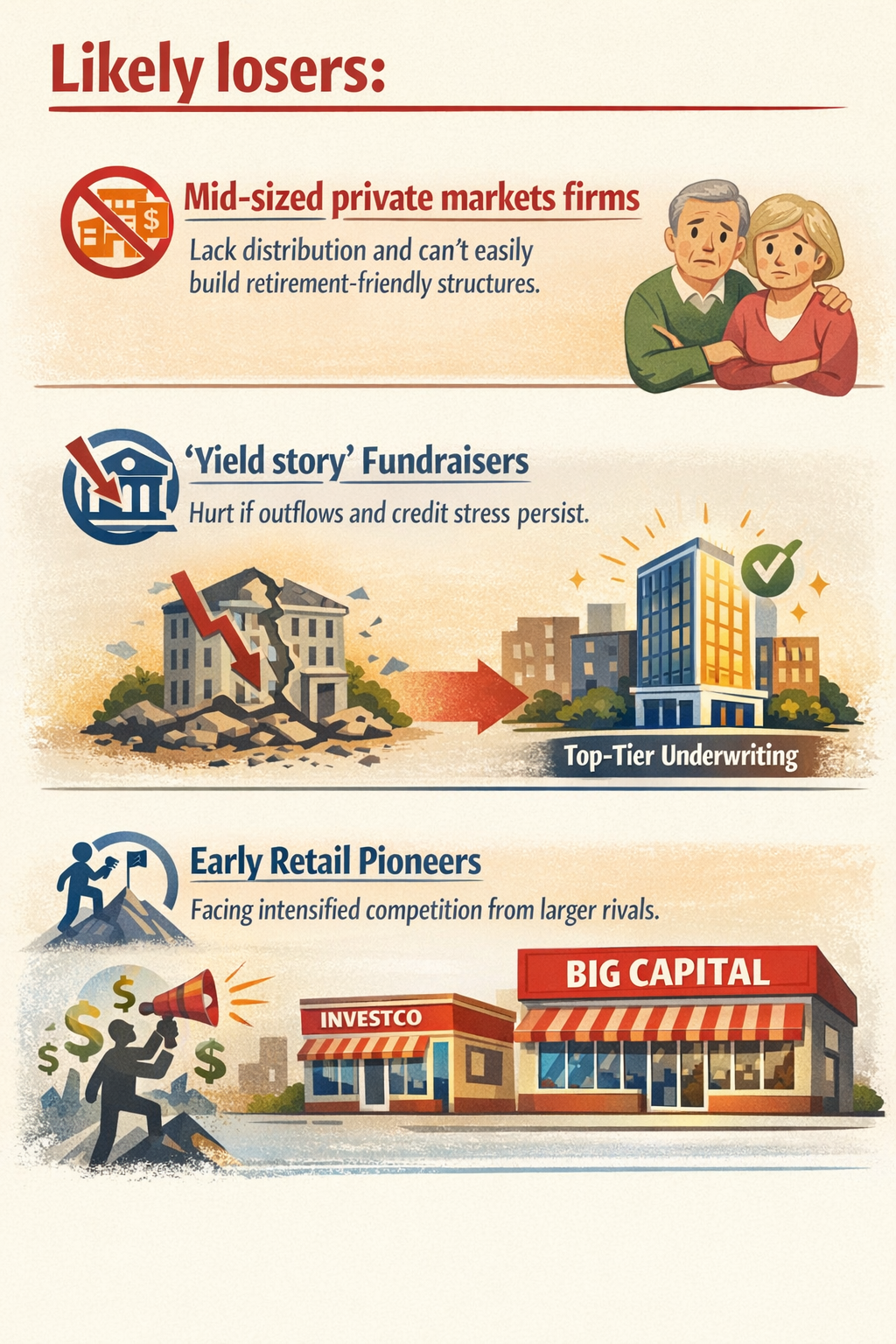
- Mid-sized private markets firms that lack distribution and can’t easily build retirement-friendly structures.
- Managers reliant on “yield story” fundraising if outflows and credit stress persist, forcing a sharper distinction between top-tier underwriting and the rest.
- Early retail pioneers facing intensified competition from larger rivals with broader product and marketing engines.
Key signposts to monitor
- Plan sponsor adoption: Which employers and retirement platforms move first, and under what fiduciary frameworks.
- Product structure design: Liquidity terms, valuation protocols, gating policies, and fee transparency.
- Performance through stress: The first real downturn test for retirement-embedded private assets will determine whether this becomes permanent or politically fragile.
- Regulatory posture: Any shift in guidance, fiduciary expectations, or disclosure requirements could accelerate—or slow—adoption.
The bottom line
Alternative investments are entering a new phase: one where the defining battleground is not just performance, but distribution—specifically, whether private markets can become a durable part of mainstream retirement allocations.
The OneDigital partnership involving Blackstone, Apollo, and Ares is emblematic of the new era. It reflects a belief that the next decade of growth will come from integrating alternatives into everyday portfolios, not simply expanding institutional relationships.
But it also raises the hardest questions the industry has faced in years: Can illiquid strategies be responsibly offered at mass scale? Can complexity be communicated clearly enough for fiduciaries and participants? And can the industry prevent the liquidity and credit-cycle tensions already visible in private credit from becoming a broader retirement-system problem?
If the answer is yes, alternative investing doesn’t just grow—it becomes structurally embedded in the financial life of the average American. That would be the most consequential capital shift in the industry since the rise of institutional private equity.