
(HedgeCo.Net) Crypto’s biggest story right now is not a new token, a new chain, or even a single exchange headline. It’s the relationship between two core pillars of the market:
- Bitcoin, still the bellwether for risk appetite, leverage, and macro sensitivity, and
- Stablecoins, the functional “payments and liquidity rails” that keep the ecosystem moving when everything else is repricing.
Over the past 48–72 hours, those two pillars have been placed under a spotlight. Bitcoin has sold off sharply, triggering one of the largest liquidation cascades in recent months. At the same time, stablecoins are experiencing a parallel moment: they’re acting as the safe harbor inside crypto, even as regulators and policymakers accelerate frameworks that will determine who controls those rails in 2026 and beyond.
This is what’s trending today: a market moving from “narrative bull cycle” to “balance-sheet reality.” And the dividing line is becoming clear—between speculative leverage and durable infrastructure.
1) Bitcoin’s slide is being driven by leverage unwinds—and macro shock
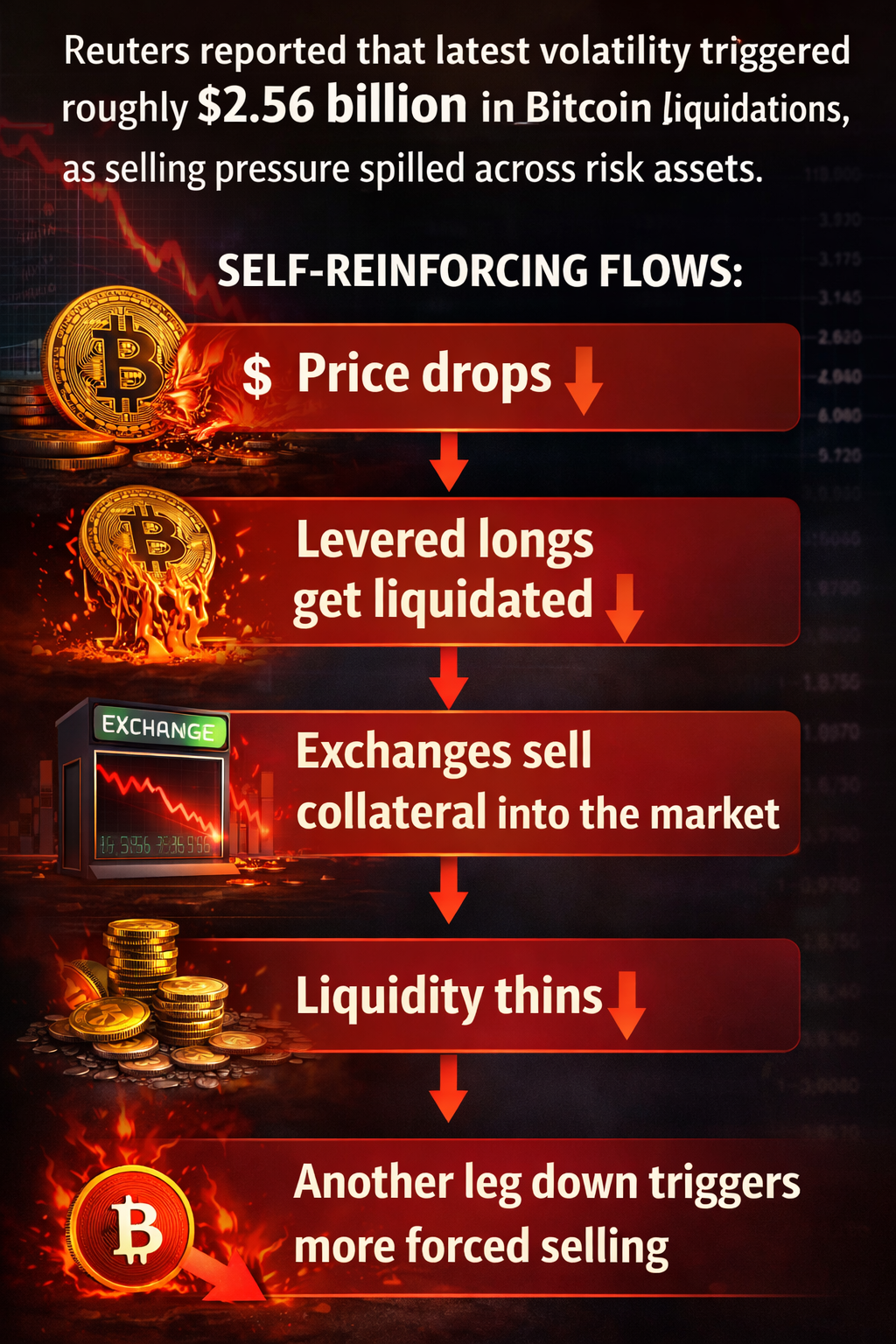
The most immediate driver of Bitcoin’s move has been mechanical: forced selling from liquidations.
Reuters reported that the latest volatility wave triggered roughly $2.56 billion in bitcoin liquidations, as selling pressure spilled across risk assets. Bitcoin, which had been trading far higher in prior months, fell to the high-$70,000s region in that report. Barron’s similarly described Bitcoin hitting a 10-month low, with the broader complex (including major alts) moving lower in sympathy.
The deeper point: when the market is heavily positioned, price declines stop being purely “sentiment.” They become self-reinforcing flows:
- Price drops ?
- Levered longs get liquidated ?
- Exchanges sell collateral into the market ?
- Liquidity thins ?
- Another leg down triggers more forced selling.
That’s exactly why this drawdown has felt fast and relentless. It’s not one seller—it’s the unwind of a structure.
Macro mattered more than crypto-native news
This time, the catalyst is not purely inside crypto. Market narratives increasingly linked the selloff to a macro and policy shock: President Donald Trump’s nomination of Kevin Warsh as the next Fed Chair, which spooked risk markets that were priced for easier liquidity ahead. Reuters also tied the downturn to broader risk-off moves across assets.
Whether Warsh ultimately ushers in tighter policy or simply changes expectations, the market impact is the same in the short run: liquidity assumptions get repriced, and highly levered assets feel it first.
2) Spot Bitcoin ETFs: flows are turning from tailwind to headwind
One of the defining features of the last cycle was the rise of spot Bitcoin ETFs as a narrative “institutionalization” force. Now, that same channel is being watched for the opposite reason: outflows.
CoinDesk reported that spot Bitcoin ETFs have recorded about $6.18 billion in net outflows over a recent stretch, a meaningful reversal from the earlier period when inflows were a consistent support. Bloomberg also flagged fading conviction among ETF buyers as the market moved into losses.
Here’s why ETF flows matter even when they don’t “cause” the move:
- They act as a sentiment barometer for allocators who don’t trade perpetual swaps.
- They influence dealer hedging and liquidity around key levels.
- They create a visible narrative: “institutions buying” vs “institutions backing away.”
A helpful example of how quickly the narrative can turn: MarketWatch noted that Strategy (formerly MicroStrategy)briefly saw Bitcoin trade below its average purchase price, underscoring how fast conditions shifted for even the most prominent corporate BTC holders.
This is the key takeaway: Bitcoin is not only trading its own fundamentals—it’s trading positioning and macro.
3) What “today” reveals about Bitcoin’s role: it’s still the risk asset inside crypto
For all the talk of Bitcoin as “digital gold,” the market action today is a reminder that—at least in trading terms—Bitcoin still behaves like a high-beta macro asset during liquidity shocks.
That doesn’t mean the long-term thesis is invalid. It means the market is transitioning into a phase where:
- cash flow and collateral matter more than storytelling, and
- funding rates, basis trades, and balance sheet capacity shape price action as much as adoption metrics.
In practical terms, professional investors are watching:
- Where liquidation clusters reset (less fuel for forced selling),
- Whether ETF outflows stabilize (less persistent headwind),
- How macro pricing evolves around rates and the dollar (risk appetite),
- Whether stablecoins keep growing (liquidity stays inside crypto).
And this brings us to the other half of today’s story: stablecoins.
4) Stablecoins are trending for the opposite reason: they’re absorbing demand:

When Bitcoin and alts slide, stablecoins often do the reverse in functional terms: they become the parking place for capital that doesn’t want to leave crypto entirely.
That pattern is visible again now. Stablecoins are trending because they are:
- the unit of account for trading,
- the settlement layer for exchanges, and
- increasingly the bridge to real-world payments.
But 2026 is adding a new twist: stablecoins are also trending because regulators are moving from “concept” to “licensing.”
Hong Kong moves toward stablecoin licensing
Reuters reported that the Hong Kong Monetary Authority (HKMA) plans to issue its first stablecoin issuer licenses in March 2026, and emphasized that only a limited number will be approved at first. This is not a symbolic step—it’s a signal that major financial hubs want stablecoins inside a supervisory perimeter, with explicit requirements around reserves, risk controls, and compliance.
That matters because it formalizes the future playing field: stablecoins are becoming regulated financial infrastructure, not just crypto products.
5) The U.S. debate is sharpening around one word: “yield”
In the U.S., the policy conversation is increasingly focused on market structure and stablecoin rules—and, specifically, the question of whether stablecoins should be allowed to pay yield.
CoinDesk reported that a White House crypto market structure meeting dug into the “stablecoin yield” debate, highlighting tensions between crypto-native firms and the banking lobby. A banking industry statement following that meeting underscores the intensity of the push to shape legislation.
Why is “yield” so sensitive?
Because if a stablecoin becomes a widely used digital dollar that pays yield, it begins to resemble a bank deposit substitute—without necessarily being a bank. That raises questions about:
- deposit-like activity outside the banking system,
- consumer protections,
- the structure of money markets, and
- systemic risk in stress events.
So while crypto traders are watching Bitcoin’s liquidation levels, policymakers are effectively debating who gets to issue “internet dollars,” under what rules, and with what economic incentives.
6) Tether is leaning into transparency—and scale
No stablecoin story is complete without Tether, because it remains a central liquidity source for global crypto markets.
In a recent update, Tether said it delivered more than $10 billion in net profits in 2025, with $6.3 billion in excess reserves and a record $141 billion exposure to U.S. Treasury holdings.
Regardless of how one views stablecoins philosophically, the market implication is clear:
- Stablecoins are deeply tied to the U.S. Treasury ecosystem, and
- their scale increasingly intersects with mainstream financial plumbing.
In periods of crypto stress, this becomes even more important. Traders, exchanges, and institutions watch stablecoin reserve narratives because stablecoins are the settlement asset when volatility spikes.
7) Circle and USDC are positioning for enterprise-grade adoption
If Tether represents global trading liquidity at massive scale, Circle (issuer of USDC) has been pushing a message built around regulated access and enterprise integrations.
Circle’s own USDC materials emphasize issuance through regulated affiliates and point to stablecoins as infrastructure “powering global finance.” Market coverage has also highlighted Circle’s roadmap framing around expanding stablecoin usage in payments and business workflows.
The trend here is bigger than one issuer: stablecoins are increasingly being sold as B2B infrastructure—cross-border settlement, treasury operations, and programmable payouts—rather than only as “exchange chips.”
8) What professionals are watching next
Today’s trend lines can be summarized as a split-screen:
Bitcoin: deleveraging and macro repricing
Watch for:
- liquidation pressure easing,
- ETF outflows stabilizing,
- funding markets normalizing,
- macro catalysts (rates, Fed expectations) calming down.
Stablecoins: regulatory acceleration + market share battles
Watch for:
- licensing regimes (Hong Kong is moving first in March),
- U.S. stablecoin rules and the yield debate,
- reserve transparency and Treasury exposure narratives,
- competition between large-scale issuers and new “regulated” entrants.
The central insight: stablecoins are becoming the strategic layer of crypto, while Bitcoin remains the volatility anchor. In a risk-off event, Bitcoin shows you where speculation is. Stablecoins show you where the real power structures are forming—distribution, regulation, and trust.
