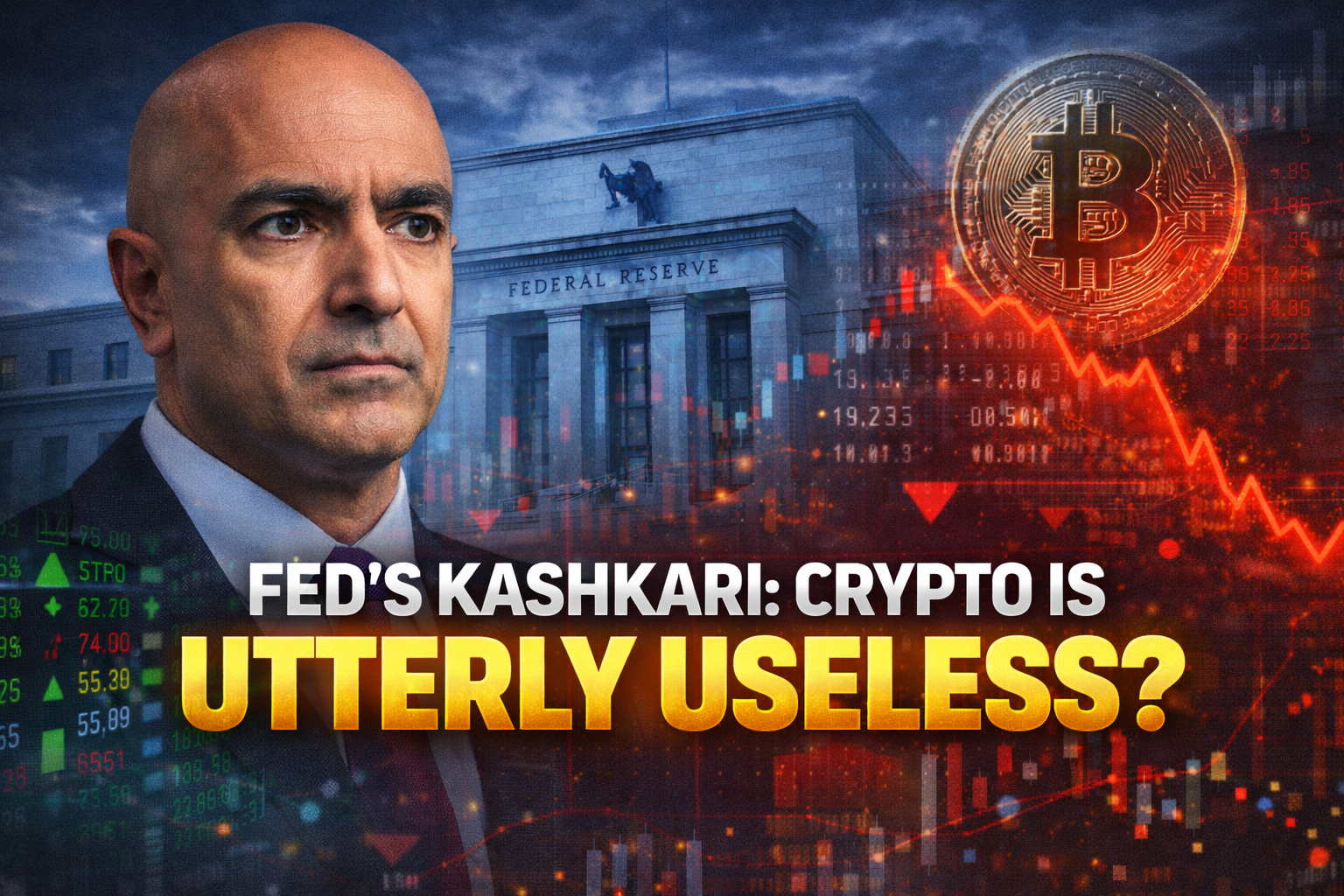
(HedgeCo.Net) When Neel Kashkari, president of the Federal Reserve Bank of Minneapolis, said crypto has been around “for more than a decade” and is “utterly useless,” he wasn’t just tossing out a spicy soundbite. He was signaling—plainly—that a meaningful faction within the U.S. central banking system still views the core crypto thesis as unproven, redundant, and potentially destabilizing if it scales in the wrong way.
For markets that have spent years trying to price in “institutional adoption,” “mainstream legitimacy,” and “regulatory clarity,” Kashkari’s critique lands like a splash of cold water. It’s also arriving at an awkward moment: crypto is simultaneously trying to mature into infrastructure (payments, settlement, tokenized assets) while still behaving, at times, like a high-beta macro trade—sensitive to liquidity, rates, and sentiment.
This is why Kashkari’s remarks matter. They sharpen the policy debate around what crypto is for, who benefits, and where the risk sits—especially around stablecoins, which are increasingly viewed as the real bridge between traditional finance and digital rails.
What Kashkari actually said—and what he was aiming at
Kashkari’s comments came during a public appearance and Q&A in North Dakota. He framed his critique around utility: if crypto is supposed to be money or a payment system, he argued, it has not demonstrated consumer advantages after more than a decade.
His sharpest policy punch was aimed at stablecoins. Kashkari challenged the claim that stablecoins represent a breakthrough for everyday payments, saying that existing tools already let consumers move funds instantly and cheaply. “I can send any one of you $5 with Venmo or PayPal or Zelle,” he said, before asking what a “magical stablecoin” can do that those systems cannot.
CoinDesk reported he also dismissed stablecoins as “buzzword salad,” reinforcing the idea that he sees much of the stablecoin pitch as marketing layered over capabilities that the legacy system already delivers.
The framing is important: Kashkari isn’t arguing crypto can’t trade, can’t rally, or can’t attract capital. He’s arguing it still fails a basic test of real-world usefulness at scale—especially when compared to technologies like AI that, in his view, already deliver tangible productivity gains.
Why a Fed president’s skepticism is not just “noise”
It’s tempting for crypto markets to brush off criticism from policymakers as an evergreen storyline—something that flares, fades, and repeats. But Kashkari’s position matters for three reasons.
First, it reflects a durable policy worldview.
Within central banking, “innovation” is not automatically a virtue. The default posture is cautious: prove the benefit, quantify the risk, and show why existing regulated systems cannot deliver the same improvement with fewer externalities. Kashkari’s Venmo/Zelle comparison is essentially that framework in one sentence.
Second, it shapes the “tone” around regulation even when it doesn’t write the rules.
Fed officials don’t pass legislation. But their views influence how regulators, lawmakers, and bank supervisors talk about the tradeoffs—especially around stablecoins, bank deposits, payments, and financial stability.
Third, it intersects with the most consequential crypto product category: stablecoins.
Bitcoin can be dismissed as a speculative store-of-value experiment and still thrive as an asset. Stablecoins are different. They function as payment instruments and settlement assets that touch banking, deposits, money markets, and potentially monetary transmission. When a Fed president is openly skeptical, that skepticism has downstream effects.
The stablecoin question: “Payments” or “banking without banks”?
Kashkari’s stablecoin challenge—“What can it do that Venmo or Zelle can’t?”—is a common critique from traditional finance. It’s persuasive at the consumer layer, where the U.S. already has fast-ish payment experiences.
But stablecoin advocates would argue the real point is not sending $5 to a friend. The value proposition is more structural:
- 24/7 settlement (not limited by banking hours or cutoffs)
- Programmability (conditional payments, escrow-like functionality, automated distribution)
- Cross-border transfer with fewer intermediaries
- Composability with trading, lending, and tokenized assets in crypto-native systems
Kashkari’s rejoinder implies: even if those are real, they do not yet justify the systemic risks or the hype—especially if stablecoins grow large enough to pressure traditional banking.
And that’s where the debate becomes less about consumer UX and more about balance sheets.
If stablecoins become a major store of transaction balances, what happens to bank deposits? What happens to the cheap funding base that supports bank lending? Kashkari has previously expressed caution about stablecoins for exactly this reason, and coverage of his remarks highlights ongoing concern that widespread stablecoin adoption could change bank funding dynamics.
Even if you believe stablecoins are useful, a central banker is likely to see them through a stability lens:
- Are reserves safe and transparent?
- What happens in a run?
- Who has redemption rights?
- What’s the backstop, if any?
- Does this migrate money away from regulated deposit-taking?
That’s why stablecoins—more than Bitcoin—are the regulatory battlefield.
Bitcoin gets caught in the crossfire—fairly or not
Kashkari’s “utterly useless” line was aimed broadly at “crypto,” and that bundling matters. Policymakers often lump Bitcoin, meme tokens, DeFi protocols, stablecoins, and blockchain infrastructure into one category: “crypto.”
Markets don’t. Investors differentiate:
- Bitcoin as a scarce asset with a monetary narrative
- Stablecoins as transactional rails and liquidity infrastructure
- Smart contract platforms as application layers
- Tokens as risk capital / venture-like exposures
But politically and rhetorically, bundling persists. Kashkari’s critique reinforces a policy stance that sees crypto’s public use case as thin relative to its footprint in speculation and leverage.
For Bitcoin holders, the practical impact is less “the Fed will ban it” and more subtle:
- Skeptical Fed rhetoric can slow institutional comfort.
- It can harden supervisory scrutiny for banks offering crypto services.
- It can tilt the debate toward stricter stablecoin frameworks, which affects crypto liquidity.
In other words: Bitcoin may be decentralized, but the ramps—banking relationships, custody, compliance, payment channels—still live in the regulated world.
Why the timing matters in 2026
Kashkari’s comments aren’t happening in a vacuum. They’re landing in a market environment where crypto is already being judged more harshly:
- Investors are asking which crypto segments generate real cash flow or real utility.
- Regulators are pushing for clearer definitions, better disclosures, and stronger consumer protections.
- Traditional finance is inching into tokenization and on-chain settlement experiments—sometimes without embracing “crypto culture.”
That last point is key: parts of what crypto promised (programmable settlement, faster rails) are now being pursued by banks, fintechs, and payment networks in regulated forms. Kashkari’s argument implicitly supports that pathway: innovate—yes, but do it in ways that don’t create parallel shadow money.
The “AI vs crypto” contrast is the real message
Kashkari contrasted crypto with AI, saying AI has tangible long-term potential for the U.S. economy and that people use AI tools daily.
That comparison is revealing. It’s not just a dig—it’s a statement about what kinds of innovation central bankers will celebrate:
- measurable productivity gains
- clear consumer benefits
- broad adoption outside trading markets
- lower risk of destabilizing financial plumbing
Crypto’s challenge is that its most visible product remains speculation, even if underneath there is genuine innovation in settlement, custody, and programmable finance.
What this means for investors and allocators
Kashkari’s critique doesn’t end the crypto story. But it does reinforce a more demanding investment framework—especially for institutional allocators who need a policy-safe narrative.
If you’re long Bitcoin:
Expect the macro/policy debate to remain a volatility catalyst. Bitcoin can rally while policymakers scoff—but sharp rhetoric can still influence marginal flows, especially through regulated channels.
If you’re watching stablecoins:
The message is clear: stablecoins will be regulated as a matter of financial stability, not treated as harmless fintech. Kashkari’s Venmo/Zelle line is a preview of the questions policymakers will keep asking.
If you’re underwriting “crypto infrastructure”:
The winning subset will be the part that can demonstrate measurable utility (settlement efficiency, cost reduction, new market structure) without leaning on hype. Policymakers are effectively saying: prove it.
Bottom line
Neel Kashkari calling crypto “utterly useless” is not just a headline—it’s a reminder that legitimacy is still contested at the highest levels of U.S. economic policy.
Crypto markets can and do thrive in spite of skepticism. But if the industry wants durable institutional adoption, it has to win a different argument than “number go up.” It has to show why crypto rails materially improve payments, settlement, and financial access—and why doing so doesn’t create new systemic risk.
Until that proof is broadly accepted, expect this tension—between market enthusiasm and policy skepticism—to remain one of the defining forces shaping Bitcoin and the broader crypto ecosystem.