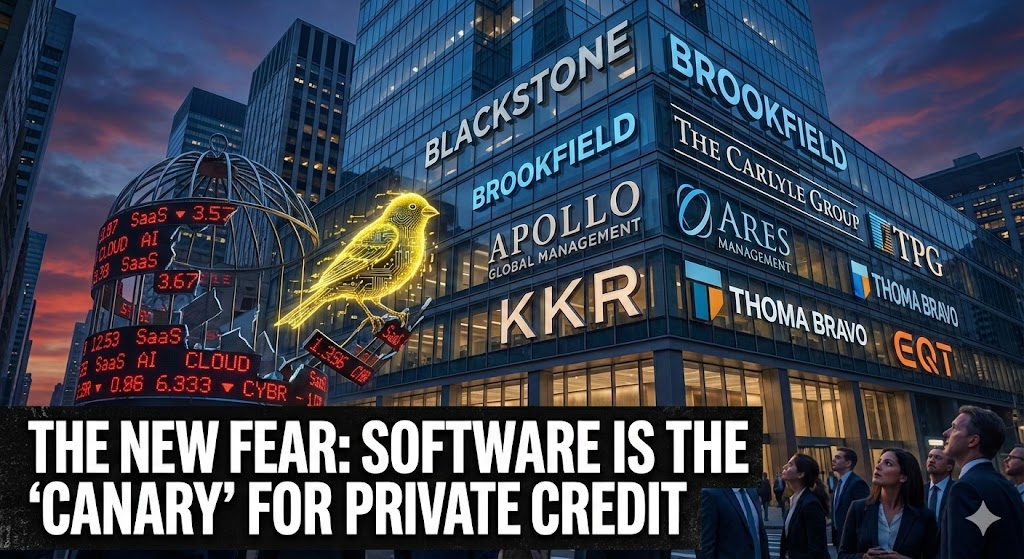
(HedgeCo.Net) The most important “today” story across the largest alternative investment firms isn’t a single mega-deal—it’s a market narrative shift that’s forcing the entire private-capital complex to explain itself in real time. Over the last week, a broad sell-off in software stocks (and the debt tied to them) has bled directly into the public valuations of the biggest alternative managers—Blackstone, Apollo, KKR, Ares and Blue Owl among them—because investors are suddenly treating “software exposure” as a proxy for credit risk, underwriting discipline, and exit optionality in a world where AI compresses moats faster than spreadsheets can model.
The new fear trade: software is the “canary” for private credit
For a decade, software was private equity’s favorite asset class. Predictable recurring revenue, strong margins, and operational levers made it the perfect LBO substrate—especially when cheap debt was abundant. The problem is that AI has changed the conversation from “software compounds” to “software disintermediates.” The idea isn’t simply that some companies will lose market share; it’s that entire categories—customer service, workflow automation, analytics, compliance tooling—could see pricing power collapse as foundation-model capabilities get embedded everywhere.
That matters for alternative managers because software isn’t only a private equity story; it’s a private-credit story. Buyouts were financed by private lenders. Software companies borrowed from BDCs, direct lenders, and structured-credit platforms. The same “stable cash flow” thesis that underwrote deals is now being stress-tested by a new type of disruption risk—one that doesn’t arrive gradually like a typical competitive cycle.
What the giants are telling investors—right now
Executives at the largest firms have moved quickly to reassure markets that the exposure is manageable, diversified, and—critically—smaller than the headlines imply. Reuters reported that Apollo, Ares, and others emphasized limited software concentration in their portfolios and highlighted that even within software, the riskiest segments represent a fraction of holdings.
This is more than messaging. Public-market investors are effectively asking for a new disclosure framework: not just “how much software,” but “what kind of software,” “what leverage,” “what covenant package,” “what sponsor support,” and “what is the AI vulnerability profile.” Alternative managers have always argued they are better risk managers than the market assumes; this is the moment they have to prove it.
The real issue is exits, not just defaults
Even if defaults don’t spike immediately, the exit environment is where the AI narrative does the most damage. If public comps derate, private marks face pressure. If IPO windows stay shut and strategic buyers hesitate, refinancings become harder, hold periods extend, and the “DPI drought” becomes a story again.
The Financial Times highlighted how a private equity software deal cycle—supercharged by leveraged finance—has run into the AI disruption narrative at the worst possible time: higher rates, slower growth, and lenders more cautious about underwriting assumptions.
Why this is trending at the largest alt firms specifically
Smaller credit shops can hide. The mega-managers can’t—because they are public, scaled, and systemically important to private markets. Their stocks become the “index” for sentiment around private credit and private equity. When the market worries that software cash flows may be less durable, it sells the bellwethers first.
And that’s why today’s trend is so consequential: AI isn’t just an opportunity theme anymore—it’s being priced as a credit factor. The firms that can quantify it, segment it, and underwrite it will widen their advantage. The firms that can’t will be forced into defensive postures—restructurings, covenant renegotiations, and slower fundraising momentum.