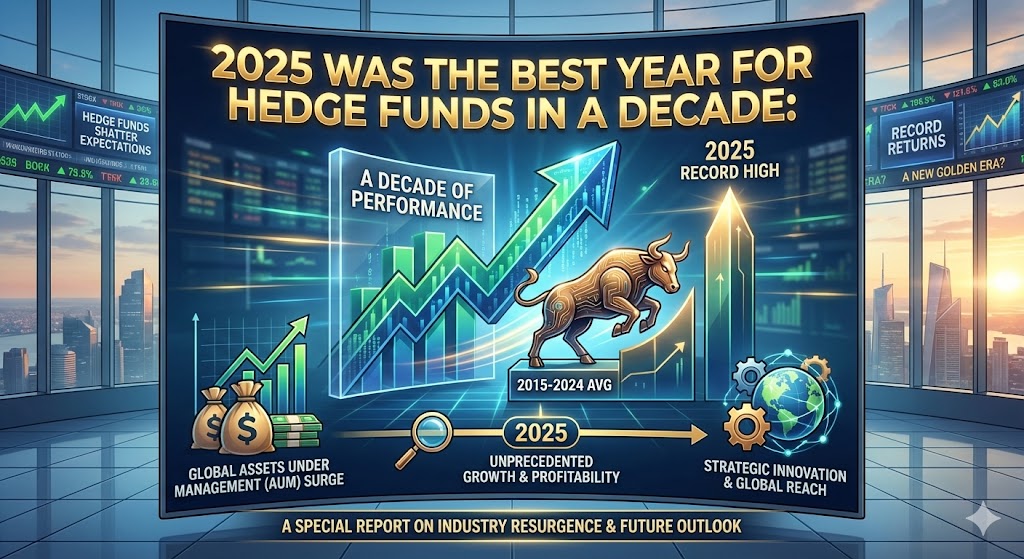
(HedgeCo.Net) Following the release of full 2025 hedge fund performance data, hedge funds posted their strongest collective results in over 15 years. Market observers and allocators now ask: is this the end of the so-called “alpha drought,” and what does this imply for capital flows and risk positioning in 2026?
The Big Numbers: Solid Returns Across Most Strategies
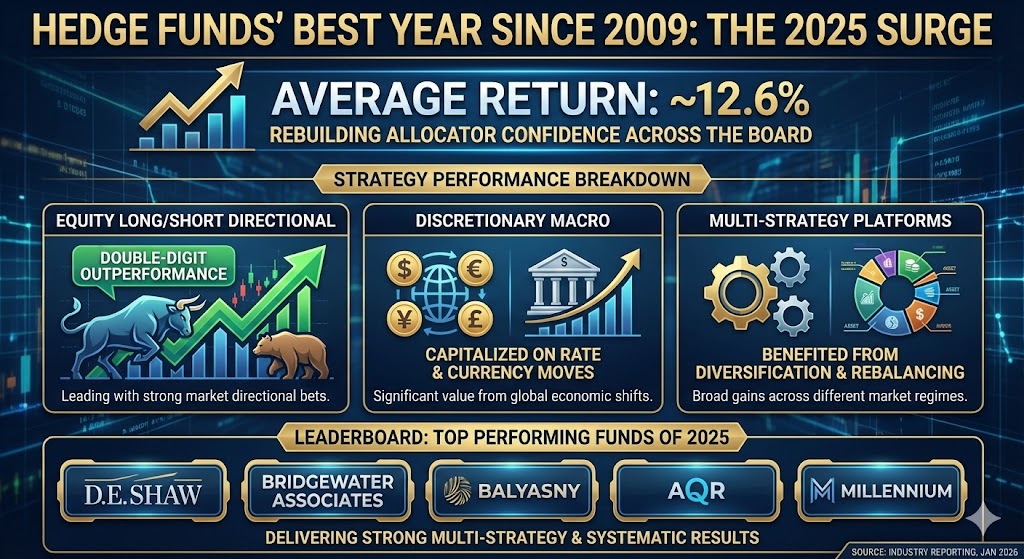
According to recent industry reporting, hedge funds delivered an average return of roughly 12.6 % in 2025, marking the best yearly result since 2009.
Returns were not uniform — some strategies excelled more than others:
- Equity long/short directional strategies led with double-digit outperformance.
- Discretionary macro funds captured significant value from rate and currency moves.
- Multi-strategy platforms benefited from broad diversification and rebalancing across regimes.
Top performing funds in 2025 included:
- D.E. Shaw, Bridgewater Associates, Balyasny, AQR, and Millennium — delivering strong multi-strategy and systematic results.
This across-the-board performance helped rebuild confidence among allocators who had previously questioned hedge funds’ ability to deliver alpha consistently in low-volatility markets.
Alpha Winter Ending?
For much of the last decade, hedge funds struggled to outperform passive benchmarks in a low-volatility, low-correlation world. Yet the combination of:
- Elevated dispersion in equity markets
- Interest rate volatility
- Macro uncertainty
- Geopolitical risk
has restored return opportunities for active managers. Some institutional outlooks suggest that the *post-2019 era of compressed alpha — often termed the “alpha winter” — may be shifting toward a regime that rewards discretionary and systematic skill.
This shift is not a fleeting phenomenon. Instead, it reflects a broader market structural change that could persist through 2026 and beyond:
- Volatility has returned as a strategic asset class driver.
- Dislocations between sectors and markets have created exploitable inefficiencies.
- Hedge funds with robust risk frameworks could capitalize on short windows of divergence.
Institutional Allocators Are Responding
Not surprisingly, allocators have taken notice. Surveys indicate that a majority of institutional investors are now planning to boost hedge fund allocations in 2026, particularly to funds demonstrating a consistent ability to generate differentiated returns across varying environments.
Several trends are notable:
1. Consolidation of Capital:
Allocators are concentrating capital with fewer, high-conviction managers rather than spreading across broad manager lists. Firms with disciplined risk models and demonstrable capacity control now attract larger allocations.
2. Capacity Negotiations Rise:
Investors increasingly negotiate capacity limits — a sign that hedge funds now have more pricing and allocation leverage after a strong performance cycle.
3. Multi-Strategy Dominance:
Triaging of funds based on performance has benefited multi-strategy platforms, which now secure the lion’s share of new capital.
These shifts suggest that 2026 could see net hedge fund inflows that rival or exceed those seen in the post-crisis recovery years — a milestone rarely forecast just 12 months ago.
Strategic Implications for Managers
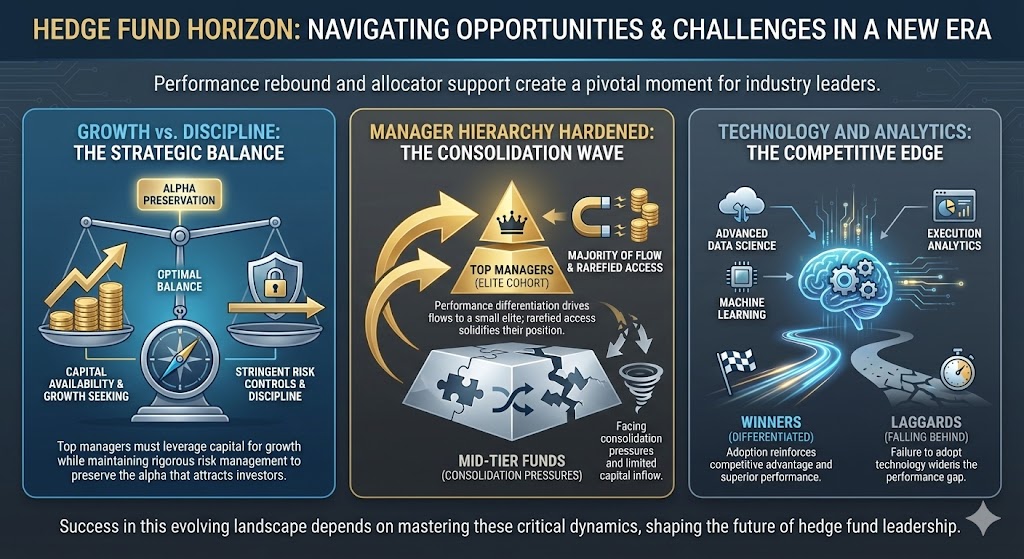
For hedge fund executives, the performance rebound and allocator support open both opportunities and challenges:
- Growth vs. Discipline:
With more capital available, top managers must balance seeking growth with maintaining stringent risk controlsto preserve the alpha that drew investors. - Manager Hierarchy Hardened:
Rarefied access and performance differentiation may drive an industry where a small cohort of top managersattract the majority of flow, while mid-tier funds face consolidation pressures. - Technology and Analytics:
Adoption of advanced data science, machine learning, and execution analytics will continue to differentiate winners and laggards, reinforcing the role of technology as a competitive edge.
What to Watch in 2026
Investors and allocators now scrutinize early 2026 performance indicators to see if hedge funds can sustain the momentum set in 2025. Areas of interest include:
- Macro volatility persistence
- Sector rotation patterns
- Liquidity and deleveraging behavior
- Capacity dynamics at leading firms
Performance momentum — if sustained — could transform hedge funds from a cyclic diversifier to a core return engine in diversified portfolios.