
(HedgeCo.Net) A tremor is moving through the private credit ecosystem. Stone Ridge Asset Management has announced that it will fulfill only 11% of investor redemption requests for its Alternative Lending Risk Premium Fund (LENDX), a vehicle heavily exposed to Buy Now, Pay Later (BNPL) and fintech-originated consumer loans.
While the move is not unprecedented, its timing—and the structure of the underlying assets—has captured the attention of institutional investors, hedge funds, and regulators alike. For many, this is not simply a fund-level liquidity decision. It is being interpreted as a potential early warning signal: a stress fracture within one of the fastest-growing segments of alternative investments.
After more than a decade of uninterrupted expansion, private credit may be entering its first true cycle of strain.
I. Understanding LENDX: A New-Age Credit Strategy
The LENDX fund represents a modern evolution of private credit—one that extends beyond traditional corporate lending into the rapidly expanding world of consumer fintech.
Unlike direct lending funds that finance middle-market companies, LENDX focuses on:
- Buy Now, Pay Later (BNPL) loans
- Marketplace lending platforms
- Fintech-originated consumer credit
These assets are characterized by:
- Shorter duration
- Higher yields
- Technology-driven underwriting
In theory, this model offers attractive risk-adjusted returns, leveraging data analytics to price credit more efficiently.
In practice, however, it introduces new layers of complexity—and risk.
II. The Redemption Shock: Why It Matters
At first glance, limiting redemptions to 11% may appear to be a routine liquidity management decision. But within the context of private credit, it carries deeper implications.
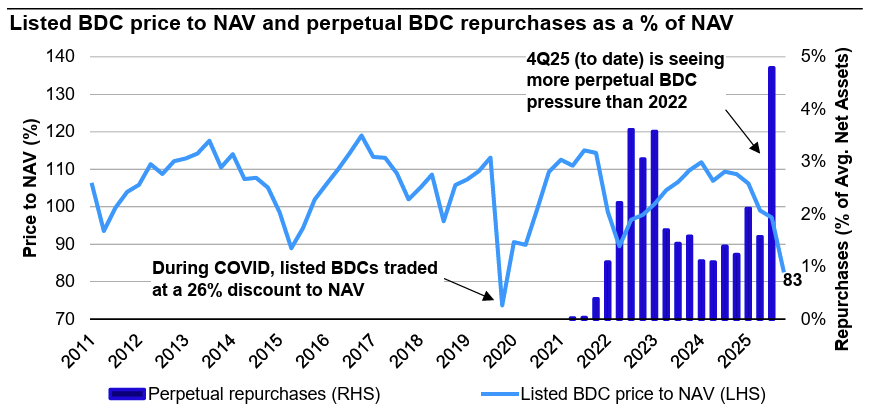

4
Private credit funds typically operate with:
- Illiquid underlying assets
- Periodic liquidity windows for investors
- Redemption gates to manage outflows
When redemption requests exceed available liquidity, managers may impose limits to avoid forced asset sales at unfavorable prices.
However, such actions can trigger:
- Investor concern about asset quality
- Heightened scrutiny of fund structures
- Contagion across similar vehicles
In this case, the exposure to consumer credit—particularly BNPL—adds another layer of sensitivity.
III. BNPL and Fintech Lending: Growth Meets Reality
Over the past several years, BNPL has been one of the fastest-growing segments in financial services.
Platforms offering installment-based payments have transformed consumer behavior, enabling:
- Instant credit approvals
- Flexible repayment structures
- Increased purchasing power
For investors, BNPL loans offered:
- High yields
- Diversification
- Exposure to a rapidly growing market
But the model is now facing its first real stress test.
Key risks include:
- Rising Delinquencies: As consumer finances tighten
- Underwriting Challenges: Limited historical data for newer borrowers
- Regulatory Pressure: Increasing oversight of consumer lending practices
In a benign economic environment, these risks are manageable. In a tightening cycle, they become more pronounced.
IV. The Liquidity Illusion in Private Credit
One of the defining features of modern private credit has been the emergence of semi-liquid structures—funds that offer periodic redemption opportunities despite holding illiquid assets.
This model has been instrumental in attracting capital, particularly from:
- Wealth management channels
- Financial advisors
- Retail investors
However, it also creates a fundamental tension:
- Assets are long-term and illiquid
- Liabilities (investor capital) are shorter-term and redeemable
This mismatch is manageable in stable conditions but becomes problematic during periods of stress.
The LENDX redemption curbs highlight this tension in real time.
V. Is This an Isolated Event—or a Broader Signal?
The key question facing the market is whether the LENDX situation is idiosyncratic or indicative of a broader trend.
Several factors suggest that it may be part of a larger pattern:
- Rising Interest Rates: Increasing borrowing costs and default risk
- Economic Uncertainty: Pressure on consumer and corporate balance sheets
- Capital Constraints: Reduced availability of refinancing options
These dynamics are not unique to LENDX—they are systemic.
As a result, investors are beginning to reassess their exposure to private credit.
VI. The Private Credit Boom: A Decade in Review
To understand the significance of current developments, it is important to consider the context of the private credit boom.
Following the Global Financial Crisis, banks retreated from lending due to regulatory constraints. Asset managers stepped in to fill the gap, creating a new ecosystem of non-bank lenders.
Firms such as Blackstone, Apollo Global Management, and Ares Management built massive platforms, deploying capital across:
- Direct lending
- Specialty finance
- Structured credit
The result was a multi-trillion-dollar asset class characterized by:
- Strong returns
- Low default rates
- High investor demand
But this success was achieved under favorable conditions—conditions that are now changing.
VII. The Turning Point: From Expansion to Scrutiny
The current environment marks a transition from expansion to scrutiny.
Investors are increasingly focused on:
- Asset Quality: Are underlying loans performing as expected?
- Liquidity Structures: Can funds meet redemption requests?
- Valuation Transparency: How are illiquid assets priced?
The LENDX situation brings these questions to the forefront.
VIII. Contagion Risk and Market Psychology
One of the most significant risks in private credit is not just fundamental deterioration—but perception.
If investors begin to lose confidence, several dynamics can unfold:
- Increased redemption requests
- Pressure on fund liquidity
- Forced asset sales
- Further declines in confidence
This feedback loop can amplify stress across the system.
While there is no evidence of widespread contagion at this stage, the situation is being closely monitored.
IX. Regulatory Implications
The rise of semi-liquid private credit funds has attracted the attention of regulators.
Concerns include:
- Investor understanding of liquidity risks
- Potential systemic vulnerabilities
- Transparency of fund structures
Events like the LENDX redemption curbs may accelerate regulatory scrutiny, potentially leading to:
- Stricter disclosure requirements
- Enhanced liquidity management rules
- Limitations on retail access
X. Opportunities Amid the Uncertainty
While the current environment presents challenges, it also creates opportunities.
Periods of stress often lead to:
- Wider credit spreads
- Attractive entry points
- Reduced competition
Experienced managers with strong capital bases may be well-positioned to deploy capital opportunistically.
XI. Strategic Considerations for Investors
For allocators, the evolving landscape requires careful navigation.
Key considerations include:
- Diversification: Avoiding concentration in specific credit segments
- Manager Selection: Prioritizing experience and risk management
- Liquidity Planning: Aligning investment horizons with fund structures
Understanding the nuances of different private credit strategies is more important than ever.
XII. Conclusion: A Stress Test in Motion
The LENDX redemption curbs represent a critical moment for private credit.
While it is too early to determine whether this is the ????? of a broader downturn, it is clear that the environment is becoming more challenging.
For an asset class that has enjoyed years of growth and stability, this may be the first real test of resilience.
And as history has shown, it is during such tests that the true strengths—and weaknesses—of financial systems are revealed.