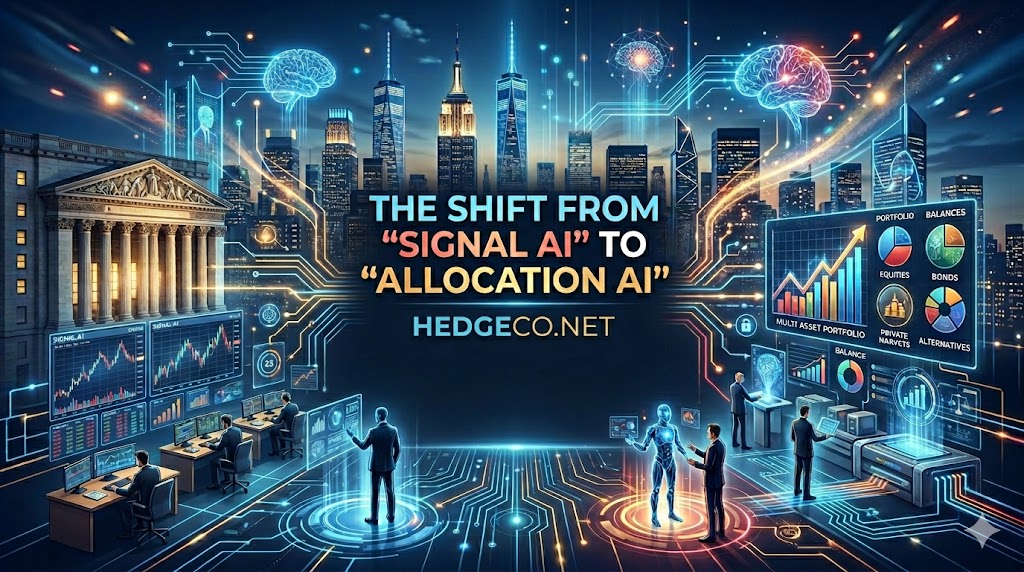
From Prediction to Capital Control: The Next Evolution of Quant Investing
(HedgeCo.Net )— A quiet but profound transformation is underway inside the world’s largest quantitative hedge funds. For decades, firms competed on their ability to generate superior trading signals—predictive models designed to identify short-term mispricings across equities, futures, and other liquid markets. Today, that paradigm is rapidly evolving.
Leading firms such as Two Sigma and emerging AI-native platforms like Alphacircle are increasingly shifting their focus from signal generation to what industry insiders are calling “Allocation AI.” Instead of simply predicting returns, these systems are being designed to dynamically allocate capital across strategies, teams, and risk buckets in real time.
The implications are enormous. This is not just an incremental improvement in quant investing—it is a structural shift in how capital is deployed, managed, and optimized across multi-strategy hedge fund platforms.
The End of the Signal Arms Race
For years, quantitative investing has been defined by an arms race in signal generation. Firms invested heavily in data acquisition, machine learning models, and computing infrastructure in an effort to extract alpha from increasingly efficient markets. However, this model is facing diminishing returns.
As more firms adopt similar techniques and access comparable datasets, the marginal value of new signals has declined. Alpha has become more crowded, decay rates have accelerated, and transaction costs have risen. In many cases, the challenge is no longer identifying opportunities—but deciding how to allocate capital among them. This realization is driving a fundamental rethinking of the quant investment process.
What Is “Allocation AI”?
At its core, Allocation AI represents a shift from prediction to decision-making.
Traditional quant models answer the question: What will this asset do next?
Allocation AI systems ask: Where should we allocate capital right now, given all available opportunities and constraints?
This requires a different class of models—ones capable of evaluating not just expected returns, but also risk, correlation, liquidity, and capacity constraints across an entire portfolio.
Many of these systems are built using deep reinforcement learning (DRL), a subset of machine learning that focuses on optimizing sequential decision-making. In this framework, the model continuously learns from its environment, adjusting its actions to maximize a defined objective function—typically risk-adjusted returns.
Unlike static allocation frameworks, these systems operate dynamically, updating positions in real time as market conditions evolve.
The Rise of the “Meta-Portfolio” Layer
One of the most important developments in this transition is the emergence of a “meta-portfolio” layer within hedge funds.
In traditional multi-strategy firms, individual portfolio managers (PMs) or “pods” operate semi-independently, each running their own strategies within defined risk limits. Capital allocation decisions are typically made at a higher level, based on performance, risk metrics, and qualitative assessments.
Allocation AI introduces a new layer of intelligence that sits above these pods, continuously optimizing capital distribution across the entire platform.
This meta-layer evaluates:
- Real-time performance of each strategy
- Correlations between strategies
- Market regime shifts
- Liquidity conditions
- Tail risk exposures
Based on these inputs, the system can dynamically reallocate capital—scaling up high-performing strategies, reducing exposure to underperforming ones, and adjusting risk in response to changing conditions.The result is a more adaptive and resilient portfolio.
Reinforcement Learning Meets Hedge Funds
The application of reinforcement learning to capital allocation is a natural evolution of its success in other domains, such as gaming and robotics. In finance, however, the stakes—and the complexity—are significantly higher.
Markets are noisy, non-stationary, and influenced by a wide range of exogenous factors. This makes it challenging to train models that can generalize effectively across different environments.
To address this, firms are investing heavily in simulation environments and synthetic data generation. These tools allow models to “learn” from a wide range of scenarios, including rare but impactful events such as market crashes.
The goal is to create systems that are not only adaptive but also robust—capable of performing under a variety of conditions.
Implications for Multi-Strategy Platforms
The shift toward Allocation AI has profound implications for the structure of multi-strategy hedge funds.
Firms like Citadel, Millennium Management, and Point72 have already built highly sophisticated platforms designed to manage dozens—or even hundreds—of independent trading teams.
Allocation AI enhances this model by introducing a more systematic and data-driven approach to capital allocation. Instead of relying solely on human judgment, firms can leverage machine learning to make more precise and timely decisions.
This could lead to:
- Improved capital efficiency
- Reduced drawdowns
- Faster adaptation to market changes
- Enhanced risk management
At the same time, it raises important questions about the role of human portfolio managers. While PMs remain critical for generating ideas and executing strategies, their autonomy may be increasingly shaped by algorithmic oversight.
The Data Advantage
A key driver of success in Allocation AI is access to high-quality data. Firms with extensive historical datasets, real-time market feeds, and proprietary information are better positioned to train and deploy effective models.
This creates a competitive advantage for large, well-capitalized firms, which can invest in data infrastructure and computing power at scale.
However, it also raises barriers to entry for smaller players, potentially leading to increased concentration within the industry.
Risk Management in an AI-Driven World
While Allocation AI offers significant benefits, it also introduces new risks. One concern is model overfitting—where systems perform well in training environments but fail in real-world conditions. This is particularly problematic in finance, where historical patterns may not repeat.
Another risk is the potential for systemic behavior. If multiple firms adopt similar models, their actions could become correlated, amplifying market movements during periods of stress.
To mitigate these risks, firms are implementing robust risk management frameworks, including:
- Model validation and stress testing
- Human oversight and intervention mechanisms
- Diversification across models and strategies
Ultimately, the goal is to strike a balance between automation and control.
The Future of Alpha
The transition to Allocation AI reflects a broader evolution in the nature of alpha.
In the past, alpha was primarily derived from information advantages—access to data or insights that others did not have. Today, as information becomes more widely available, the focus is shifting toward execution and optimization.
The ability to allocate capital efficiently, manage risk dynamically, and adapt to changing conditions is becoming a key differentiator.
This does not mean that signal generation is obsolete. Rather, it becomes one component of a larger system—one that integrates prediction with decision-making in a more holistic framework.
Institutional Implications
For institutional investors, the rise of Allocation AI has important implications for manager selection and portfolio construction.
Allocators must evaluate not only a fund’s track record, but also its technological capabilities, data infrastructure, and approach to AI integration.
Questions that were once peripheral are now central:
- How does the firm allocate capital across strategies?
- What role does AI play in decision-making?
- How are models validated and monitored?
These considerations are likely to become increasingly important as the industry evolves.
Conclusion: A New Operating System for Capital
The shift from Signal AI to Allocation AI represents a fundamental transformation in the hedge fund industry. It is a move from isolated predictions to integrated decision-making—a new operating system for capital deployment.
For firms that successfully implement these systems, the potential benefits are substantial: improved performance, enhanced risk management, and greater resilience in the face of market uncertainty.
For those that do not, the risk is falling behind in an increasingly competitive landscape. As this trend continues to unfold, one thing is clear: the future of investing will not be defined solely by what you know, but by how effectively you act on it.