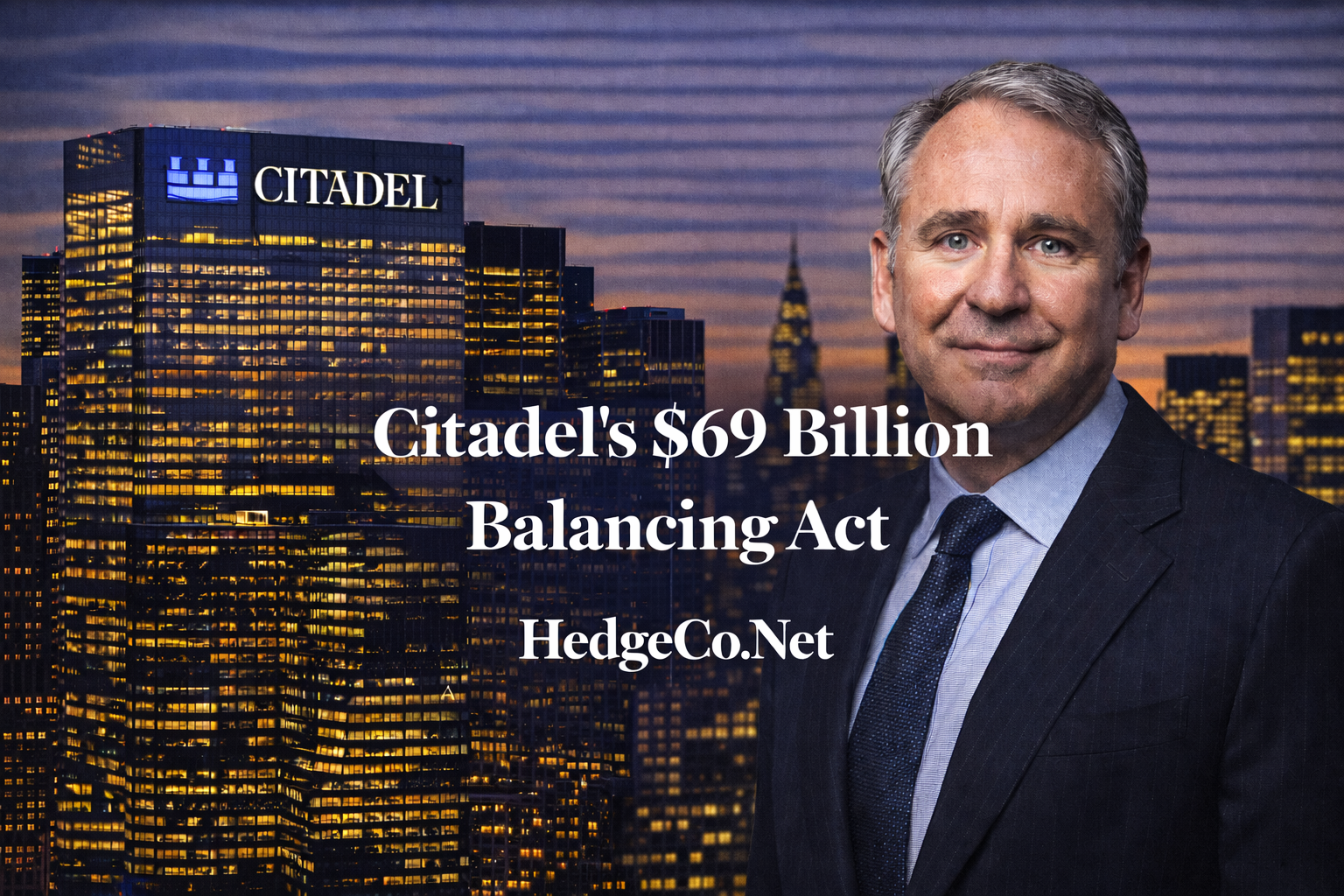
(HedgeCo.Net) In a year defined by volatility, dispersion, and rapidly shifting macro narratives, Citadel finds itself navigating one of the most complex operating environments in its history. The firm, led by billionaire founder Ken Griffin, has long been regarded as the gold standard of multi-strategy hedge fund performance—delivering consistent, risk-adjusted returns across market cycles. Yet in 2026, even Citadel is confronting a new reality: a widening divergence between strategies that is testing the very foundations of its investment model.
At the center of this dynamic is a striking internal split. While Citadel’s flagship Wellington fund—its largest and most closely watched vehicle—has experienced a modest drawdown, other divisions within the firm, particularly its Tactical Trading unit, are posting strong gains. This divergence is not merely a short-term anomaly; it reflects deeper structural forces reshaping the hedge fund landscape.
The question facing investors is no longer whether Citadel can generate returns—it is how the firm manages the growing complexity of doing so in a fragmented and increasingly unpredictable market environment.
A Tale of Two Strategies
Citadel’s recent performance can best be understood as a tale of two strategies. On one side is Wellington, the firm’s flagship multi-strategy fund, which has built its reputation on delivering steady, diversified returns across equities, fixed income, commodities, and macro trading. On the other is Tactical Trading, a more nimble and opportunistic platform designed to capitalize on short-term market dislocations.
In March 2026, this contrast became particularly pronounced. Wellington posted a decline of approximately 1.9%—a modest loss by historical standards, but notable given the fund’s typically stable performance profile. Meanwhile, Tactical Trading surged, delivering gains of more than 5% year-to-date.
This divergence highlights a key challenge for large, diversified hedge funds: the difficulty of maintaining consistent performance across multiple strategies in an environment where market conditions are evolving rapidly.
The Macro Backdrop: A Perfect Storm
To understand the forces driving this split, one must consider the broader macroeconomic context. The first quarter of 2026 has been marked by a confluence of disruptive factors, including:
- Escalating geopolitical tensions, particularly in energy-sensitive regions
- Persistent inflationary pressures
- Uncertainty surrounding central bank policy
- Increased volatility across asset classes
These dynamics have created a market environment characterized by sharp, often unpredictable movements. Traditional correlations between asset classes have weakened, and the effectiveness of diversification has been called into question.
For a fund like Wellington, which relies on balancing exposures across a wide range of strategies, this environment presents significant challenges. Positions that are designed to hedge one another can instead move in tandem, reducing the benefits of diversification.
By contrast, Tactical Trading thrives in precisely this kind of environment. Its mandate is to identify and exploit short-term opportunities, often driven by the very dislocations that are challenging more traditional strategies.
The Evolution of Multi-Strategy Investing
Citadel’s experience in 2026 reflects a broader evolution within the hedge fund industry. The multi-strategy model, which has dominated the landscape over the past decade, is being tested by a new regime of higher volatility and increased macro influence.
Historically, multi-strategy funds have generated alpha by combining a variety of uncorrelated strategies, thereby smoothing returns and reducing risk. However, this approach assumes a relatively stable correlation structure—an assumption that is increasingly being challenged.
In periods of market stress, correlations tend to converge, undermining the benefits of diversification. This phenomenon was evident during the “March Malaise,” when many strategies across the industry experienced simultaneous losses.
For firms like Citadel, the implication is clear: success in the current environment requires not just diversification, but adaptability.
Tactical Trading: The Rise of Opportunistic Alpha
Citadel’s Tactical Trading unit represents a shift toward a more opportunistic approach to investing. Rather than relying on long-term positioning, this strategy focuses on identifying and exploiting short-term market inefficiencies.
Key characteristics of Tactical Trading include:
- Rapid turnover of positions
- High sensitivity to market signals
- Flexibility across asset classes
- Emphasis on liquidity
In 2026, these attributes have proven particularly valuable. As markets have reacted to geopolitical developments and economic data releases, Tactical Trading has been able to capitalize on the resulting volatility.
This success underscores an important point: in today’s markets, alpha is increasingly being generated through speed and agility, rather than long-term positioning alone.
Risk Management in a Fragmented Market
Despite the divergence in performance, Citadel’s overall risk management framework remains one of its greatest strengths. The firm has invested heavily in systems that monitor exposures in real time, allowing it to respond quickly to changing conditions.
Key elements of Citadel’s risk management approach include:
- Centralized oversight of portfolio risk
- Strict limits on leverage and position sizes
- Continuous stress testing across scenarios
These measures have helped the firm navigate periods of market stress without incurring significant losses. Even in the case of Wellington’s recent drawdown, the magnitude of the loss has been relatively contained.
However, the current environment is testing the limits of even the most sophisticated risk management systems. As correlations shift and new risks emerge, maintaining a balanced portfolio becomes increasingly complex.
The Role of Scale: Advantage or Constraint?
With approximately $69 billion in assets under management, Citadel is one of the largest hedge funds in the world. This scale provides significant advantages, including:
- Access to top-tier talent
- Investment in cutting-edge technology
- Ability to deploy capital across a wide range of opportunities
At the same time, scale can also present challenges. Large funds may face constraints in terms of liquidity and flexibility, particularly when attempting to adjust positions quickly.
In contrast, smaller, more nimble funds may be better positioned to exploit certain opportunities, particularly in less liquid markets.
Citadel’s ability to balance these competing dynamics—leveraging its scale while maintaining agility—will be a key determinant of its future success.
Investor Perspective: Stability vs. Opportunity
For investors, Citadel’s recent performance raises important questions about the role of multi-strategy hedge funds within a portfolio.
On one hand, funds like Wellington are valued for their stability and consistency. Even modest drawdowns can be seen as a deviation from expectations.
On the other hand, the strong performance of Tactical Trading highlights the potential for higher returns in more dynamic strategies.
This creates a tension between two objectives:
- Preserving capital and minimizing volatility
- Maximizing returns through opportunistic investing
For many investors, the optimal approach may involve a combination of both—allocating capital across different strategies to achieve a balance between stability and growth.
The Competitive Landscape
Citadel’s balancing act is taking place within an increasingly competitive industry. Firms such as Millennium Management and Point72 are also adapting their strategies to navigate the current environment.
This competition is driving innovation across the industry, as firms seek to differentiate themselves through:
- Enhanced data analytics
- Advanced trading technologies
- Innovative investment strategies
In this context, Citadel’s ability to maintain its leadership position will depend on its capacity to evolve alongside the market.
Looking Ahead: Navigating the New Regime
As 2026 unfolds, the challenges facing Citadel—and the hedge fund industry more broadly—are unlikely to dissipate. Instead, markets are entering a new regime characterized by:
- Higher volatility
- Greater macro influence
- Increased dispersion across assets
In this environment, the traditional playbook may no longer be sufficient. Success will require a willingness to adapt, innovate, and embrace new approaches to investing.
For Citadel, this may involve:
- Expanding its Tactical Trading capabilities
- Enhancing integration between strategies
- Continuing to invest in technology and data
Conclusion: A Test of Resilience
Citadel’s $69 billion balancing act is more than a story of short-term performance—it is a reflection of the broader challenges facing the hedge fund industry in 2026.
The divergence between Wellington and Tactical Trading highlights the complexities of managing a large, diversified portfolio in a rapidly changing market. It also underscores the importance of adaptability, agility, and innovation.
For investors, the key takeaway is that even the most successful funds are not immune to market dynamics. However, the ability to navigate these challenges—and to emerge stronger as a result—is what ultimately defines long-term success.
In this regard, Citadel remains well-positioned. While the road ahead may be uncertain, the firm’s track record, resources, and strategic vision provide a strong foundation for navigating whatever comes next.
As markets continue to evolve, one thing is clear: the era of easy alpha is over. The future belongs to those who can balance risk and opportunity with precision—and few firms are better equipped to do so than Citadel.