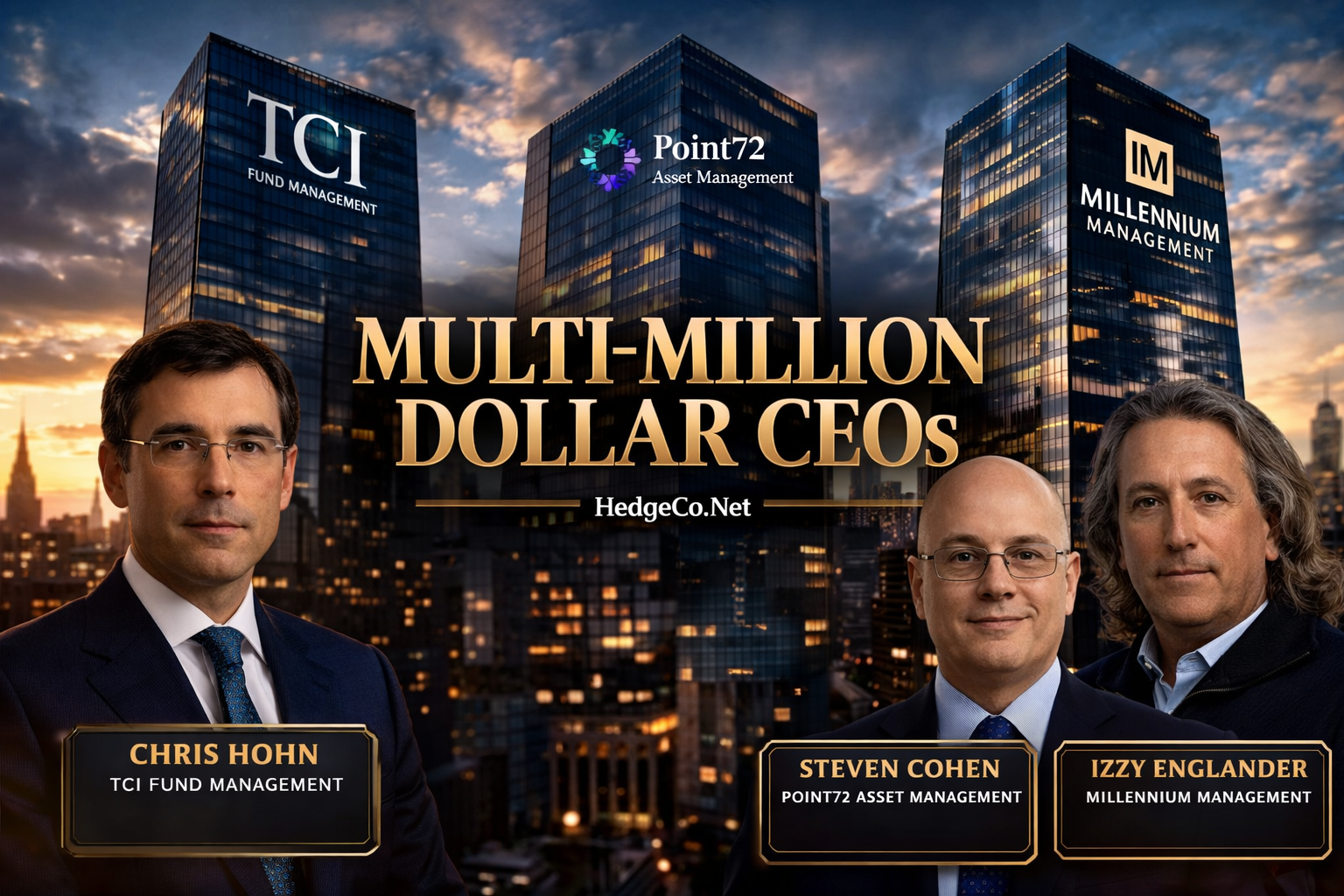
(HedgeCo.Net) — The 2025 performance year, reported in early 2026, will be remembered as a defining moment in the history of alternative investments. At the center of this milestone is an extraordinary surge in earnings among the world’s top hedge fund managers, culminating in what many are calling the most profitable era ever recorded for individual allocators of capital. Leading the charge was Chris Hohn, whose estimated $4.9 billion payday set a new high-water mark for the industry. Close behind were Steven Cohen with roughly $4 billion and Izzy Englander with approximately $3.5 billion, reinforcing the dominance of multi-strategy platforms and concentrated equity conviction.
This year’s “Rich List” is not just a scoreboard of wealth—it is a reflection of structural shifts reshaping the hedge fund ecosystem. From the rise of platform models and institutional capital flows to the evolution of fee structures and risk management, the forces behind these record earnings offer a roadmap for where the industry is heading next.
A Record-Breaking Year in Context
To understand the magnitude of the 2026 Rich List, it is important to place it within historical context. Hedge fund compensation has always been closely tied to performance, typically governed by the “2 and 20” model—2% management fees and 20% performance fees. However, in recent years, fee compression, investor scrutiny, and increased competition had led many to question whether the golden age of hedge fund paydays was fading.
2025 decisively answered that question.
A combination of elevated volatility, macro dislocations, and dispersion across asset classes created a near-perfect environment for active managers. Unlike passive strategies, which struggled to navigate sharp rotations and geopolitical shocks, hedge funds were able to exploit inefficiencies across equities, fixed income, commodities, and derivatives.
The result: outsized returns for top-performing funds—and, by extension, record compensation for the managers behind them.
Chris Hohn and the Power of Concentrated Conviction
At the top of the list, Chris Hohn’s performance stands out not only for its scale but for its strategy. As the founder of TCI Fund Management, Hohn has long been known for his concentrated, high-conviction approach to investing. Unlike multi-manager platforms that diversify across hundreds of positions, TCI often runs a focused portfolio of large, high-quality companies.
This approach paid off handsomely in 2025. With major positions in global equities benefiting from structural growth trends—particularly in technology, infrastructure, and energy transition—TCI generated exceptional returns. Hohn’s ability to combine deep fundamental analysis with long-term thematic positioning allowed the fund to capitalize on both cyclical rebounds and secular tailwinds.
Equally important is TCI’s activist overlay. Hohn has not hesitated to engage with management teams, pushing for operational improvements, capital returns, and governance changes. This blend of activism and long-term investing has proven to be a powerful formula in an era where alpha is increasingly scarce.
The Platform Era: Cohen and Englander Redefine Scale
If Hohn represents the power of concentration, then Steven Cohen and Izzy Englander embody the rise of the multi-manager “platform” model.
Firms like Point72 Asset Management and Millennium Management operate as ecosystems of trading teams—often referred to as “pods”—each running their own strategies within a centralized risk framework. This model has gained immense popularity over the past decade, and 2025 may have been its most successful year yet.
Cohen’s Point72, with its aggressive expansion into new asset classes and data-driven strategies, delivered strong performance across multiple pods. Meanwhile, Englander’s Millennium continued to refine its disciplined approach to risk management, emphasizing tight drawdown controls and consistent returns.
The platform model offers several advantages:
- Diversification of alpha sources across geographies and asset classes
- Rapid capital allocation to top-performing teams
- Strict risk controls that limit downside volatility
- Scalability, allowing firms to manage tens of billions without sacrificing performance
These features have made platform funds particularly attractive to institutional investors—and highly lucrative for their founders.
The Role of Volatility and Market Structure
One of the key drivers behind the 2025 earnings boom was market volatility. From geopolitical tensions in the Middle East to shifting central bank policies and continued disruptions in global supply chains, markets experienced significant swings throughout the year.
For hedge funds, volatility is not a risk—it is an opportunity.
Dislocations between sectors, regions, and asset classes created fertile ground for relative value trades, macro positioning, and event-driven strategies. Managers who could quickly adapt to changing conditions were able to generate substantial alpha.
Moreover, the increasing complexity of modern markets has widened the gap between skilled active managers and passive strategies. As correlations broke down and dispersion increased, the value of expertise, data, and execution became more pronounced.
Institutional Capital: Fueling the Machine
Another critical factor behind the record Rich List earnings is the surge in institutional capital flowing into hedge funds.
Pension funds, endowments, and sovereign wealth funds have been reallocating capital toward alternative investments in search of diversification and higher returns. With traditional portfolios under pressure from inflation and interest rate volatility, hedge funds have re-emerged as a key component of institutional asset allocation.
This influx of capital has had a compounding effect:
- Larger asset bases increase fee revenue
- Performance fees scale with AUM, amplifying earnings
- Top managers attract disproportionate inflows, reinforcing their dominance
In many ways, the Rich List is as much a story about capital concentration as it is about performance.
Fee Structures: Evolution, Not Decline
While fee compression has been a major theme in recent years, the 2026 Rich List demonstrates that performance can still command premium pricing.
Many top funds have adapted their fee structures rather than abandoning them. Variations include:
- Tiered performance fees based on return thresholds
- Hurdle rates that align incentives with investors
- Founder share classes offering reduced fees for early investors
Despite these innovations, the core principle remains unchanged: exceptional performance justifies exceptional compensation.
In fact, some of the largest payouts on the Rich List were driven by funds that not only generated high returns but did so with relatively low volatility—enhancing their appeal to institutional clients.
Technology, Data, and the Arms Race for Alpha
Behind the scenes, the success of top hedge fund managers is increasingly driven by technology and data.
Firms are investing billions in:
- Alternative data sources, from satellite imagery to credit card transactions
- Machine learning models to identify patterns and signals
- High-performance computing for real-time analytics
- Proprietary trading systems that enhance execution speed and efficiency
This technological arms race has raised the barriers to entry for new managers while giving established firms a significant competitive advantage.
For platform funds in particular, technology serves as the backbone of their operations—enabling centralized risk management, data sharing, and performance monitoring across dozens or even hundreds of trading teams.
The Human Factor: Talent Wars Intensify
While technology plays a crucial role, the hedge fund industry remains fundamentally driven by human talent.
The record earnings of 2025 have intensified competition for top portfolio managers, analysts, and traders. Firms are offering increasingly lucrative compensation packages, including:
- Multi-million dollar guarantees
- Profit-sharing arrangements
- Long-term incentive plans
This “talent war” is especially pronounced among multi-manager platforms, where the success of the firm depends on the performance of individual pods.
As a result, the Rich List is not just a reflection of individual achievement—it is also a testament to the teams and infrastructure supporting these managers.
Criticism and Controversy
Despite the industry’s success, the 2026 Rich List has not been without controversy.
Critics argue that the massive payouts highlight broader issues of income inequality and raise questions about the social value of hedge fund activities. Others point to the potential risks associated with large, highly leveraged funds operating in increasingly interconnected markets.
There are also concerns about capacity constraints. As funds grow larger, it becomes more difficult to deploy capital efficiently without impacting markets. This has led some firms to return capital to investors or close to new inflows—ironically enhancing their exclusivity and appeal.
What It Means for the Future
The implications of the 2026 Rich List extend far beyond individual earnings. They signal a broader shift in the investment landscape, with several key trends likely to shape the future of the industry:
1. Continued Dominance of Multi-Manager Platforms
The success of firms like Point72 and Millennium suggests that the platform model will remain a central pillar of the hedge fund industry.
2. Greater Institutional Integration
As hedge funds become more embedded in institutional portfolios, their influence on global markets will continue to grow.
3. Rising Barriers to Entry
The increasing importance of technology, data, and scale will make it more challenging for new managers to compete.
4. Evolving Fee Structures
While performance will always command a premium, funds will continue to innovate in how they align incentives with investors.
5. Expansion into New Asset Classes
From private credit to digital assets, hedge funds are broadening their reach, creating new opportunities—and risks.
A New Golden Age?
So, does the 2026 Rich List mark the beginning of a new golden age for hedge funds?
The answer appears to be yes—but with important caveats.
The industry is more sophisticated, competitive, and capital-intensive than ever before. Success at the highest levels requires not only exceptional investment skill but also access to resources, technology, and talent.
For investors, the message is clear: the gap between top-tier managers and the rest of the field is widening. Identifying and accessing these elite performers will be critical to achieving superior returns.
For the managers themselves, the stakes have never been higher. As the rewards grow, so too do the expectations—and the scrutiny.
Conclusion
The 2026 Rich List Records are more than a snapshot of extraordinary wealth—they are a reflection of an industry in transformation. From the concentrated brilliance of Chris Hohn to the scalable dominance of Steven Cohen and Izzy Englander, the paths to success may differ, but the outcome is the same: unprecedented earnings in a rapidly evolving financial landscape.
As hedge funds continue to adapt to new challenges and opportunities, one thing is certain: the race for alpha—and the rewards that come with it—is far from over.
And if 2025 is any indication, the next chapter may be even more lucrative.