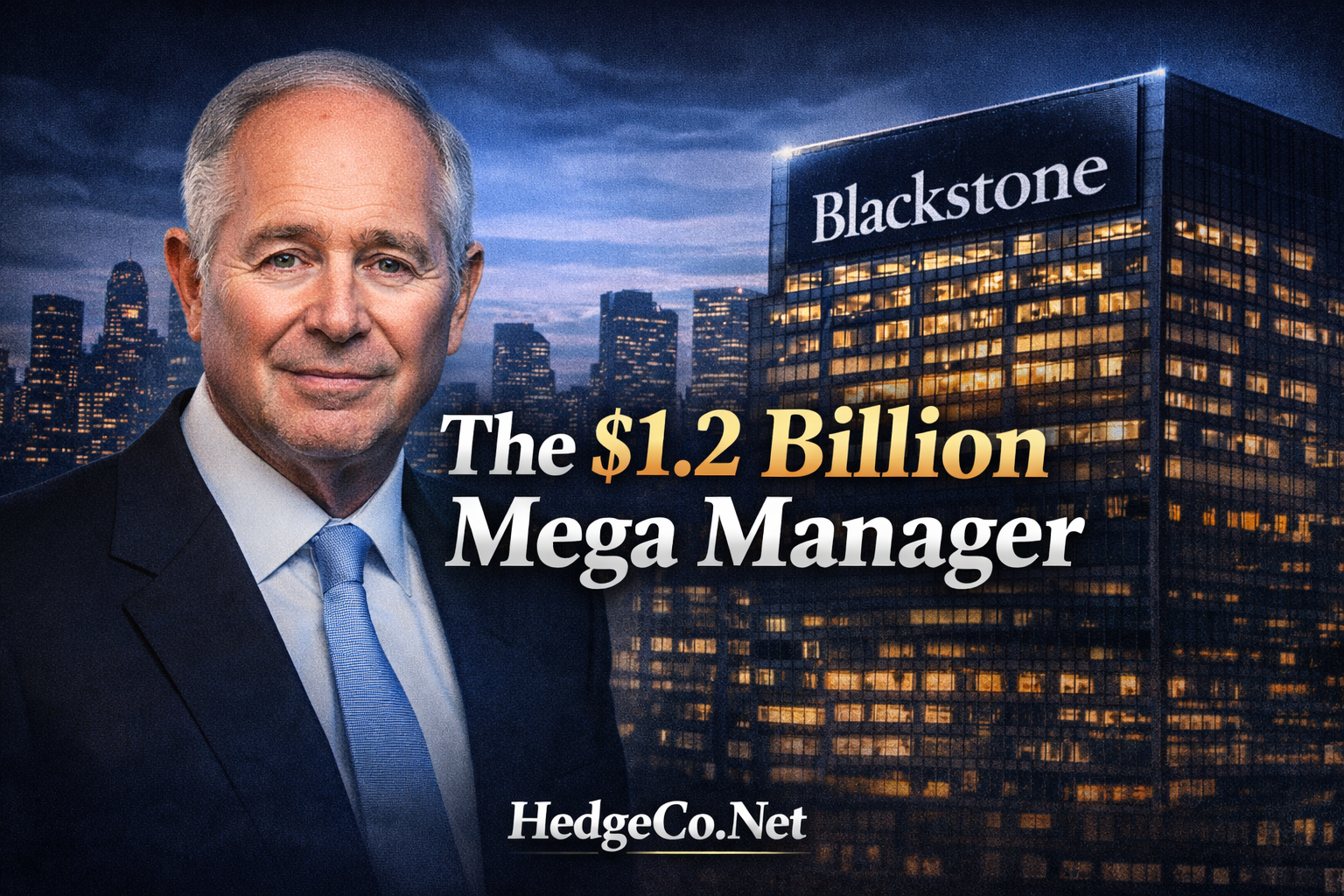
(HedgeCo.Net) In the world of alternative investments, compensation is not merely remuneration — it is revelation. And when the co-founder and CEO of Blackstone Inc., Stephen A. Schwarzman, reportedly earned approximately $1.2 billion in a single year, it sent a signal far beyond the boardroom.
That figure is not simply a headline. It is a data point about scale, carry structures, capital formation, investor confidence, and the extraordinary economic leverage embedded within modern alternative asset platforms.
To understand what this compensation truly represents, one must look beyond the optics and into the mechanics of the mega-manager model that now dominates global private markets.
The Architecture of Billion-Dollar Compensation
Unlike traditional corporate CEOs, whose compensation is primarily salary and stock grants, leaders of alternative asset management firms derive the bulk of their wealth from ownership stakes and carried interest participation.
At firms like Blackstone:
- Management fees generate steady operating income.
- Carried interest produces performance-linked upside.
- Equity ownership compounds value as assets under management grow.
- Dividend distributions flow directly to founders and insiders.
Blackstone now oversees over $1 trillion in assets. That scale, once unthinkable in private markets, transforms even modest percentage economics into enormous absolute payouts.
For context:
- A 1% incremental increase in firm-wide AUM equates to billions in new fee-earning capital.
- Performance fees on flagship private equity and credit funds can exceed hundreds of millions annually.
- Dividends from a publicly traded asset manager compound year after year.
Schwarzman’s compensation reflects the flywheel effect of scale. It is less about a single year’s performance and more about the structural economics of a platform built over four decades.
The Mega-Manager Model: Industrialized Alternatives
Blackstone and its peers have effectively industrialized alternative investing. What was once a boutique partnership model is now a multi-vertical global capital machine spanning:
- Private equity
- Private credit
- Real estate
- Infrastructure
- Insurance solutions
- Secondaries
- Growth equity
- Retailized semi-liquid funds
This diversification reduces volatility in earnings while preserving upside through carry.
Importantly, Blackstone’s public listing amplified this effect. Unlike private partnerships, publicly traded alternative managers can monetize equity while continuing to participate in growth. Shareholders fund expansion; insiders maintain leverage.
The result is a new economic archetype: the founder-CEO as capital allocator, platform architect, and institutional shareholder.
Public Markets Meet Private Economics
Schwarzman’s payout also reflects the maturation of alternatives into mainstream finance.
Once viewed as opaque, fee-heavy, and exclusive, private markets have moved toward institutional legitimacy and retail access. Blackstone’s strategic push into semi-liquid vehicles, 401(k) inclusion initiatives, and insurance partnerships has broadened its capital base beyond sovereign funds and pensions.
The democratization of alternatives, ironically, has strengthened the economics of the platforms that enable it.
As retail capital flows into private credit and infrastructure products, recurring management fees stabilize revenue streams. Carry becomes additive rather than existential.
In effect, the volatility of performance-driven earnings has been smoothed by permanent capital.
The Optics Question
Yet billion-dollar payouts inevitably raise questions.
At a time when parts of private credit face redemption pressure and valuation scrutiny, large executive compensation packages invite political and investor attention.
Critics argue:
- Wealth concentration undermines alignment narratives.
- Public shareholders bear volatility while insiders monetize stability.
- Regulatory scrutiny may intensify as private markets expand into retirement accounts.
Supporters counter:
- The economics were contractually structured decades ago.
- Founders assumed early risk before institutionalization.
- Compensation reflects equity ownership, not discretionary bonuses.
Both perspectives are valid. But structurally, nothing about Schwarzman’s compensation suggests fragility. If anything, it underscores durability.
Compensation as Competitive Signal
Within the hedge fund and private equity ecosystem, compensation also functions as a recruitment beacon.
Mega-funds compete aggressively for:
- Portfolio managers
- Quantitative researchers
- Credit analysts
- Infrastructure specialists
- AI-focused investment talent
When leadership demonstrates that scale translates into generational wealth, it reinforces the narrative that joining a mega-platform offers asymmetrical upside.
In this way, compensation is cultural capital.
The Strategic Context
Blackstone’s expansion into data centers, insurance-linked credit, infrastructure partnerships, and retail products suggests a deliberate shift toward long-duration, fee-stable businesses.
The market is no longer simply rewarding high IRRs. It is rewarding capital durability.
The firm’s dividend model also aligns insiders with public shareholders. As Blackstone’s earnings expand, so too do shareholder distributions — including those received by Schwarzman.
This alignment tempers criticism that compensation is disconnected from performance.
A Structural Inflection Point for Alternatives
The billion-dollar payout symbolizes something larger: alternative asset managers have become systemically significant institutions.
They now:
- Finance mid-market corporate America.
- Underwrite infrastructure and energy assets.
- Support private equity buyouts globally.
- Provide capital solutions when banks retrench.
In many cases, they operate as shadow investment banks with more flexibility and longer capital horizons.
The compensation attached to leadership reflects this expanded mandate.
What It Means for Investors
For allocators, Schwarzman’s payout raises three key considerations:
- Platform Stability: Founder-led firms often exhibit long-term strategic discipline.
- Fee Durability: Recurring management income provides earnings resilience.
- Political Risk: Visibility invites regulatory focus.
In short, mega-manager economics are becoming more durable — but also more scrutinized.
The Bottom Line
Stephen Schwarzman’s compensation is not an anomaly. It is a manifestation of the alternative asset management model at scale.
As private markets continue integrating into retirement accounts and public portfolios, mega-firms will likely grow larger, not smaller.
And as they grow, the economic rewards for platform architects will continue to compound.
The question is not whether billion-dollar payouts will recur.
The question is whether the regulatory, political, and competitive environment will evolve to challenge them.
For now, the economics remain firmly intact.