TCI Management $19M in Profits: “Rewriting the Record Books.”
(HedgeCo.Net) In the world of alternative investments, hedge funds occupy a unique and often controversial position. They operate at the intersection of sophisticated financial engineering, global macroeconomic analysis, and concentrated investment conviction. At the pinnacle of this industry stand a small group of billionaire fund managers whose investment decisions can move markets and whose profits have become legendary.
In recent years, hedge fund profits have surged to historic levels. The largest hedge funds have generated tens of billions of dollars in gains for investors in a single year, reinforcing their reputation as some of the most powerful players in global finance. The scale of these profits is staggering: in 2025 alone, the top hedge fund managers collectively generated more than $115 billion for investors, highlighting the immense financial impact of elite hedge fund strategies.
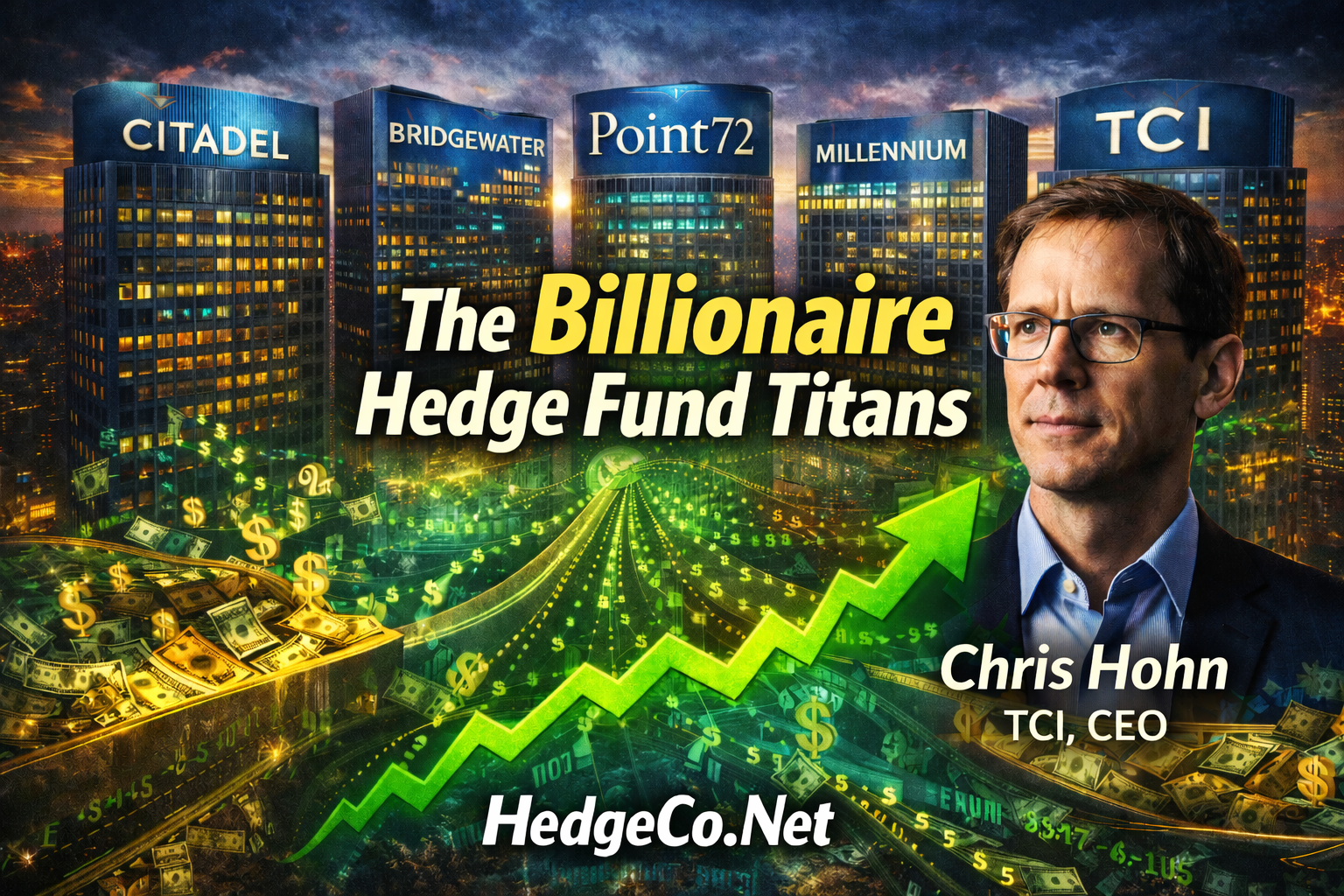
Among the standout performers was billionaire investor Chris Hohn, whose firm, TCI Fund Management, delivered $18.9 billion in profits for investors in 2025, the largest single-year gain ever recorded by a hedge fund.
The record-breaking performance of Hohn and other hedge fund giants underscores several important trends shaping the industry:
- The growing dominance of mega hedge funds managing tens of billions of dollars.
- The rise of concentrated high-conviction equity strategies.
- The increasing influence of macroeconomic and geopolitical forces on market performance.
- The widening gap between elite hedge funds and the rest of the industry.
Understanding this transformation requires a closer look at the world’s most powerful hedge fund managers, their investment strategies, and the structural forces reshaping the hedge fund industry.
The Rise of the Billionaire Hedge Fund Manager
The hedge fund industry began in the mid-20th century as a relatively small niche within asset management. Early hedge funds were designed to provide absolute returns regardless of market direction, often using leverage and short selling to hedge risk.
Over time, the industry evolved into a global ecosystem managing trillions of dollars. Hedge funds now employ a wide range of strategies, including:
- long-short equity investing
- quantitative trading
- macroeconomic speculation
- event-driven investing
- distressed debt strategies
At the center of this ecosystem stand a small group of elite hedge fund managers whose track records have attracted enormous amounts of institutional capital.
Many of these individuals have become billionaires through a combination of management fees, performance fees, and long-term investment success.
The most famous hedge fund managers include:
- Ken Griffin (Citadel)
- Ray Dalio (Bridgewater Associates)
- Izzy Englander (Millennium Management)
- David Shaw (D. E. Shaw)
- Steve Cohen (Point72)
- Chris Hohn (TCI Fund Management)
These individuals represent the upper tier of the hedge fund world, where firms often manage tens or even hundreds of billions of dollars.
Chris Hohn and the Record-Breaking Year
Among hedge fund managers, few stories have captured the industry’s attention like the remarkable performance of Chris Hohn’s TCI Fund Management.
In 2025, the firm generated $18.9 billion in profits for investors, surpassing the previous record set by Ken Griffin’s Citadel hedge fund in 2022.
The performance represented a historic milestone in hedge fund history.
TCI’s flagship fund delivered approximately 27% returns after fees, an extraordinary result given the fund’s large size and the challenging macroeconomic environment.
The firm manages roughly $77 billion in assets, making it one of the largest hedge funds in the world.
The scale of the profits highlights the power of concentrated investment strategies. Unlike many hedge funds that diversify across hundreds of positions, TCI is known for maintaining a relatively focused portfolio of high-conviction investments.
The Investment Strategy Behind the Success
Hohn’s investment approach differs significantly from the multi-strategy “pod shop” model that dominates much of the modern hedge fund industry.
Instead of employing dozens or hundreds of independent trading teams, TCI operates with a centralized investment structure. Hohn personally oversees the firm’s core investment decisions, maintaining tight control over portfolio construction.
This structure allows the firm to pursue large, concentrated investments in companies that Hohn believes possess strong competitive advantages.
Key characteristics of TCI’s strategy include:
Concentrated Equity Positions
TCI focuses on a relatively small number of companies with dominant market positions.
Long-Term Investment Horizon
Unlike many hedge funds that trade frequently, TCI often holds positions for several years.
Activist Engagement
The firm sometimes engages with corporate management teams to advocate for operational improvements.
Structural Industry Themes
TCI frequently invests in industries benefiting from long-term structural trends.
This combination of high conviction and disciplined portfolio management has produced exceptional results over the firm’s history.
Aerospace and Defense: A Winning Trade
One of the key drivers behind TCI’s record performance was its significant exposure to aerospace and defense companies.
The firm made major investments in companies such as:
- GE Aerospace
- Airbus
- Safran
These investments benefited from rising defense spending and increased demand for aerospace equipment amid geopolitical tensions.
Shares of several aerospace companies surged as governments around the world increased military spending in response to geopolitical conflicts.
This trend highlights the importance of geopolitical analysis in modern hedge fund strategies. Understanding how global political developments influence industries can create significant investment opportunities.
The Broader Hedge Fund Profit Boom
While TCI captured headlines, it was not the only hedge fund delivering impressive results.
Several other major hedge funds also produced substantial profits during the same period.
According to industry data, the top 20 hedge fund managers generated approximately $115 billion in gains for investors in 2025, reflecting one of the strongest years in the industry’s history.
Notable performers included:
- Bridgewater Associates
- D. E. Shaw
- Citadel
- Pershing Square
Bridgewater reportedly generated more than $15 billion in gains, while D. E. Shaw produced roughly $12.7 billion for investors.
These results illustrate the extraordinary scale of capital flowing through the hedge fund industry.
Citadel and the Legacy of Ken Griffin
Although TCI achieved the largest annual profit in 2025, Citadel remains the most profitable hedge fund in history.
Founded by billionaire investor Ken Griffin, Citadel has generated more than $90 billion in cumulative profits for investors since its inception.
Citadel operates one of the most sophisticated multi-strategy hedge fund platforms in the world, employing thousands of professionals across global trading desks.
The firm’s success is built on several pillars:
- advanced quantitative models
- massive computing infrastructure
- diversified trading strategies
- centralized risk management
Citadel’s flagship Wellington fund has delivered consistently strong returns for decades, cementing Griffin’s reputation as one of the most successful hedge fund managers of all time.
The Multi-Strategy Hedge Fund Model
Many of the largest hedge funds now operate using a multi-strategy structure.
This model, sometimes called the “pod shop,” involves dividing the firm into multiple independent trading teams, each responsible for specific investment strategies.
Examples include:
- Millennium Management
- Point72
- Citadel
- Balyasny Asset Management
Each team manages its own portfolio within strict risk limits set by the firm’s central risk management system.
This structure allows hedge funds to pursue a wide range of strategies simultaneously while maintaining tight control over overall portfolio risk.
The model has proven highly effective in generating consistent returns.
Institutional Investors Fuel the Growth
The rapid growth of mega hedge funds has been fueled by institutional investors.
Large pension funds, sovereign wealth funds, and endowments increasingly allocate capital to hedge funds as part of diversified portfolios.
Institutional investors are attracted to hedge funds for several reasons:
- diversification benefits
- access to sophisticated investment strategies
- potential for alpha generation
- risk management capabilities
As a result, many of the largest hedge funds now manage tens of billions of dollars.
This institutional capital has enabled hedge funds to expand their trading operations, technology infrastructure, and global presence.
Technology and the Quantitative Revolution
Technology has become one of the defining features of the modern hedge fund industry.
Quantitative hedge funds such as D. E. Shaw and Two Sigma rely heavily on advanced algorithms, machine learning models, and massive datasets to identify trading opportunities.
These firms employ teams of data scientists, mathematicians, and engineers alongside traditional investment professionals.
The rise of quantitative investing has transformed financial markets.
Trading decisions that once relied primarily on human judgment are now increasingly driven by complex algorithms analyzing vast amounts of data.
The Billionaire Lifestyle and Public Attention
The extraordinary wealth generated by hedge fund managers has also drawn significant public attention.
Many hedge fund billionaires have become prominent figures in business, philanthropy, and politics.
Chris Hohn, for example, is known for his substantial philanthropic contributions. Through his charitable foundation, he has donated billions of dollars to causes related to global health, climate change, and education.
Ken Griffin has also become one of the most influential philanthropists in the United States, donating hundreds of millions of dollars to universities, cultural institutions, and public initiatives.
Despite these philanthropic efforts, hedge fund managers often face criticism regarding income inequality and financial market practices.
Challenges Facing the Hedge Fund Industry
Despite recent success, the hedge fund industry faces several significant challenges.
Fee Pressure
Investors increasingly demand lower management and performance fees.
Competition from Passive Investing
Low-cost index funds continue to attract significant capital.
Market Efficiency
As markets become more efficient, generating consistent alpha becomes more difficult.
Regulatory Scrutiny
Hedge funds face increasing oversight from financial regulators.
These challenges have forced many hedge funds to adapt their strategies and business models.
The Future of Billionaire Hedge Funds
Looking ahead, the hedge fund industry is likely to remain a central component of global financial markets.
Several trends are likely to shape the industry’s future:
Continued Industry Consolidation
Large hedge funds will likely continue gaining market share.
Technology-Driven Investing
Artificial intelligence and machine learning will play increasingly important roles.
Growth of Alternative Data
Investment decisions will increasingly rely on unconventional data sources.
Expanding Institutional Demand
Institutional investors will continue allocating capital to hedge funds.
These developments suggest that billionaire hedge fund managers will remain powerful figures in global finance.
Conclusion: The Power of Elite Hedge Fund Managers
The record profits generated by hedge fund managers in recent years highlight the remarkable influence of the industry’s elite players.
Firms such as TCI, Citadel, Bridgewater, and D. E. Shaw are not merely investment funds—they are global financial institutions capable of shaping markets and influencing capital flows worldwide.
Chris Hohn’s record-breaking $18.9 billion profit in 2025 illustrates the extraordinary potential of disciplined, high-conviction investment strategies.
At the same time, the broader success of the hedge fund industry demonstrates the enduring demand for sophisticated investment strategies capable of navigating complex global markets.
As financial markets continue evolving, the world’s billionaire hedge fund managers will remain at the forefront of global investing—deploying capital, identifying opportunities, and redefining the boundaries of modern finance.