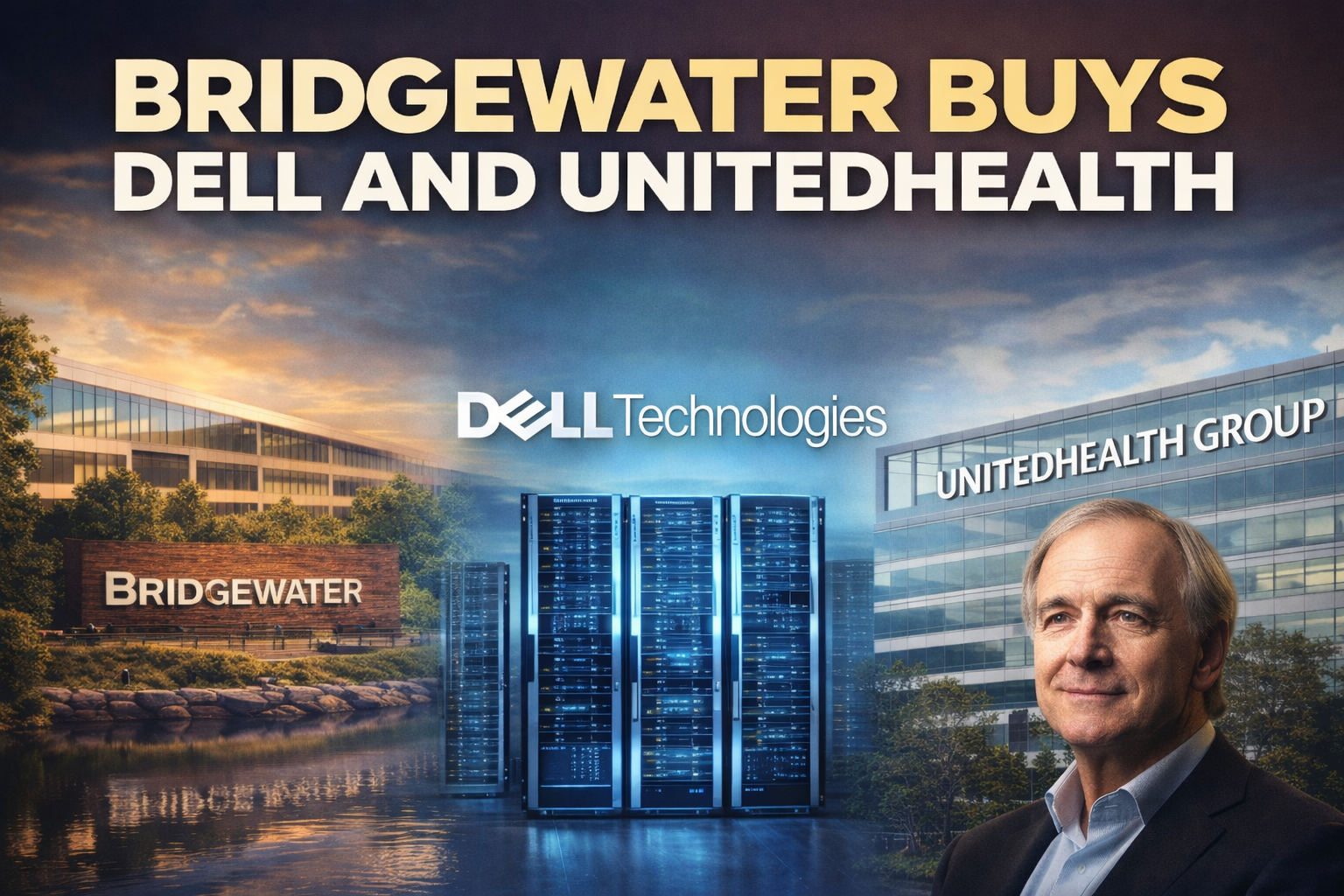
(HedgeCo.Net) When Bridgewater Associates adjusts its equity exposure, markets tend to pay attention—not because Bridgewater chases short-term performance, but because its positions often reflect deep macro judgments about where the global economy is headed. The firm’s recent purchases of Dell Technologies and UnitedHealth Group are a case in point.
At first glance, the two companies seem to have little in common. One is a legacy technology hardware and enterprise infrastructure provider. The other is the largest healthcare services and insurance company in the United States. But viewed through Bridgewater’s macro lens, the logic becomes clear. Together, these positions form a coherent statement about where resilience, cash flow stability, and structural demand will matter most in the next phase of the market cycle.
This is not a bet on momentum. It is a bet on durability.
Bridgewater’s philosophy: equities as macro expressions
Bridgewater’s approach to investing has always been fundamentally different from that of traditional equity managers. Founded by Ray Dalio, the firm built its reputation on the idea that economies function like machines—driven by credit cycles, productivity trends, monetary policy, and political constraints. Every asset, including equities, is viewed as a component within a larger system.
In this framework, stock positions are rarely about picking winners in isolation. Instead, they are vehicles for expressing macro views: inflation versus deflation, tightening versus easing financial conditions, growth versus stagnation, and stability versus fragility. When Bridgewater buys equities, it typically does so because those companies align with the firm’s assessment of the prevailing and upcoming economic regime.
That regime today looks very different from the one that dominated the 2010s and early 2020s.
A changed market regime: why durability now matters more than growth
For more than a decade, global markets were shaped by ultra-low interest rates, abundant liquidity, and aggressive monetary accommodation. That environment rewarded long-duration assets—particularly high-growth technology companies whose value lay far in the future. Capital was cheap, valuation discipline was loose, and momentum often mattered more than fundamentals.
That era is over.
Today’s market is defined by:
- Higher-for-longer interest rates, raising the cost of capital
- Persistent inflation risks, even if headline numbers fluctuate
- Geopolitical fragmentation, adding uncertainty to global supply chains
- Extreme valuation dispersion, particularly in technology and AI-linked stocks
In such an environment, the tolerance for earnings volatility shrinks. Companies dependent on cheap financing, optimistic forecasts, or perfect execution face greater downside risk. By contrast, businesses with recurring revenues, pricing power, and balance-sheet strength become increasingly valuable.
Bridgewater’s purchases of Dell and UnitedHealth fit squarely within this macro reality.
Dell Technologies: owning the backbone of the digital economy
Dell is not the most glamorous name in technology investing. It does not design cutting-edge AI models or dominate social media narratives. Instead, Dell operates in the background—building and supplying the physical infrastructurethat underpins modern computing.
That role is precisely what makes Dell attractive in a late-cycle, higher-rate environment.
Enterprise infrastructure as a structural necessity
Dell’s core businesses—enterprise servers, storage systems, networking equipment, and PCs—serve as the backbone of corporate IT environments. While discretionary software spending can be delayed or reduced during periods of uncertainty, spending on core infrastructure is far harder to defer. Companies may slow expansion, but they cannot allow critical systems to fail.
This creates a degree of revenue stability that many high-growth tech firms lack.
AI exposure without speculative valuation
One of the most important nuances in Bridgewater’s Dell position is how it captures AI exposure indirectly. As artificial intelligence workloads proliferate, demand for computing power, storage, and data-center infrastructure rises. Dell benefits from this trend without relying on speculative assumptions about AI adoption curves or future monetization models.
In other words, Dell participates in the AI build-out through hardware demand, not hype-driven narratives. For a macro fund wary of valuation excess, this distinction matters enormously.
Cash flow and capital discipline
Dell’s emphasis on cash generation, debt reduction, and shareholder returns stands in contrast to many growth-oriented technology firms that reinvest aggressively and depend on favorable capital markets. In a world where financing conditions are tighter, this discipline becomes a competitive advantage.
From Bridgewater’s perspective, Dell represents a way to remain invested in technological progress while anchoring exposure in tangible assets, recurring demand, and financial prudence.
UnitedHealth Group: healthcare as an anchor of stability
If Dell represents defensive exposure within technology, UnitedHealth represents something even more fundamental: economic inevitability.
Healthcare demand does not ebb and flow with consumer sentiment in the same way discretionary spending does. Aging populations, chronic disease prevalence, and ongoing medical needs create structural demand that persists across economic cycles.
UnitedHealth sits at the center of that system.
Demographics as a long-term tailwind
The aging of the U.S. population is one of the most powerful and predictable trends in the economy. As the population grows older, healthcare utilization increases, driving demand for insurance coverage, managed care, and medical services. UnitedHealth’s diversified platform is uniquely positioned to benefit from this trend over decades, not quarters.
Scale, data, and pricing power
UnitedHealth’s scale provides advantages that smaller competitors cannot easily replicate. Its ability to manage medical costs, negotiate provider pricing, and deploy data analytics helps protect margins even in periods of healthcare inflation. In a sector where costs are constantly under pressure, scale is not just an advantage—it is a necessity.
Defensive performance characteristics
Historically, healthcare stocks—and UnitedHealth in particular—have exhibited lower volatility and smaller drawdowns during market stress. For a macro-oriented portfolio, this makes UnitedHealth not only a return generator but also a risk stabilizer.
Bridgewater’s interest in UnitedHealth reflects a broader preference for assets that can perform reasonably well across a wide range of economic outcomes.
The unifying theme: resilience over narrative
What ties Dell and UnitedHealth together is not their industry, but their economic role. Both companies operate in areas of structural necessity. Both generate predictable cash flows. Both possess scale advantages. And both are less dependent on optimistic narratives or speculative valuation multiples.
This combination is precisely what tends to outperform in late-cycle or transitional environments—when markets become less forgiving and dispersion increases.
Bridgewater’s positioning suggests a belief that the next phase of equity returns will not be driven by broad market beta, but by selective exposure to businesses that can endure volatility and still compound value.
How this fits into broader hedge fund trends
Bridgewater’s moves are consistent with a wider shift across the hedge fund industry. Many of the largest funds are:
- Reducing exposure to crowded mega-cap growth trades
- Increasing allocations to healthcare, infrastructure, and defensive technology
- Emphasizing balance-sheet strength and cash-flow durability
- Preparing portfolios for higher volatility and greater dispersion
After years in which hedge funds struggled to keep pace with liquidity-fueled equity markets, the current environment plays more to their strengths. Dispersion, macro uncertainty, and valuation sensitivity create opportunities for disciplined, risk-aware strategies.
In that sense, Dell and UnitedHealth are not isolated bets. They are emblematic of a broader industry recalibration.
What Bridgewater’s move signals about its market outlook
Bridgewater’s purchases do not imply a wholesale retreat from equities. Rather, they suggest a more nuanced outlook: markets are likely to remain investable, but only for those willing to be selective.
Key signals embedded in this positioning include:
- An expectation of continued volatility, rather than a smooth upward trajectory
- A belief that fundamentals will matter more than narratives
- A preference for assets that can withstand multiple macro scenarios
This aligns closely with Bridgewater’s historical behavior during periods of economic transition. The firm tends to reduce reliance on momentum and increase exposure to assets that offer acceptable outcomes across a range of possibilities.
Implications for institutional investors
For allocators observing Bridgewater’s moves, the lesson is not necessarily to replicate the trades, but to understand the framework behind them.
In 2026 and beyond:
- Equity exposure should increasingly emphasize quality and durability
- Sector diversification will matter more as correlations shift
- Defensive positioning does not mean sacrificing returns—it means improving risk-adjusted outcomes
In an environment where drawdowns can materialize quickly, portfolios anchored in stable cash flows and structural demand may offer a smoother path through uncertainty.
The bottom line: resilience as the new source of alpha
Bridgewater’s decision to buy Dell and UnitedHealth is a reminder that investing success is often about adapting to changing conditions. As the global economy moves further away from the era of easy money and abundant liquidity, the sources of return are shifting.
In this new environment, resilience is becoming a form of alpha.
By allocating capital to companies grounded in structural demand, operational scale, and predictable earnings, the world’s largest hedge fund is signaling that the next phase of the market will reward durability over drama. For investors willing to look past headlines and hype, that message may prove invaluable in the years ahead.