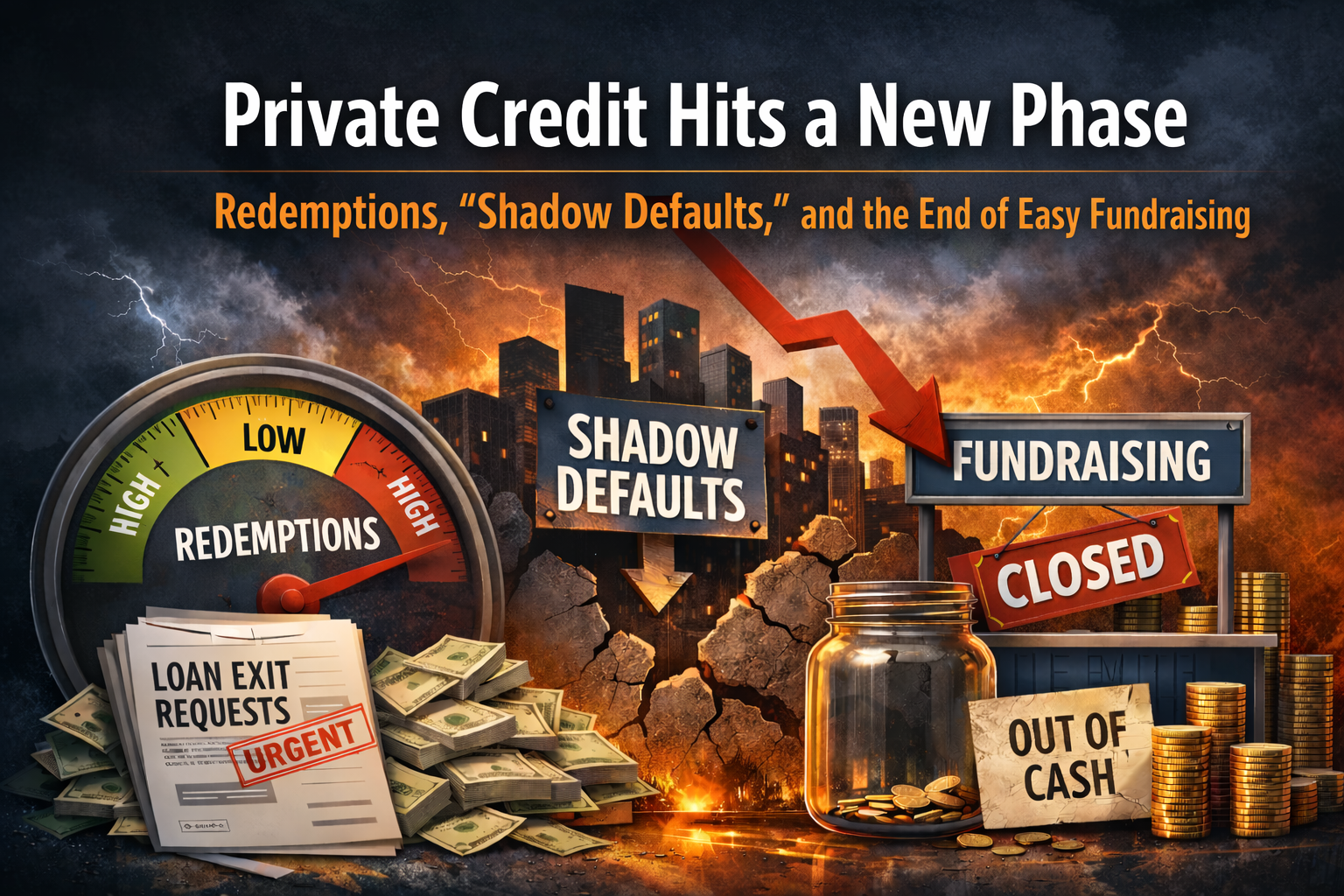
(HedgeCo.Net) After years of uninterrupted growth, U.S. private credit is confronting a defining test: investor liquidity demands colliding with loan workouts, extensions, and rising stress in the middle market. The private credit machine was built on a powerful promise: floating-rate income, low volatility, and lender control. But today’s storyline is that liquidity is no longer a theoretical risk—it’s showing up as real investor pressure in large vehicles tied to private credit (including publicly traded BDC structures) and as growing unease about restructurings that postpone recognition of losses.
This doesn’t mean private credit “breaks.” It means it matures—into a cycle where underwriting dispersion matters again, and where the weakest vintages are separated from the strongest platforms.
The three forces redefining the trade
1) The redemption reality check
When investors rush for the exits, the questions become immediate:
- What can you sell quickly?
- At what haircut?
- And does your fund structure match the liquidity expectations you implicitly sold?
Recent reporting highlights investor outflows and the tension this creates for vehicles that must balance income narratives with portfolio liquidity management.
2) “Shadow defaults” and extend-and-pretend risk
In a stressed environment, lenders and borrowers often prefer amendments: maturity extensions, covenant resets, PIK toggles, and payment holidays. That can be rational—but it also creates a gray zone where true credit deterioration is masked by restructuring optics. That’s the essence of the “shadow default” concern.
3) Fundraising becomes underwriting-led, not macro-led
For much of the last decade, private credit fundraising benefited from macro conditions (bank retrenchment, yield hunger, floating-rate appeal). In this phase, the fundraising pitch must prove:
- vintage discipline,
- workout expertise,
- sector selection,
- and portfolio concentration controls.
A real-time example of the platform advantage
Deals like Ares Management leading large direct-lending financings underscore that scaled managers can still command capital—especially when the underlying businesses are positioned as recession-resilient and the lender has structuring leverage.
But note what this signals: the market is rewarding platform underwriting + structuring, not generic exposure. The winners are those who can price risk correctly and manage downside when things go sideways.
What this means for 2026 allocations
- Expect a barbell: mega-platforms gaining share, while mid-tier lenders face tougher fundraising and higher scrutiny.
- Expect more secondaries: investors rebalancing private credit exposure without waiting for natural runoff.
- Expect more differentiation: sector expertise and workout track record become front-and-center.
Private credit isn’t “over.” It’s simply exiting its honeymoon period.