
(HedgeCo.Net) In the hierarchy of modern hedge funds, performance alone no longer tells the whole story—but it still sets the pecking order. And in the latest scorecard, Point72 has nudged ahead of its two most closely watched multi-strategy rivals, Citadel and Millennium, underscoring a broader reality: the multi-strategy “platform” model is not just surviving the post-zero-rate era—it’s thriving.
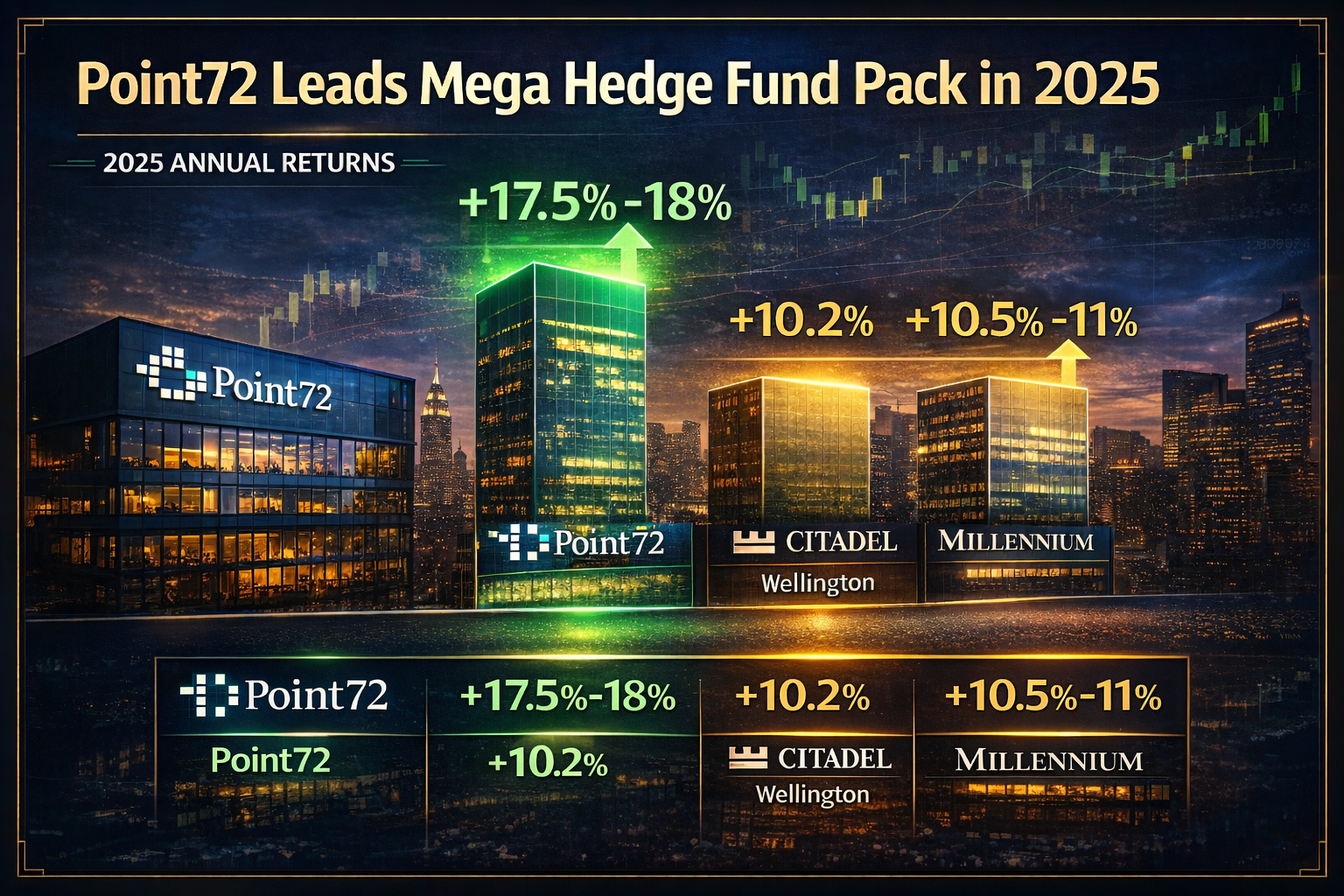
(HedgeCo.Net) Reports on 2025 results indicate Point72 finished the year in the high-teens (roughly 17.5%–18%), outpacing Citadel’s flagship Wellington (about 10.2%) and Millennium (about 10.5%–11%). The spread is meaningful: in a business where volatility is managed as carefully as return, a several-hundred-basis-point edge at this scale can translate into billions of dollars in incremental performance fees, stronger investor flows, and a recruiting flywheel that compounds competitive advantage.
But the deeper takeaway isn’t simply that Point72 “won” a single year. It’s what the outperformance says about where hedge fund alpha is being manufactured right now—and why multi-strategy funds, once criticized for their cost structures and organizational sprawl, are again being treated by allocators as a near-core portfolio allocation.
The 2025 backdrop: a market built for platforms
To understand why the multi-strategy complex has been soaring, you have to start with the environment. By several industry measures, 2025 was a notably strong year for hedge funds. Hedge Fund Research’s Fund Weighted Composite advanced +12.4% in 2025, its strongest calendar year since 2009, reflecting broad-based gains across strategies. Meanwhile, Reuters reported that top multi-manager and macro funds benefited from an AI-fueled equity rally and bursts of policy-driven volatility tied to trade and fiscal uncertainty.
This combination—persistent dispersion, episodic volatility, and crowded consensus trades that repeatedly broke down—creates an unusually fertile playing field for multi-strategy platforms. The reason is structural: these firms are built to monetize many different kinds of opportunity sets at once, shifting risk and capital toward what is working, while cutting exposures quickly when a pocket of the portfolio hits turbulence. In a single-manager model, you might be “right” on macro but “wrong” on equities and still lose the year. In a platform model, you can be wrong in several places and still produce a steady compounding profile—because the machine is designed to keep harvesting idiosyncratic edges wherever they appear.
Point72’s edge: same machine, sharper execution
Point72, Citadel, and Millennium all operate some variant of the “pod shop” architecture: teams (often called pods) run relatively independent books with tight risk limits; central risk management monitors exposures across the house; capital is reallocated dynamically; and underperforming risk is reduced with little sentimentality. It’s a model built for speed, diversification, and industrialized risk control—and it has become the dominant operating system of large hedge funds.
So why did Point72 come out ahead?
The best explanation is that the firm managed to align three elements more effectively than peers across the year:
- Better capture of equity and thematic dispersion. Multi-strategy platforms tend to excel when stock-level dispersion is high (winners and losers separate), because long/short teams can generate alpha without requiring the overall market to cooperate. Reuters explicitly pointed to market volatility and an AI-driven rally as conditions that supported strong hedge fund performance. Point72 has long had an equity-centric identity even as it expanded into a broader platform; in a year when tech and AI narratives repeatedly rewrote leadership, that heritage likely mattered.
- Tighter “loss discipline” at the pod level. The platform model’s defining feature is not just diversification—it’s stop-loss culture. Risk is cut quickly, and internal capital is treated as scarce. When executed well, this produces a smoother ride and fewer catastrophic drawdowns. When executed poorly, the organization can churn talent, rack up costs, and still underdeliver.
- More efficient capital allocation across pods. Capital allocation is the hidden art inside platforms. Two firms can employ the same pod framework and still deliver very different outcomes based on how quickly they scale what’s working, how they size factor exposures, and how they avoid correlated crowding. The 2025 leaderboard suggests Point72’s internal allocator function—how it moved risk through the year—was particularly effective.
It’s also worth noting that “beating Citadel and Millennium” doesn’t require those firms to have a bad year. A 10%–11% return can be an excellent outcome for a volatility-controlled strategy. But in a year where the broader hedge fund complex was strong, and where some competitors posted much larger gains, the gap highlights how competitive—and path-dependent—the platform game has become.
Citadel and Millennium: strong businesses, different year
Citadel’s Wellington fund returning around 10.2% and Millennium around 10.5% still reflect effective risk management and the ability to grind out returns in a complex macro regime. Citadel also reported stronger performance in some other strategies (for example, reports noted higher returns in certain non-flagship funds), which reinforces a key point: these are multi-engine firms, not one-product stories.
Millennium’s long-running franchise strength is similarly rooted in its architecture: a vast roster of teams, rigorous risk controls, and an institutional operating model that prioritizes consistency. Recent reporting also highlighted Millennium’s evolving corporate reality—such as a minority-stake transaction—another signal that the biggest platforms are increasingly being treated like enduring financial institutions rather than founder-driven partnerships.
In other words, Point72 outperforming does not imply structural weakness at rivals. It’s more accurate to say that 2025 rewarded a particular blend of exposures, allocator decisions, and execution quality—and Point72 happened to get that blend right more often.
Why multi-strategy funds are soaring (and why allocators keep coming back)
The allocator case for multi-strategy platforms has strengthened for five reasons:
1) They monetize dispersion, not direction.
Traditional long-biased strategies live and die by whether the market goes up. Platforms can generate returns in sideways markets if dispersion is high. That matters in an era where macro shocks, AI-driven business model disruption, and policy volatility repeatedly reshuffle winners and losers.
2) They are engineered for regime shifts.
When inflation, rates, and policy uncertainty whipsaw markets, a single-manager fund can be trapped in its house view. Platforms can redeploy risk across equities, credit, macro, quant, and relative value as regimes shift—often in weeks, not quarters.
3) They sell consistency—and investors are buying it again.
Institutional allocators have always prized “all-weather” return streams, but the last few years intensified the desire for strategies with lower drawdowns and steadier compounding. That dynamic has supported industry growth and renewed interest in platform exposure.
4) Scale has become a feature, not a bug.
The old critique was that hedge funds get worse as they get bigger. Multi-strategy platforms partially defy this because growth can add more independent strategies and better diversification, if managed well. Morgan Stanley noted that assets at multi-PM platforms increased from $185 billion (2019) to $350 billion (2023)—a stark measure of how quickly this segment institutionalized.
5) Talent markets increasingly favor platforms.
In today’s hedge fund labor market, pods offer portfolio managers a clear proposition: defined risk limits, deep infrastructure, and the ability to focus on trading rather than building a firm. That attracts high-output talent—and forces competitors to keep paying up to maintain their rosters. A recent industry discussion highlighted how the model’s “flywheel” works: performance brings assets, assets fund more teams and infrastructure, and that scale further reinforces competitiveness.
The cost controversy hasn’t disappeared—it’s just been outweighed
None of this erases the biggest critiques of the platform model: high fees, high operating costs, and the potential for “fee stacking” when expenses are passed through to investors. There’s also the cultural critique—pods can create internal competition rather than collaboration, leading to churn and short time horizons.
Yet the market keeps voting with capital. When platforms deliver, allocators tolerate the expense because the alternative—missing consistent, uncorrelated performance—can be more costly at the portfolio level. And 2025 reinforced the perception that platforms, particularly the best-run ones, are built to harvest alpha in exactly the kind of world investors believe we’re living in now: volatile, policy-driven, and increasingly shaped by technology shocks.
What this means for 2026: the “platform premium” is back
Early 2026 reporting suggested large hedge funds started the year positively, with Point72 among those posting gains in January—another small data point consistent with the idea that platforms remain positioned to take advantage of volatility and dispersion. Meanwhile, industry-wide January performance updates showed macro strategies leading and a strong start for hedge funds broadly, reflecting an opportunity-rich tape.
The bigger question isn’t whether Point72 can beat Citadel and Millennium every year—it won’t, and no platform does. The question is whether the platform model itself will continue to command a premium allocation in institutional portfolios.
Right now, all the structural forces point in that direction:
- Market structure continues to favor fast, multi-asset traders.
- Dispersion is sustained by technology disruption and uneven earnings resilience.
- Policy volatility injects macro-driven opportunity spikes across rates, FX, and commodities.
- Investors are increasingly skeptical of traditional “set-and-forget” diversification and are paying for strategies that can actively manage risk.
In that context, Point72’s 2025 outperformance reads less like a one-off headline and more like a signal: the multi-strategy arms race is intensifying, and execution—allocator judgment, risk management, and talent density—is separating winners inside the same overall model.
Point72 delivered the sharper year. Citadel and Millennium delivered solid ones. And the real “winner” may be the platform structure itself—an operating system built for a market that no longer behaves like the old playbook assumed.