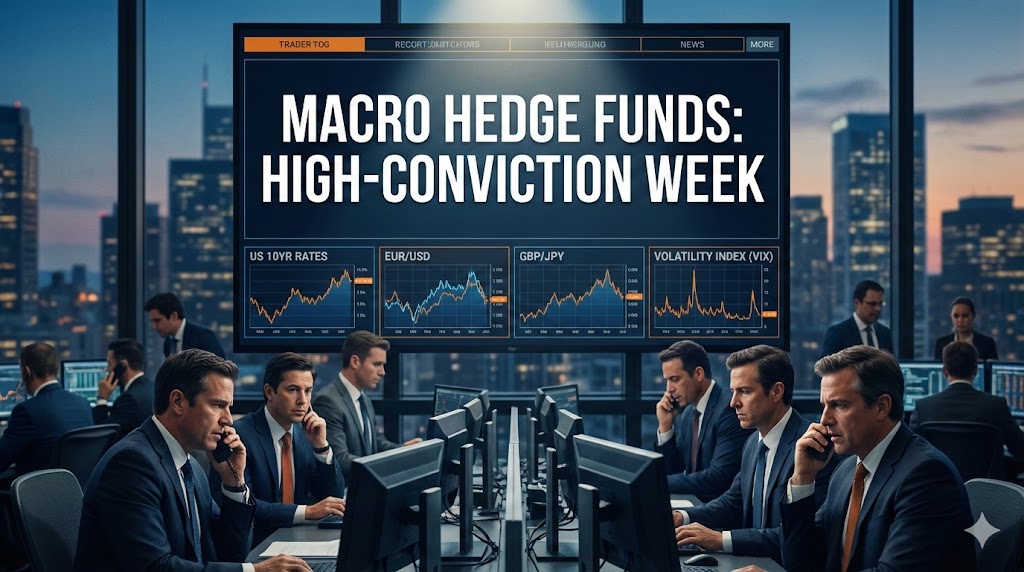
(HedgeCo.Net) As markets reopen Monday, global macro hedge funds are stepping into what feels like a high-conviction trading window—one defined by renewed rates volatility, fragile risk sentiment, and a widening gap between macro narratives and market pricing. After months of positioning around “soft landing” assumptions, macro desks are reassessing exposures as inflation persistence, fiscal stress, and AI-driven growth divergence collide.
For the largest macro hedge funds, this is not a week for passive exposure. It is a week for expression.
Rates: The Core Battlefield
Interest rates remain the central axis of macro risk. While central banks have signaled patience, markets are increasingly skeptical that policy easing will arrive cleanly or uniformly.
Macro funds are entering Monday focused on three questions:
- Is the front end mispriced?
Short-dated rate markets continue to oscillate between optimism and caution. Any recalibration of inflation expectations could trigger sharp repricing. - Does the long end reflect fiscal reality?
Sovereign issuance, deficit expansion, and term premium debates are back in focus. Large macro funds are increasingly expressing views through curve steepeners rather than outright duration bets. - Are cross-market correlations breaking down?
The historical link between rates and risk assets has weakened, creating tactical opportunities.
Managers at firms such as Bridgewater Associates and Brevan Howard are reportedly leaning into relative-value expressions rather than directional conviction—favoring optionality over binary calls.
FX: Policy Divergence Reasserts Itself
Foreign exchange is quietly re-emerging as a primary macro opportunity.
Diverging growth trajectories, asymmetric inflation paths, and uneven fiscal discipline are creating dispersion that FX-focused macro teams thrive on. Dollar strength is no longer a consensus trade, and macro funds are increasingly selective about where they express USD exposure.
Key themes for Monday:
- G10 divergence trades between commodity-linked currencies and structurally weaker economies
- Emerging market FX differentiation, particularly in countries with credible monetary policy
- Volatility harvesting, as FX options remain relatively cheap compared to macro uncertainty
For large macro platforms, FX is not just a return driver—it is a portfolio stabilizer as equity volatility remains regime-dependent.
Commodities and Energy: Structural, Not Cyclical
Energy and commodities are returning to macro relevance, not as inflation hedges alone, but as expressions of geopolitical risk and supply-side constraint.
Macro funds are closely watching:
- Energy supply discipline
- Industrial metals linked to AI infrastructure
- Agricultural volatility tied to climate disruption
Rather than chasing beta, macro PMs are structuring trades around supply asymmetry and policy risk, often through options or relative-value spreads.
Volatility Is Back in the Macro Toolbox
Perhaps the most important shift heading into Monday is how macro funds are treating volatility itself.
After years of volatility suppression, macro managers are once again long convexity—using options to position for tail risk without overcommitting capital.
This reflects a broader philosophical change: volatility is no longer something to hedge away. It is an asset.
Why This Monday Matters
Macro hedge funds thrive when narratives fracture and pricing lags reality. Heading into this week, those conditions are firmly in place.
This is not a crisis environment—but it is a recalibration environment. And for macro funds, recalibration is where alpha lives.