(HedgeCo.Net) The biggest story inside the U.S. hedge fund industry today is not a single blockbuster trade or quarterly return number. It is a structural repositioning underway at the largest hedge funds—firms managing tens or hundreds of billions of dollars that now dominate global trading, liquidity provision, and market microstructure.
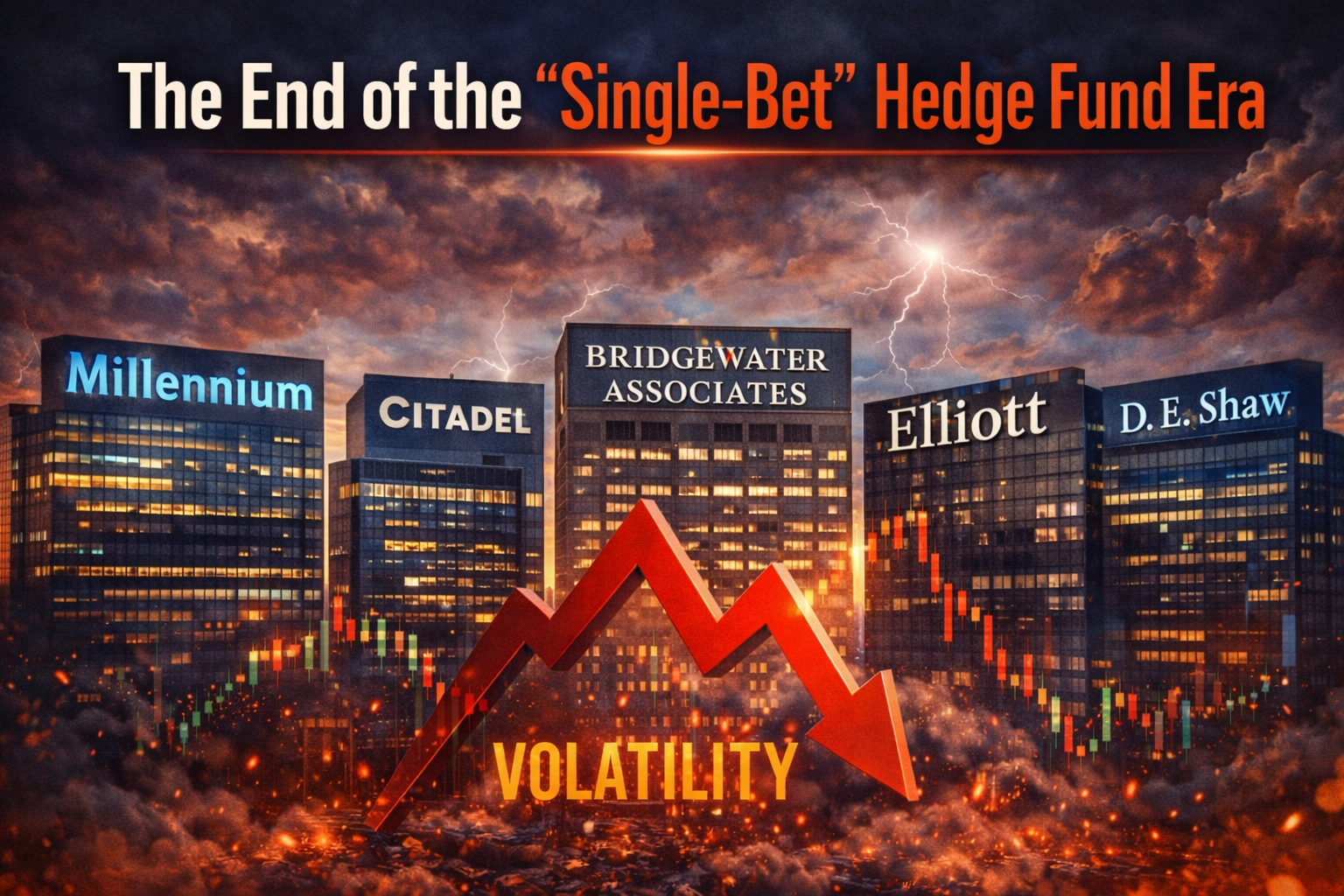
Firms such as Citadel, Millennium Management, Bridgewater Associates, D. E. Shaw, and Elliott Management are all responding to the same reality: 2026 is shaping up to be a year defined by volatility, narrative-driven markets, and rapid regime shifts across asset classes.
The result is a quiet but consequential evolution in how the largest hedge funds deploy capital, manage risk, and define competitive advantage.
The End of the “Single-Bet” Hedge Fund Era
One of the clearest trends inside the largest hedge funds today is the continued erosion of the old “star manager” model. In its place stands a platform-driven approach that emphasizes diversification of decision-making, tight risk limits, and constant capital reallocation.
Multi-strategy platforms—led by Citadel and Millennium—have turned hedge fund management into something closer to capital orchestration than traditional investing. Hundreds of portfolio managers operate within strict drawdown constraints, with capital flowing dynamically to strategies and teams that are performing right now, not those with reputational legacy.
This structure is increasingly influential across the industry. Even firms that historically relied on discretionary macro or concentrated equity bets are adopting elements of the platform model, recognizing that allocators now prioritize return consistency and downside control over headline-grabbing conviction trades.
Citadel: Volatility as a Feature, Not a Bug
Citadel remains the clearest example of how scale, technology, and structure can be weaponized in volatile markets. With thousands of employees across trading, research, technology, and execution, Citadel is less a hedge fund in the traditional sense and more a financial operating system.
In 2026, Citadel’s internal focus has sharpened around three priorities:
- Volatility monetization – Options, relative value, and short-horizon trading strategies thrive when dispersion is high.
- Cross-asset integration – Equity, fixed income, commodities, and macro desks are increasingly interconnected, allowing the firm to express views through the most efficient instrument.
- Relentless risk discipline – Capital is cut quickly when performance deteriorates, reinforcing a culture where survival precedes conviction.
Citadel’s positioning underscores a broader truth: in modern markets, speed and adaptability outperform narrative certainty.
Millennium Management: The Economics of Scale and Optionality
Millennium’s evolution mirrors Citadel’s in structure but differs in culture. Millennium is often described by allocators as a “manager of managers,” where the firm’s primary edge lies in capital allocation discipline rather than directional market insight.
What is trending today inside Millennium is an increased emphasis on:
- Shorter holding periods, reducing exposure to macro surprises
- Higher turnover strategies that thrive on micro-inefficiencies
- Aggressive pruning of underperforming teams, even in difficult market environments
In 2026, Millennium’s biggest advantage is not market foresight—it is optionality. The firm can rapidly pivot away from crowded trades, sectors facing narrative risk (such as parts of software or crypto-linked equities), and macro regimes that stop working.
For allocators, Millennium has become less about upside capture and more about portfolio ballast—a hedge fund designed to survive almost any market environment.
Bridgewater: Macro Relevance Returns in a Fragmented World
After years of skepticism about discretionary macro, 2026 is shaping up to be a reassertion of the strategy’s relevance—and Bridgewater is again central to that conversation.
Global macro conditions have become more complex, not less. Interest rates remain structurally higher. Fiscal policy is more active. Geopolitical risk is persistent rather than episodic. Currency volatility is no longer dormant.
Bridgewater’s renewed focus has been on regime identification rather than short-term forecasting. The firm’s research-driven approach—centered on understanding how inflation, growth, and policy interact—has gained renewed attention from institutional allocators seeking protection against equity and credit concentration.
What’s trending today is not a single Bridgewater trade, but a broader allocator reassessment: macro hedge funds are once again being viewed as core risk-management tools, not opportunistic satellites.
D. E. Shaw: Quant Discipline in a Noisy Market
In an environment dominated by headlines, sentiment swings, and narrative shocks, quant-driven hedge funds have quietly regained relevance. D. E. Shaw stands out as a firm that has consistently blended systematic rigor with discretionary judgment.
The firm’s current positioning reflects several industry-wide shifts:
- Greater use of alternative data, including non-traditional signals
- Shorter signal half-lives, requiring faster model adaptation
- Tighter correlation controls, as factor crowding becomes a persistent risk
What distinguishes D. E. Shaw in 2026 is not raw performance volatility but stability through chaos. While discretionary funds debate narratives, quant platforms increasingly trade behavioral patterns—how markets react, overreact, and revert.
For allocators fatigued by story-driven drawdowns, this discipline has renewed appeal.
Elliott Management: Activism in a Capital-Constrained World
While multi-strategy and quant funds dominate daily trading narratives, Elliott Management represents a different kind of hedge fund power—one rooted in time, influence, and capital structure expertise.
Elliott’s relevance in 2026 is tied to stress. Higher interest rates, refinancing challenges, and uneven economic growth are creating fertile ground for activist and event-driven strategies. Corporate balance sheets built for a zero-rate world are being tested, and Elliott thrives in these moments.
Current trends around Elliott include:
- Increased focus on credit and capital structure activism
- Longer-duration campaigns, reflecting complex negotiations
- Global reach, with activism no longer confined to U.S. equities
Elliott’s approach contrasts sharply with the high-frequency adaptability of platforms like Citadel—but both reflect a core hedge fund truth: control over outcomes matters more than market direction.
Risk Is the Product in 2026
Across the largest hedge funds, one theme dominates internal discussion: risk is no longer something to be minimized—it is something to be engineered.
Volatility, dispersion, and uncertainty are no longer viewed as temporary dislocations. They are structural features of modern markets driven by:
- Algorithmic trading and passive flows
- Rapid information diffusion
- Geopolitical fragmentation
- Policy uncertainty
The biggest hedge funds are responding by redesigning portfolios around resilience, not prediction. That means more hedges, more optionality, and fewer assumptions about stable correlations.
What Allocators Are Really Buying Today
When institutional investors allocate to the largest hedge funds in 2026, they are not primarily buying alpha. They are buying:
- Crisis management capability
- Liquidity under stress
- Behavioral discipline
- Operational robustness
Performance still matters—but consistency, transparency, and survival matter more.
This is why the largest hedge funds continue to gather assets even as smaller, more volatile funds struggle. Scale has become a competitive advantage, not a hindrance.
The Bottom Line
The biggest hedge funds in the United States are trending today not because of flashy trades, but because they are redefining what hedge funds are supposed to do in a structurally unstable world.
Citadel and Millennium are perfecting volatility-driven platforms. Bridgewater is reasserting macro’s relevance. D. E. Shaw is proving the durability of disciplined quant investing. Elliott is exploiting stress where others retreat.
Together, they reveal a simple truth about 2026:
Hedge funds are no longer just return engines—they are market infrastructure.