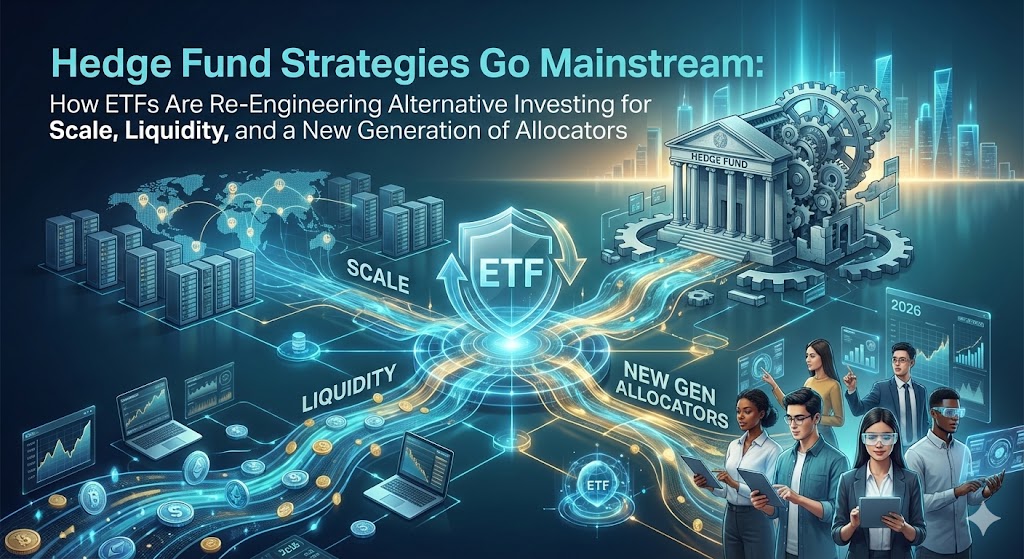
How ETFs Are Re-Engineering Alternative Investing for Scale, Liquidity, and a New Generation of Allocators
(HedgeCo.Net) For decades, hedge funds occupied a rarefied corner of global finance. They promised diversification, downside protection, and uncorrelated returns—but at a cost. High minimums, long lockups, opaque strategies, limited transparency, and complex operational requirements kept hedge funds firmly in the domain of institutions and ultra-wealthy investors.
That era is now undergoing a profound transformation.
In 2026, one of the most consequential trends in alternative investments is the migration of hedge-fund-style strategies into ETF wrappers. What was once exclusive is becoming accessible. What was illiquid is becoming tradable. And what was opaque is becoming systematic, transparent, and scalable.
This is not a marketing gimmick. It is a structural evolution—one that is redefining how investors access alternative risk premia, how asset managers package sophisticated strategies, and how portfolios are constructed in an increasingly volatile world.
The Pressure on the Traditional Hedge Fund Model
The hedge fund industry is not disappearing—but it is changing under pressure from multiple directions.
Performance dispersion has widened dramatically. While a handful of elite multi-strategy platforms continue to compound capital, many mid-tier hedge funds have struggled to justify fees relative to public markets. At the same time, allocators have become more sensitive to liquidity, transparency, and operational risk.
Regulatory scrutiny has increased. Operational due diligence standards have risen. And competition from private credit, private equity, and systematic strategies has intensified.
Against this backdrop, asset managers began asking a critical question: Can the core economic exposures of hedge funds be delivered more efficiently?
ETFs, long associated with passive investing, have become the answer.
From Alpha Mystique to Systematic Exposure
The rise of hedge-fund-style ETFs reflects a broader intellectual shift within finance: a recognition that much of hedge fund performance can be decomposed into identifiable, repeatable risk factors.
These include:
- Trend-following and time-series momentum
- Equity and credit carry
- Volatility harvesting
- Relative-value and statistical arbitrage
- Macro factor exposure across rates, FX, and commodities
While discretionary managers still matter, especially in complex or event-driven strategies, many hedge fund returns can be approximated using systematic models—executed with discipline, transparency, and risk controls.
ETFs provide an ideal vehicle for delivering these exposures at scale.
BlackRock and the Institutionalization of Liquid Alternatives
No firm has pushed this transition more decisively than BlackRock.
Through its systematic investing platform, BlackRock has launched a series of active ETFs designed to replicate hedge-fund-like outcomes—particularly absolute-return and market-neutral profiles—while maintaining daily liquidity and full regulatory oversight.
These funds blend multiple strategies, including:
- Systematic macro signals
- Dynamic asset allocation
- Volatility management
- Long/short factor exposures
The objective is not to “beat” hedge funds in raw returns, but to deliver risk-adjusted diversification—returns that behave differently from traditional equity and bond portfolios.
For allocators, this represents a powerful proposition: hedge-fund-style behavior without hedge-fund-style friction.
Why ETFs Are the Perfect Delivery Mechanism
ETFs solve several longstanding problems in alternative investing.
1. Liquidity Without Abandoning Discipline
Traditional hedge funds require lockups to protect strategy integrity. ETFs, by contrast, offer daily liquidity—yet most systematic strategies are naturally suited to liquid markets.
This makes ETFs particularly effective for macro, trend, factor, and relative-value strategies that trade futures, equities, and liquid derivatives.
2. Transparency and Risk Oversight
ETF structures require daily holdings disclosure or clear methodology descriptions, dramatically improving transparency compared with commingled hedge funds.
For institutional and wealth allocators alike, this reduces operational risk and improves portfolio-level risk management.
3. Cost Efficiency
ETF expense ratios are typically a fraction of hedge fund fees. While they may not capture idiosyncratic alpha, they often deliver similar diversification benefits at a much lower cost.
Advisors and the Democratization of Hedge Fund Exposure
Perhaps the most transformative impact of hedge-fund-style ETFs is occurring in the wealth-management channel.
Financial advisors have long recognized the value of alternatives—but faced practical barriers to implementation. Hedge fund subscriptions are operationally cumbersome, illiquid, and often unsuitable for client portfolios that require flexibility.
ETFs change that equation.
Advisors can now allocate to liquid alternatives alongside equities and bonds, rebalance portfolios dynamically, and explain exposures in plain language. This has accelerated adoption across model portfolios, retirement platforms, and private banks.
In effect, hedge fund strategies are no longer alternatives—they are becoming portfolio tools.
Not a Replacement—A Complement
It is critical to understand what hedge-fund-style ETFs are not.
They are not replacements for elite discretionary hedge funds with unique informational edges. They are not designed to exploit corporate actions, activism, or bespoke event-driven opportunities.
Instead, they occupy a different role: systematic diversification engines.
Many institutions now view ETFs as a first layer of alternatives exposure—providing broad diversification—while reserving capital for specialized hedge funds where true alpha potential justifies complexity and illiquidity.
This barbell approach is becoming increasingly common.
The Competitive Implications for Asset Managers
The rise of hedge-fund-style ETFs is reshaping competitive dynamics across the asset-management industry.
Scale Wins
Running sophisticated systematic strategies inside ETFs requires technology, data, and risk infrastructure. Large firms with global platforms are best positioned to compete.
Branding Matters
As hedge-fund-like products enter retail and advisor channels, brand trust becomes critical. Investors may not fully understand the strategies—but they trust the platform.
Fee Compression Accelerates
As systematic strategies become commoditized, fees will continue to fall. Managers must differentiate through execution quality, portfolio construction, and risk outcomes—not mystique.
Performance in a Volatile World
The appeal of hedge-fund-style ETFs is strongest during periods of macro uncertainty—precisely the environment investors face today.
Rising rates, geopolitical fragmentation, technological disruption, and shifting correlations have made traditional asset allocation less reliable. Investors are searching for strategies that can adapt dynamically, manage volatility, and perform across regimes.
Systematic macro and alternative-risk-premia ETFs are designed for exactly that purpose.
While returns may be more modest than headline-grabbing hedge fund winners, their consistency and diversification value are increasingly prized.
Regulatory Tailwinds and Structural Momentum
Regulators have quietly supported this evolution. ETFs offer standardized reporting, strong investor protections, and clear governance frameworks. Compared with opaque private vehicles, they fit neatly within modern regulatory regimes.
This alignment has accelerated approvals and encouraged further innovation—from interval funds to hybrid alternative vehicles that blend ETF liquidity with private-market exposure.
The result is a rapidly expanding universe of liquid alternatives.
A Redefined Hedge Fund Landscape
The hedge fund industry is not shrinking—it is splitting.
On one side are large, complex multi-strategy platforms that continue to dominate institutional alpha generation. On the other are systematic, rules-based strategies delivered efficiently through ETFs and similar vehicles.
Both models can coexist. In fact, they reinforce each other by clarifying what investors are truly paying for.
Alpha is becoming scarcer and more valuable. Beta-like hedge fund exposures are becoming cheaper and more accessible.
The Future of Alternatives Is Hybrid
Hedge-fund-style ETFs represent more than product innovation. They represent a philosophical shift in alternative investing—from exclusivity to efficiency, from opacity to structure, and from mystique to measurable outcomes.
In 2026, investors are no longer asking whether alternatives belong in portfolios. They are asking how to implement them intelligently.
ETFs are emerging as one of the most powerful answers.
Hedge fund strategies are no longer confined to gated vehicles and closed doors. They are entering the mainstream—reshaped for a new era where access, liquidity, and risk management matter as much as returns.