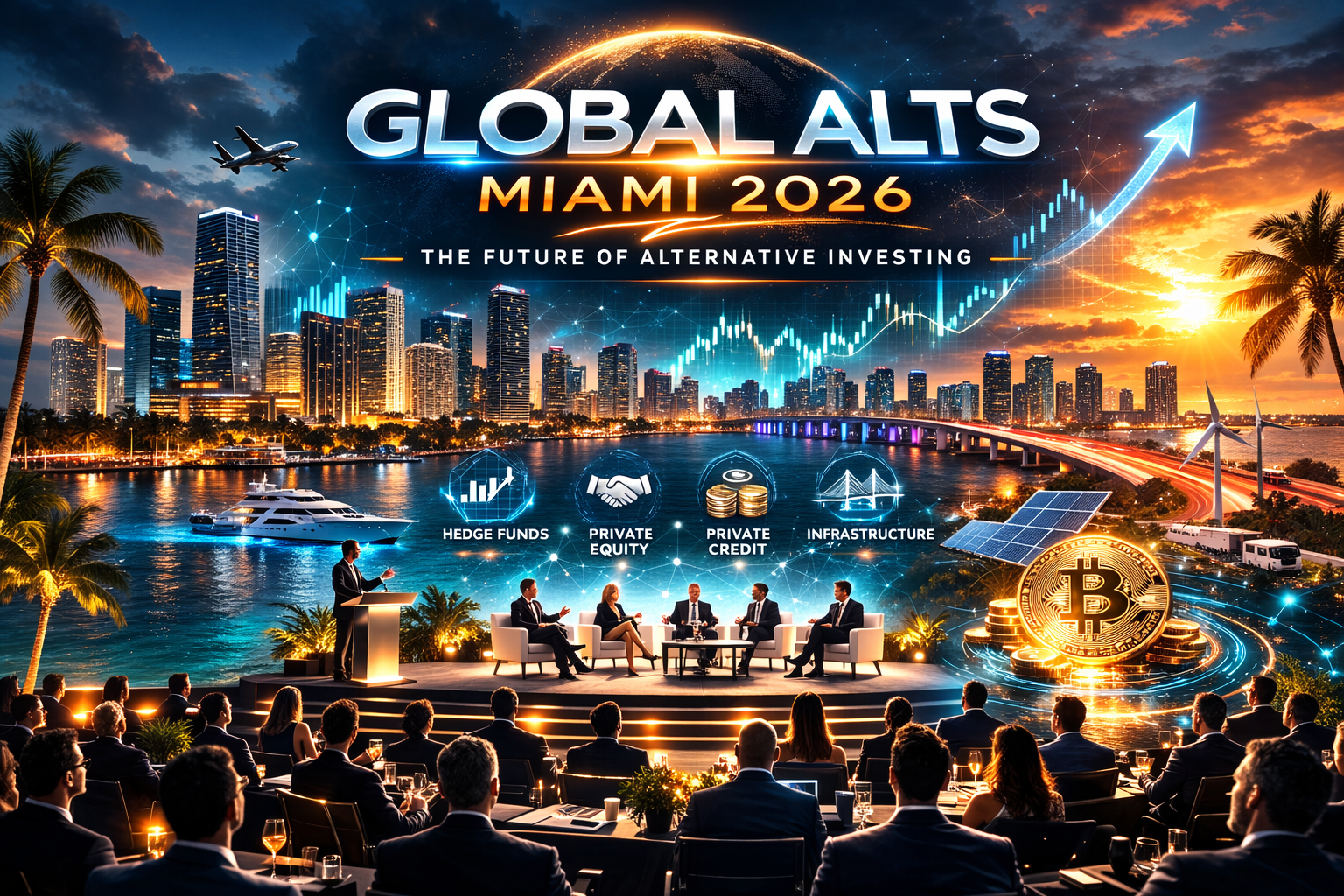
(HedgeCo.Net) Miami has become the capital of alternative investing—and Global Alts Miami 2026 confirmed why. As thousands of hedge fund managers, private equity executives, private credit specialists, institutional allocators, sovereign wealth funds, family offices, and fintech innovators converged on South Florida, this year’s Global Alts Miami conference marked a decisive moment for the industry. No longer a niche or cyclical allocation, alternatives are now the backbone of institutional portfolios—and the conversations in Miami reflected a market undergoing structural change rather than tactical adjustment.
Hosted by Managed Funds Association, Global Alts Miami has evolved into the industry’s most influential annual gathering. In 2026, the tone was unmistakably different: less about recovery, more about dominance, scale, and system-level importance.
A New Center of Gravity for Global Capital
Miami’s rise as an alternatives hub is no coincidence. Over the last five years, the city has attracted hedge funds, crypto firms, private equity offices, and multi-strategy platforms seeking regulatory flexibility, global connectivity, and talent mobility. Global Alts Miami 2026 captured that momentum in full.
Attendance reached record levels, with senior decision-makers—not just marketers or IR teams—dominating panels and closed-door sessions. CIOs, portfolio managers, risk chiefs, and founders used the conference to articulate how alternative assets are reshaping capital markets amid persistent volatility, geopolitical fragmentation, and technological disruption.
The message was clear: alternatives are no longer a hedge against the system—they are the system.
Scale, Permanence, and the End of the Boutique Era
One of the most consistent themes throughout the conference was scale. Whether discussing hedge funds, private credit, infrastructure, or multi-asset platforms, speakers emphasized that size is no longer optional—it is strategic.
Mega-managers described how scale enables:
- Superior access to deal flow
- Lower cost of capital
- Broader diversification across strategies and geographies
- Resilience during liquidity stress events
Smaller, single-strategy firms were notably candid about the challenges ahead. Many acknowledged that without differentiated alpha or niche expertise, survival increasingly depends on partnerships, platforms, or consolidation.
The era of the standalone boutique is giving way to the era of institutionalized alternatives.
Hedge Funds: From Tactical Traders to Market Infrastructure
Hedge funds were front and center at Global Alts Miami 2026, but the narrative has shifted. Instead of debating whether hedge funds “work,” allocators focused on how hedge funds now function within portfolios.
Key takeaways included:
- Multi-strategy platforms are viewed as core holdings, not opportunistic allocations
- Risk-controlled, market-neutral strategies are prized amid macro uncertainty
- Talent density and internal capital markets are decisive advantages
Several large hedge fund leaders framed their firms less as trading vehicles and more as risk-management institutions—designed to absorb volatility, intermediate liquidity, and deploy capital dynamically across regimes.
For allocators, the appeal is stability: consistent returns, lower drawdowns, and institutional governance at scale.
Private Credit: Growth Engine Under Scrutiny
Private credit remained one of the most discussed—and scrutinized—asset classes at the conference. While fundraising momentum remains strong, panels reflected a more nuanced, sober tone than in prior years.
Industry leaders acknowledged:
- Increased dispersion between top-tier and marginal lenders
- Rising borrower stress in select sectors
- Greater emphasis on covenant quality, structure, and downside protection
Rather than retreat, large credit managers framed 2026 as a year of selectivity, not contraction. Many argued that volatility creates opportunity for well-capitalized lenders with permanent capital and disciplined underwriting frameworks.
Importantly, allocators signaled that private credit allocations are becoming more sophisticated—favoring managers with scale, workout expertise, and the ability to navigate restructurings if needed.
Private Equity Repositions for a Higher-Rate World
Private equity conversations in Miami centered on adaptation. The easy-money era is definitively over, and buyout firms are recalibrating strategies accordingly.
Recurring themes included:
- Greater focus on operational value creation
- Longer hold periods
- Increased use of structured equity and hybrid capital
- Expansion into infrastructure, energy transition, and data-driven assets
Several sponsors emphasized that returns going forward will be earned—not engineered. Financial leverage is no longer the primary driver; execution, pricing power, and resilience matter more than ever.
Despite challenges, confidence remained high among top-tier firms, particularly those with diversified platforms and global reach.
Technology, AI, and the Redefinition of Edge
Artificial intelligence was omnipresent at Global Alts Miami 2026—but not in a hype-driven way. Discussions focused on how AI is already reshaping underwriting, trading, risk management, and portfolio construction.
Use cases highlighted included:
- Real-time risk aggregation across multi-strategy platforms
- Predictive analytics in private credit underwriting
- AI-driven operational improvements in portfolio companies
- Enhanced compliance and surveillance systems
Rather than replacing investment judgment, speakers emphasized that AI amplifies scale and speed—reinforcing advantages for firms with deep data, capital, and talent pools.
Allocators Speak: Alternatives Are No Longer Optional
Perhaps the most consequential voices at the conference were allocators themselves. Pension funds, endowments, insurers, and family offices were remarkably aligned in their messaging.
Key allocator perspectives:
- Alternatives are now foundational, not tactical
- Portfolio construction is shifting from asset classes to outcomes
- Liquidity management and transparency are critical selection criteria
- Manager selection increasingly favors platforms over products
One allocator summarized the mood succinctly: “We don’t ask whether to allocate to alternatives anymore. We ask whether we can afford not to.”
Miami as the Industry’s Symbolic Capital
Beyond panels and presentations, Global Alts Miami 2026 reinforced Miami’s symbolic role in the evolution of finance. The city represents flexibility, globalization, and a break from legacy financial centers—mirroring the transformation underway in alternative investing itself.
As capital becomes more mobile, strategies more complex, and markets more interconnected, Miami’s rise reflects the industry’s broader realignment toward agility and global reach.
Conclusion: A Defining Moment for Alternative Investments
Global Alts Miami 2026 was not just another industry conference—it was a statement of maturity.
The alternatives industry has entered a new phase defined by:
- Institutional scale
- Permanent capital
- Technological integration
- Systemic importance
What once sat at the margins of portfolios now anchors them. What once promised diversification now delivers infrastructure-level stability. And what once chased opportunity now defines it.
For investors, managers, and allocators alike, the message from Miami was unmistakable:
Alternative investments are no longer the future of finance. They are its prese