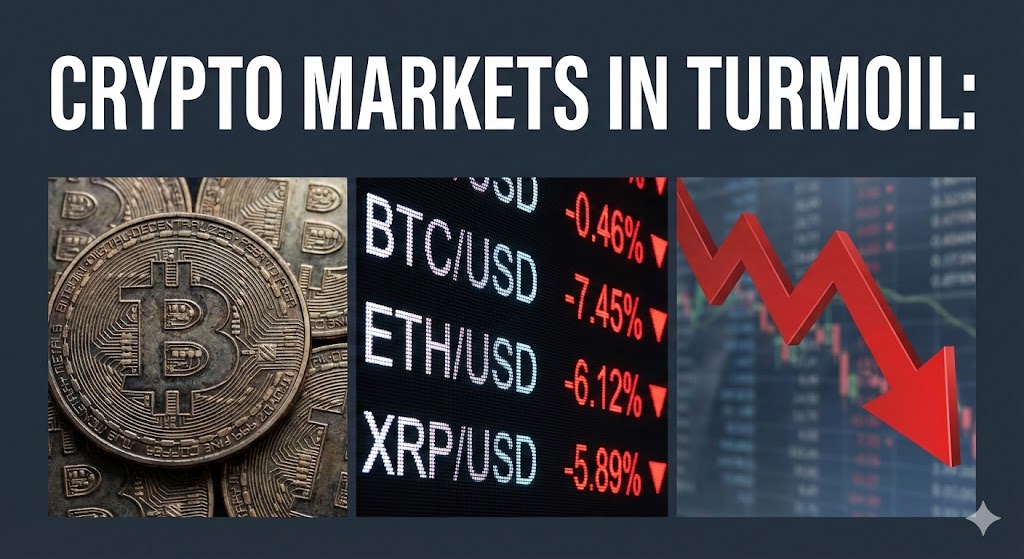
(HedgeCo.Net) Cryptocurrencies are experiencing one of the most volatile periods in months in early February 2026. Despite earlier rebounds, bitcoin and the broader market are slipping back, price volatility is accelerating, and macro data-linked traders are increasingly cautious. However, on-chain data shows large holders returning, meme and niche tokens outperform, and regulatory uncertainty is shaping sentiment. This article digs into price dynamics, market structure drivers, institutional flows, and key catalysts to watch next.
1. Market Context — A Fragile Rally Fades into Renewed Selloff
At the center of current market debates is bitcoin’s price trajectory. After a period of sharp rebound that briefly lifted BTC above $70,000, prices have slipped back below key psychological levels this week. Data from major exchange markets indicates BTC trading down roughly 2.8 % over 24 hours on February 11, dipping below the $68,000 mark in real-time market bids — reflecting renewed selling pressure from short-term traders and risk-off sentiment.
This comes amid a broader backdrop where bitcoin and other major assets have struggled to sustain gains. Earlier in the week, BTC briefly traded below $70,000 as investors digested key U.S. economic data and brace for upcoming inflation and jobs reporting — classic “risk-off” trading triggers.
Ether (ETH) and other Layer-1 assets have mirrored this weak performance — with ETH down notably while some meme and speculative tokens buck the trend.
2. The Technical Picture: Rangebound, Not Broken — Yet
From a technical perspective, bitcoin’s recent price action paints a picture of consolidation rather than outright collapse:
- Support levels near $65k–$68k have been tested repeatedly.
- Technical models suggest BTC is in a rangebound regime, fluctuating between $60k support and mid-$70k resistance, with institutional flows providing intermittent support.
- Derivative market data shows long positions being reduced by professional traders, signaling caution among leveraged players.
This divergence between institutional demand and derivatives trader behavior is critical: while whale wallets and institutions absorb dips, tactical traders are de-risking in the short term.
3. On-Chain Signals: Whales Accumulate, Shorts Decline
Despite price weakness, behavioral on-chain metrics suggest a structural narrative that isn’t purely bearish:
? Whale Accumulation Resumes
Large BTC holders — often referred to as “whales” — have been net buyers in recent weeks, accumulating tens of thousands of coins. This activity is among the largest such buying sprees seen since late 2025, occurring as smaller retail investors and momentum traders retreat.
Whale accumulation historically signals two potential outcomes:
- Long-term conviction from deep liquidity participants.
- Reduced exchange supply, which can support price stability later.
? Exchange Outflows and Liquidity Behavior
Separate market observations point to increased exchange outflows, especially for Ethereum — a trend tied to staking behavior and long-term holding rather than immediate trading. This dynamic can tighten available supply temporarily, supporting price floors even as markets trade lower.
4. Altcoins & Niche Winners: Not All Tokens Move Together
In an otherwise subdued market, certain tokens are bucking the downtrend:
- Memecoins and highly speculative assets have shown relative strength, with some indices indicating gains while BTC and ETH languish.
- Projects with specific growth narratives or upcoming events — including social-driven catalysts — are keeping segments of the market active.
Most notably, traders are watching XRP price behavior and event cadence around community-focused initiatives to see whether renewed engagement lifts sentiment after a period of altcoin decline.
5. Macro & Regulated Flows: Impacts on Crypto Sentiment
Beyond price charts and blockchain data, broader market forces are shaping sentiment:
- Risk-off sentiment in equities and tech typically correlates with selling pressure in crypto.
- Institutional flows — such as net inflows into spot BTC ETFs — suggest differentiated demand behavior: mainstream institutional capital is accumulating while leveraged retail bets unwind.
- Regulatory noise and policy uncertainty — especially concerning stablecoin yields and banking integration — continue to weigh on risk assets.
In this context, institutional players view crypto more as a macro asset class that interacts with equities, rates, and FX — rather than a pure speculative playground.
6. A Deeper Look at Price Drivers
? Psychological Levels Matter
BTC’s ability (or inability) to hold $68k–$70k is crucial. This range has become a psychological pivot zone where volatility spikes, institutional orders cluster, and derivatives traders adjust positioning.
? Spot ETF Inflows
Despite price weakness, spot ETF inflows into BTC products continue to rise in cumulative net asset value. This indicates that some institutional capital is already positioning for medium-term strength even as short-term volatility persists.
? Altcoin Correlation Patterns
Most altcoins remain highly correlated with BTC direction in the current environment. However, the strength in select speculative or narrative coins suggests a bifurcation: macro correlated risk assets vs. idiosyncratic attention tokens.
7. Where We Go From Here: Markets, Sentiment, and Strategy
What’s next hinges on a few core catalysts:
- Ongoing policy signals from U.S. regulators and central bank data releases.
- Macro risk appetite tied to equities, rates, and global liquidity conditions.
- Realized demand from institutional holders versus retail exit dynamics.
In short, crypto markets remain in a high-uncertainty phase where tactical trading dominates near-term price action, but structural buying from deep players points to asymmetrical potential outcomes.
Concluding Thought
This isn’t simply a bearish selloff. What we’re witnessing is a rotation of behavior — short-term leveraged traders exiting, while deep-pocketed holders and institutions build positions. If macro risks abate and risk assets stabilize, the current price ranges could become a launching pad for a renewed uptrend later in 2026.
Article 2 — Regulation Gridlock, Policy Turf Wars & Market Structure: The Crypto Policy Narrative Shaping Price and Adoption in 2026
Summary:
Beyond price moves, the policy and institutional environment for crypto in 2026 is equally consequential. This article explores how regulatory uncertainty, stablecoin policy debates, TradFi vs. DeFi sector friction, and broader public sector engagement are shaping market sentiment. These developments — not price charts alone — are increasingly driving allocation decisions from institutional capital and risk models for retail as well.
1. White House Crypto Roundtables: Policy Meets Politics
One of the most significant developments this week was a high-profile working session at the White House that brought together central banking officials, traditional banking interests, and crypto industry representatives to discuss a legislative framework for stablecoins and digital assets.
Unlike previous meetings where crypto firms set the agenda, banker adversaries in this session resisted engagement around key industry priorities — notably around stablecoin yield programs and decentralized finance (DeFi) integration. This marks a notable shift in how policymakers view the political economy of crypto adoption: not as a fringe technology, but as a contested space where incumbents are actively shaping regulatory outcomes.
Stablecoin yield programs — mechanisms that allow holders to earn interest — have become a focal point of debate. Banking lobbies argue they present risks to financial stability, while industry advocates view them as fundamental to crypto’s ongoing integration into mainstream finance.
2. TradFi vs. DeFi: The Policy Dance That Will Define 2026
This White House session reflects a deeper tension: TradFi institutional interests versus decentralized finance advocates. Traditional banking groups want to see crypto integrate through regulated intermediaries, whereas DeFi proponents argue for native blockchain protocols that reduce reliance on legacy infrastructure.
This tension plays out in several tangible ways:
- Regulatory frameworks that govern custody, settlement, and real-world asset tokenization.
- Taxation and reporting regimes around digital asset holdings.
- Stablecoin yield and banking interface rules — which could transform or stall DeFi yield offerings depending on legislative outcomes.
Rather than being an abstract policy fight, these are economic incentives that directly affect liquidity providers, exchange operators, and yield farmers.
*3. XRP as a Case Study: Policy Stalling Sentiment, ETF Dynamics
The token XRP offers a live case study of how policy impacts price and sentiment. Recent market behavior shows XRP snapping a brief winning streak as broader markets weakened and policy optimism stalled due to the lack of legislative progress around crypto market structure.
Even after a two-day positive price move, XRP faced downward pressure when talks failed to render clear pathways for stablecoin yield frameworks or comprehensive legislation. This highlights a core dynamic in today’s market: crypto prices are now highly sensitive to political and policy clarity — nearly as much as to pure technical or on-chain fundamentals.
4. International and Cross-Border Dynamics: A Global Chessboard
While U.S. policy discussions set large-scale narrative framing, global developments continue to shift adoption landscapes:
- Asian regulators (e.g., Hong Kong) are actively opening markets to perpetual contracts and regulated derivatives— drawing capital flows from other jurisdictions.
- Europe and Canada are expanding crypto ETF products, offering broader institutional access, which could dilute U.S. dominance in market liquidity and pricing benchmarks.
These cross-border flows matter because regulated access frameworks often dictate where institutional capital can deploy large sums with risk controls.
5. Real-World Banking Integration: The Strategic Reserve and Macro Considerations
Emerging policy narratives also include proposals — some bipartisan — aimed at establishing national strategic crypto reserves or embedding digital assets into public sector balance sheet planning. Discussions around such frameworks suggest potential future scenarios where central governments hold digital asset positions not just for speculative reasons, but as macro-economic policy tools and strategic risk assets.
Whether these forward-looking concepts mature into legislation this year remains uncertain. But their very existence is reshaping how institutional allocators think about long-term risk premiums, inter-market correlations, and portfolio diversification.
6. Enforcement, Compliance & Legal Risk: The New Baseline
One less-discussed but critical dimension is compliance enforcement. Agencies are tightening scrutiny around AML/KYC, securities law compliance, and exchange reporting standards. As enforcement actions rise, firms and custodians face increased legal risk — which in turn affects liquidity provisioning and capital commitments.
Recent market moves reflect not just fear of price drops, but fear of legal tightening without clear frameworks — causing institutions to adopt more cautious postures.
7. Public Adoption vs. Institutional Hesitation
Retail crypto adoption numbers remain strong compared with early 2020s levels. However, institutional participation is now bifurcated:
- Long-term allocators are hunting for regulated product exposures (spot ETFs, custody solutions) but increasingly demand policy risk premiums in return.
- Short-term tactical traders are highly sensitive to macro data releases, interest rate expectations, and derivatives sentiment.
This landscape is evolving where price direction is less “pure crypto” and more a function of macro risk, policy clarity, and cross-market liquidity dynamics.
8. The Coming Regulatory Inflection Points
Looking forward, key policy milestones that could materially affect the market trajectory in 2026 include:
- Legislative action on stablecoin frameworks and yield products.
- Central bank digital currency (CBDC) policy integration and differentiation from decentralized stablecoins.
- Regulatory clarity on smart contract legal status, DeFi custody rules, and cross-border settlement protocols.
Each represents not just a legal milestone, but a liquidity and capital market shift.
9. Conclusion: Between Policy Paralysis and Strategic Opportunity
Crypto’s present narrative is not simply about price charts. It’s increasingly about who writes the operating rules for the next decade.
- Markets are reacting to regulatory ambiguity and TradFi-DeFi friction.
- Institutional capital is demanding policy certainty before deploying large pools into longer-term bets.
- Price action reflects a composite of investor risk tolerance, macro economic inputs, and legislative stalemate.
As 2026 unfolds, understanding crypto will require not just reading charts, but deciphering policy jockeying, cross-border capital flows, and global regulatory agendas.
This is the era where policy earns its weighting in risk models — and crypto investors who integrate that lens will hold an informational edge in navigating what comes next.