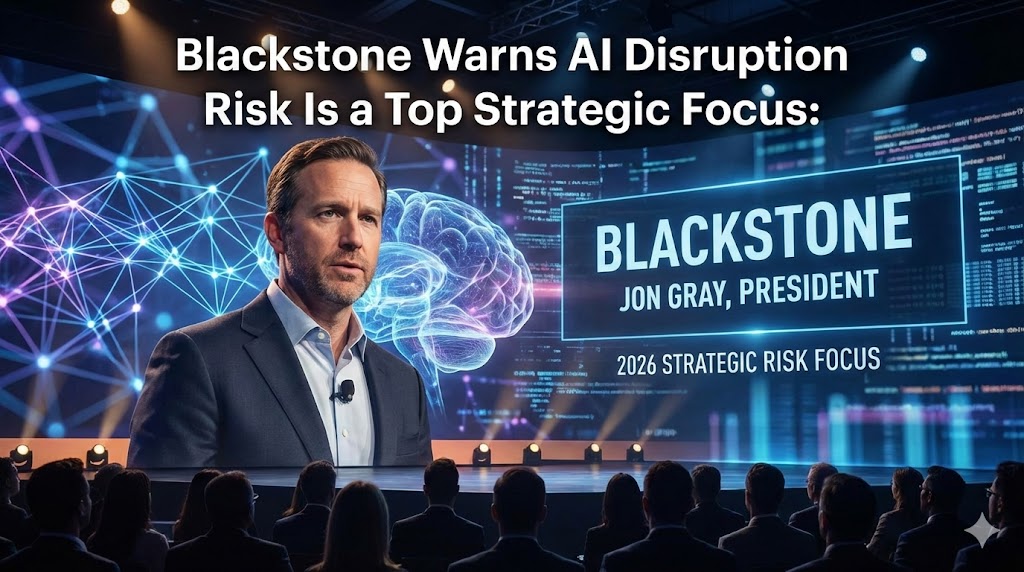
(HedgeCo.Net) When the world’s largest alternative asset manager talks about risk, markets tend to listen. So when Blackstone Inc.president Jon Gray publicly framed artificial intelligence as a top strategic risk consideration—not just an opportunity—it marked a subtle but important shift in how the private-markets industry is thinking about AI in 2026.
Blackstone is not stepping back from AI. Quite the opposite. The firm is one of the largest global investors in data centers, power infrastructure, and digital real assets that underpin the AI boom. But Gray’s warning makes clear that AI is a dual-use force: a powerful engine of capital deployment on one side, and a destabilizing shock to established business models on the other. For a firm with nearly $1 trillion in assets spanning private equity, real estate, credit, and infrastructure, understanding where AI destroys value is now just as important as identifying where it creates it.
AI as a risk factor, not just a growth story
For much of the past two years, AI has been framed almost exclusively as an upside narrative in markets. Productivity gains, margin expansion, and new demand curves have dominated investor presentations and earnings calls. Public equities rewarded perceived “AI winners,” while private capital poured into anything linked to compute, data, or automation.
Blackstone’s message introduces a more mature framing: AI is not sector-neutral. Its economic impact will be uneven, and in some cases, deeply disruptive.
Jon Gray highlighted industries such as auto insurance and collision repair as examples where AI-driven changes could fundamentally alter cost structures, claims behavior, and long-term profitability. That is not a theoretical concern. Advances in driver-assistance systems, autonomous features, and AI-enabled risk modeling are already changing accident frequency, repair complexity, and underwriting assumptions.
For a diversified alternative manager, this matters because AI disruption shows up in multiple parts of the capital stack. It affects equity valuations, credit risk, real-asset utilization, and even long-dated infrastructure assumptions. A portfolio that ignores second-order effects risks being blindsided.
Auto insurance and collision repair: a case study in AI disruption
Why single out auto insurance and collision repair? Because they illustrate how AI can simultaneously reduce and redistribute risk.
On one hand, AI-enabled safety systems promise fewer accidents over time. That sounds positive—until you consider what it means for insurers whose pricing models depend on historical loss frequency, or for collision-repair businesses whose volumes are tied directly to accident rates.
On the other hand, when accidents do occur, they are becoming more expensive to fix. Vehicles embedded with sensors, cameras, and software require specialized repairs, recalibration, and proprietary parts. AI reduces frequency but increases severity, reshaping economics in unpredictable ways.
For investors like Blackstone, which may have exposure through private equity holdings, credit portfolios, or real estate tied to service networks, this creates a complex risk profile. Cash flows that once looked stable can become volatile. Competitive moats can erode faster than expected. What was once a defensive, cash-generative sector can turn into a restructuring story.
Gray’s warning signals that Blackstone is actively stress-testing these dynamics across portfolios, rather than assuming AI is a blanket positive.
The paradox at the heart of Blackstone’s AI strategy
At first glance, there appears to be a contradiction in Blackstone’s stance. How can AI be a top risk while also being a core investment theme?
The answer lies in where Blackstone is choosing to express its AI exposure.
Rather than betting heavily on application-layer winners—where competition, regulation, and technological obsolescence are hardest to predict—Blackstone has leaned into the “picks and shovels” of the AI economy: data centers, power generation, transmission, cooling infrastructure, and digital real estate.
These assets benefit from AI adoption regardless of which software models or platforms ultimately win. Training and running AI systems is extraordinarily energy-intensive. Compute demand scales exponentially. Physical infrastructure becomes the bottleneck.
From Blackstone’s perspective, owning the underlying rails of the AI economy offers a more durable risk-return profile than chasing thematic equity upside. At the same time, that strategy does not immunize the rest of the portfolio from AI’s disruptive force—which is why risk management has moved to the foreground.
AI and private equity: margin expansion or margin erosion?
In private equity, AI has been widely marketed as a tool for margin expansion—automating workflows, improving pricing, optimizing supply chains, and accelerating growth. Those benefits are real, but they are not evenly distributed.
For some portfolio companies, AI adoption will be a source of competitive advantage. For others, it will be table stakes that simply prevent decline. And for a subset, AI may actively undermine the core business model.
Blackstone’s focus on AI risk suggests heightened scrutiny of traditional PE assumptions. Value-creation plans built on labor arbitrage, incremental efficiency, or modest digital upgrades may no longer be sufficient. If AI reshapes customer behavior or eliminates intermediaries, entire investment theses can be invalidated.
This is particularly relevant in service-heavy sectors—insurance, logistics, professional services, and parts of healthcare—where AI can compress margins by shifting power toward data owners and platform providers.
Credit portfolios feel AI risk differently
In private credit, AI disruption presents a different challenge. Credit investors are less concerned with upside optionality and more focused on downside protection and cash-flow durability.
If AI alters revenue stability, cost structures, or capital intensity, it can weaken debt-service capacity long before equity investors fully recognize the problem. A business that looks stable on historical metrics may face a rapid inflection if AI-enabled competitors or substitutes emerge.
Blackstone’s emphasis on AI risk reflects the reality that credit risk is increasingly technological risk. Covenants, underwriting models, and recovery assumptions all need to incorporate faster disruption cycles. The margin for error is smaller when technological change accelerates.
Infrastructure and real assets: the safer side of AI exposure
Where Blackstone appears most comfortable is infrastructure and real assets tied directly to AI demand.
Data centers are the most visible example. AI workloads require dense compute, reliable power, and low-latency connectivity. Supply constraints in power generation and transmission amplify the value of well-located, well-capitalized assets.
Here, AI is less a disruptive force and more a demand supercharger. The risk shifts from obsolescence to execution: permitting delays, grid constraints, regulatory hurdles, and capital intensity.
Blackstone’s strategy suggests confidence that these risks are manageable—and preferable to the existential uncertainty AI introduces in other sectors.
A broader message to the alternatives industry
Blackstone’s framing carries implications beyond its own portfolio. As the largest alternative manager, its views often become reference points for allocators, competitors, and policymakers.
The message is clear: AI is no longer just an investment theme; it is a systemic variable. Ignoring it as a source of disruption is no longer acceptable for firms managing long-duration capital.
This has consequences for valuation, due diligence, and portfolio construction across private markets. Managers who treat AI as a generic tailwind risk overpaying for assets whose economics are quietly deteriorating. Those who integrate AI risk into underwriting may sacrifice short-term enthusiasm for long-term resilience.
Implications for investors and allocators
For institutional investors, Blackstone’s warning reinforces the need to ask harder questions about AI exposure—both explicit and implicit.
Allocators should be probing managers on:
- How AI risk is incorporated into underwriting and stress testing
- Which portfolio companies face direct substitution or margin pressure
- How quickly managers believe AI-driven disruption can materialize
- Whether AI exposure is concentrated in infrastructure, applications, or legacy businesses
The answers will increasingly differentiate managers in a crowded alternatives landscape.
AI as a maturity test for alternative investing
Ultimately, Blackstone’s stance reflects the maturation of AI as an economic force. Early phases of technological revolutions tend to produce euphoric narratives and indiscriminate capital flows. Later phases reward selectivity, realism, and risk management.
By elevating AI disruption to a top strategic concern, Blackstone is signaling that the industry has entered that latter phase.
The firm is not retreating from AI. It is repositioning around it—embracing the infrastructure opportunity while acknowledging that AI will break as many business models as it builds.
For alternative investors navigating 2026 and beyond, that may be the most important takeaway of all.