
(HedgeCo.Net) The largest crypto investment firms are entering 2026 with renewed confidence, deeper institutional integration, and an increasingly sophisticated approach to digital assets. What was once a volatile, retail-driven market has matured into a strategic battleground for hedge funds, asset managers, proprietary trading firms, and global financial institutions deploying capital at scale.
From record ETF flows to the rise of multi-strategy crypto platforms, today’s crypto investment landscape looks fundamentally different from even two years ago. At the center of this shift are the industry’s largest players—firms that are no longer debating whether to invest in crypto, but how aggressively and how structurally to do so.
ETFs Reshape Institutional Access
One of the most powerful trends shaping crypto investment firms today is the sustained impact of U.S.-listed spot Bitcoin and Ethereum ETFs. Since their approval, these vehicles have fundamentally altered how institutions gain exposure to digital assets.
Large allocators—including pension funds, endowments, and family offices—are increasingly routing crypto exposure through ETFs rather than direct token ownership. This has allowed firms like BlackRock and Fidelity to dominate flows while simultaneously legitimizing crypto within traditional portfolio construction frameworks.
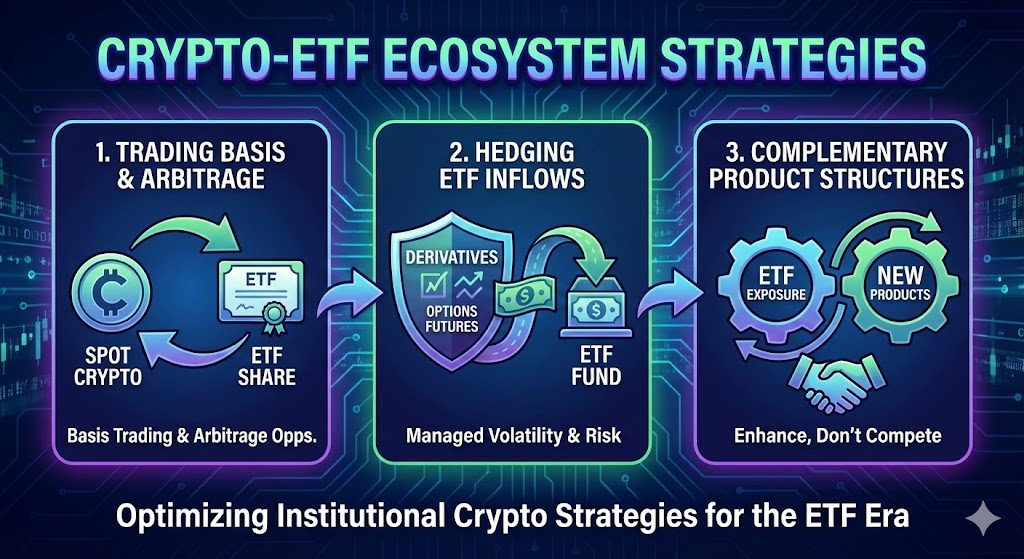
Crypto investment firms are responding by:
- Trading ETF-related basis and arbitrage strategies
- Hedging ETF inflows with derivatives
- Structuring products that complement ETF exposure rather than compete with it
The result is a tighter linkage between traditional capital markets and crypto price discovery—something that did not exist at scale prior to 2024.
Multi-Strategy Crypto Funds Gain Ground
Another major trend today is the rise of multi-strategy crypto investment firms, mirroring the structure of traditional hedge fund giants.
Firms such as Galaxy Digital and Pantera Capital are no longer reliant on directional beta. Instead, they deploy capital across:
- Market-neutral arbitrage
- Volatility trading
- Venture and private token rounds
- Yield and structured credit strategies
This diversification is attracting institutional capital that previously avoided crypto due to drawdown risk. Allocators now view crypto funds less as speculative vehicles and more as alternative return engines comparable to macro or relative-value hedge funds.
Custody, Compliance, and Infrastructure Take Center Stage
Behind the scenes, infrastructure has become the true competitive moat. Large crypto investment firms are investing heavily in:
- Institutional custody solutions
- Segregated accounts and SMAs
- Regulatory reporting and risk transparency
Custodians such as Coinbase have emerged as critical partners, offering regulated custody services that meet institutional compliance standards. For many allocators, custody strength is now as important as performance.
This infrastructure arms race is accelerating consolidation, favoring well-capitalized firms with global compliance teams and institutional-grade operations.
Hedge Funds Re-Enter Crypto with Discipline
After pulling back during the 2022–2023 downturn, traditional hedge funds are once again allocating to crypto—but with far more discipline.
Multi-manager platforms and macro hedge funds are selectively deploying capital into:
- Bitcoin as a macro hedge
- Ethereum as a programmable asset class
- Volatility strategies around major protocol upgrades
Rather than chasing momentum, these firms are integrating crypto into broader portfolios alongside rates, currencies, and equities. The result is steadier flows and reduced reflexive volatility.
AI, Quant Models, and Systematic Trading
Quantitative and AI-driven strategies are increasingly shaping crypto investment returns. Large firms are using machine learning to:
- Detect cross-venue pricing inefficiencies
- Model on-chain behavior
- Anticipate liquidity shocks
Because crypto trades 24/7 and generates vast datasets, it has become an ideal testing ground for systematic strategies. Firms with advanced data science capabilities are consistently outperforming discretionary peers in volatile markets.
Looking Ahead
As 2026 unfolds, the biggest trend is not price—it’s institutional permanence. Crypto investment firms are no longer building for cycles; they are building for decades.
With ETFs anchoring capital, infrastructure maturing, and strategies diversifying, digital assets are becoming a durable pillar of the global alternative investment universe.