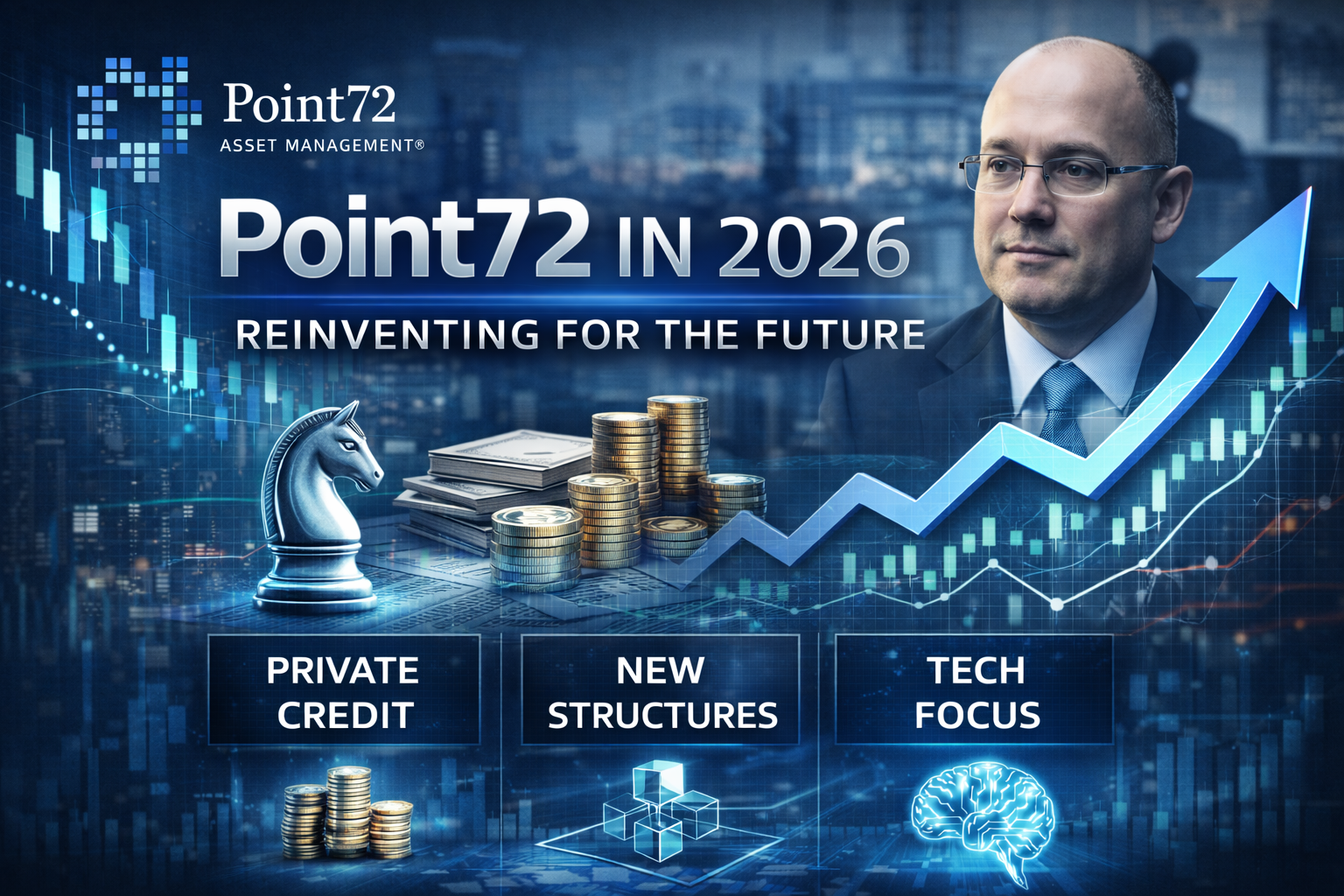
(HedgeCo.Net) In an industry where performance and prestige are tightly correlated, 2026 is shaping up to be a pivot year for many of the largest US hedge funds, not just in headline returns but in strategic evolution. Nowhere is this more visible than among the upper echelon: Point72 Asset Management, Citadel, and Millennium Management are recalibrating their business models and investment priorities to stay ahead of competition and satisfy demanding institutional capital.
Point72 Reinvents Itself With New Structures
At approximately $41.5 billion in assets, Steven Cohen’s Point72 has been expanding beyond traditional long/short equity into broader multi-strategy domains, aligning with wider hedge fund industry trends.
Recent developments at Point72 reveal a structural reorganization aimed at sharpening investment focus and capital efficiency. In late 2025, the firm announced a split of its equities unit into distinct operating entities designed to enhance specialization and agility across markets.
Additionally, Point72 has signaled expansion into private credit and new asset categories, reflecting broader industry shifts toward diversified alpha sources and alternative income streams.
Leadership transitions, including strategic leadership departures and new hires from consulting and banking, illustrate a broader trend: hedge funds are increasingly recruiting professionals with cross-discipline expertise in technology, analytics, and capital markets to elevate decision-making frameworks.
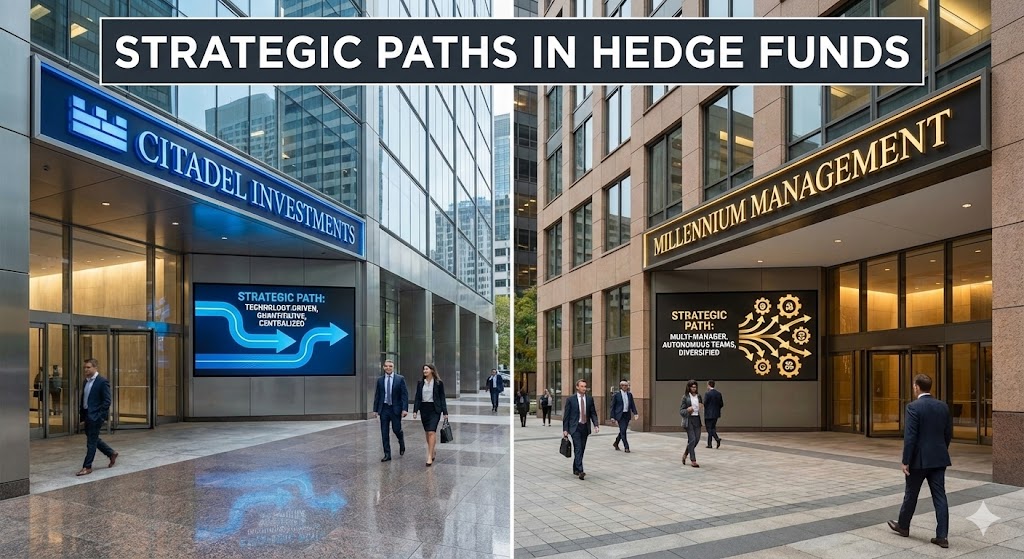
Citadel’s Balanced Returns and Engineering Precision
While some rivals posted double-digit exuberance in 2025, Citadel’s flagship Wellington Fund posted a respectable ~10% return — evidence of engineering precision over headline volatility chasing.
This reflects a broader strategic posture at Citadel: risk discipline and diversified alpha engines remain central, rather than concentrated strategy bets. Citadel continues to invest heavily in technology infrastructure, algorithmic research, and risk management platforms, maintaining its reputation as a rigorously engineered trading powerhouse.
Millennium’s Evolving Multistrategy Framework
Millennium Management — one of the largest hedge funds globally with roughly $79 billion in assets — continues to refine its multistrategy operations to extract consistent returns across environments.
Unlike more concentrated macro or quant funds, Millennium’s approach deliberately blends thousands of small, diversified risk positions to smooth portfolio outcomes, making it attractive to allocators seeking predictable volatility profiles. But in highly directional markets — such as the AI-driven rallies of 2025 — this diversification can dilute performance, a factor behind Millennium’s more modest returns relative to agile peers.
A New Competitive Landscape
What’s striking about the largest hedge funds today is how competition has broadened. Firms that were once largely categorized as quant, macro, or discretionary are now converging in product offerings and technology capabilities:
- AI, systematic research, and signal processing have become universal expectations rather than experimental advantages.
- New product vehicles, including separate accounts, managed accounts, and private credit extensions, are blurring lines between hedge funds and broader alternative investment firms.
- Talent competition extends beyond finance — with hedge funds recruiting from tech, data science, and even gaming sectors.
For these leading firms, the objective isn’t just return numbers — it’s institutional viability: staying indispensable to pension plans, sovereign funds, and endowments that scrutinize performance persistence, risk control, and capital stability.
Investor Demand and Fee Pressures
Allocators continue to drive trends. Although evidence of renewed demand exists — particularly as stocks show valuation tensions and traditional fixed income remains challenged — hedge funds also face more scrutiny on fee structures and performance benchmarks than in the past decade.
The biggest firms, with scale and institutional infrastructure, are pioneering new fee arrangements and reporting standards that attempt to strike a balance between investor expectations and operational economics.