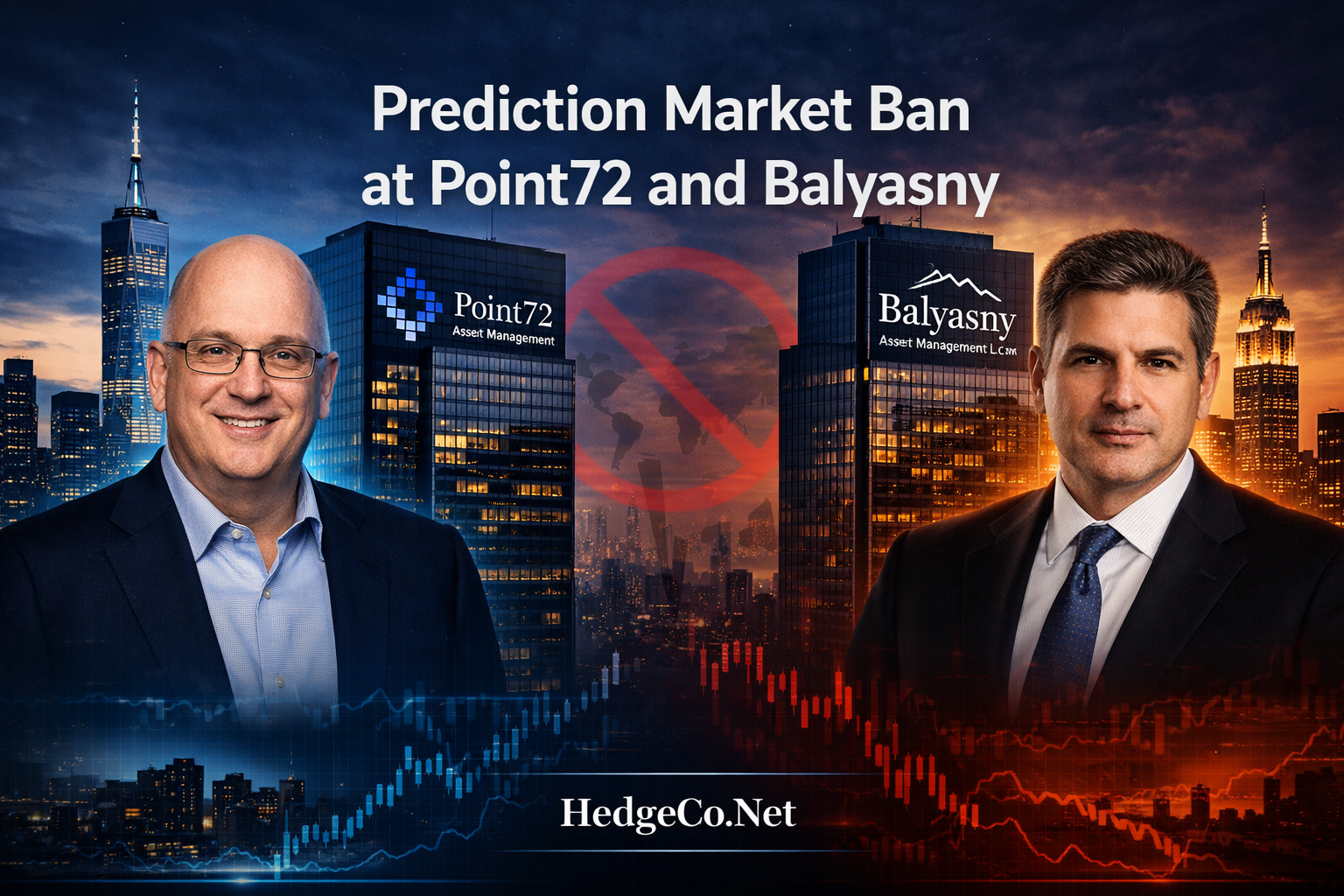
(HedgeCo.Net) In a move that underscores the evolving complexity of modern markets, both Point72 Asset Management and Balyasny Asset Management have restricted their employees from trading on prediction markets such as Polymarket and Kalshi.
The decision comes amid a surge in popularity of event-driven trading platforms, where participants can speculate on outcomes ranging from elections and central bank decisions to geopolitical flashpoints. While these platforms have grown rapidly in both liquidity and legitimacy, hedge fund compliance teams are increasingly viewing them as a gray area—one that blurs the line between hedging, speculation, and potential regulatory exposure.
This development signals more than just an internal policy shift. It highlights a deeper transformation underway across the alternative investment landscape: the collision of traditional portfolio management with a new class of real-time, event-linked financial instruments.
The Rise of Prediction Markets as a Financial Tool
Prediction markets have evolved far beyond their early perception as novelty betting platforms. Today, they function as sophisticated information aggregators, often producing real-time probabilities that rival or even outperform traditional polling and forecasting models.
Platforms like Polymarket and Kalshi allow users to trade contracts tied to binary or probabilistic outcomes—such as whether a specific candidate will win an election, whether inflation will exceed a threshold, or whether a geopolitical event will occur within a defined timeframe.
For hedge fund professionals, the appeal is obvious:
- Pure exposure to discrete events without broader market noise
- High-frequency information signals derived from crowd consensus
- Opportunities for arbitrage against traditional assets (e.g., equities, FX, rates)
- Potential hedging tools for macro and geopolitical risk
In theory, a portfolio manager concerned about election volatility or a geopolitical shock could use prediction markets as a direct hedge—something that traditional instruments like options or futures cannot always replicate cleanly.
But in practice, the integration of these tools into institutional workflows introduces a host of complications.
Why Hedge Funds Are Pulling Back
The decision by Point72 and Balyasny to restrict access reflects mounting concern across three key dimensions: compliance risk, information leakage, and reputational exposure.
1. Regulatory Ambiguity
While Kalshi operates under U.S. regulatory oversight, many prediction markets—particularly crypto-native platforms like Polymarket—exist in less clearly defined jurisdictions.
This creates a compliance challenge:
- Are these trades considered derivatives?
- Do they fall under gambling regulations?
- How should firms monitor and report such activity?
For large hedge funds managing billions in institutional capital, even minor regulatory uncertainty can represent unacceptable risk.
2. Insider Information and Material Non-Public Data
Perhaps the most significant concern is the potential misuse of material non-public information (MNPI).
Hedge fund professionals often have access to:
- Proprietary research
- Corporate insights
- Government or policy-related intelligence
- Channel checks and expert networks
If such information were used—intentionally or unintentionally—to trade on prediction markets, it could trigger serious legal consequences.
Unlike equities or options markets, prediction platforms are still developing surveillance and enforcement mechanisms, increasing the risk that improper activity could go undetected—or worse, later scrutinized.
3. Conflict of Interest and Firm Reputation
There is also a reputational dimension.
Imagine a scenario where:
- A portfolio manager profits from a geopolitical event on a prediction market
- While simultaneously managing capital exposed to that same event
Even if the trades are legal, the optics could be problematic—especially for firms that market themselves as disciplined, institutional-grade investment managers.
For firms like Point72, founded by Steve Cohen, and Balyasny, known for its rigorous multi-strategy approach, maintaining investor trust is paramount.
The “Shadow Hedging” Phenomenon
One of the more subtle dynamics at play is what industry insiders are beginning to call “shadow hedging.”
This refers to situations where traders:
- Use personal accounts to hedge risks not easily expressed within firm portfolios
- Or seek to profit from short-term event outcomes outside formal mandates
Prediction markets, with their simplicity and accessibility, are uniquely suited for this behavior.
For example:
- A macro trader anticipating election volatility might take positions on a political outcome
- A rates trader might speculate on central bank decisions via event contracts
While these trades may be logically consistent with professional views, they exist outside the firm’s oversight—creating governance blind spots.
The bans by Point72 and Balyasny effectively shut down this parallel channel.
A Broader Industry Trend
These restrictions are unlikely to remain isolated. Across the hedge fund industry, compliance teams are increasingly focused on non-traditional trading venues, including:
- Crypto exchanges
- Prediction markets
- Decentralized finance (DeFi) platforms
- Tokenized asset marketplaces
As the boundaries between finance, technology, and information markets continue to blur, firms are being forced to rethink their internal controls.
In many cases, the response has been conservative: restrict first, evaluate later.
Implications for Markets and Investors
The implications of this shift extend beyond internal compliance policies.
1. Reduced Institutional Participation
If major hedge funds restrict employee participation, prediction markets may lose a key source of sophisticated capital and information flow.
This could:
- Reduce liquidity
- Increase volatility
- Make pricing less efficient
2. Continued Growth—But Outside Institutions
At the same time, retail participation in prediction markets continues to surge, particularly in crypto-native ecosystems.
This creates a divergence:
- Institutional capital remains cautious
- Retail and semi-professional traders drive growth
Over time, this could lead to a two-tiered information market, where institutional insights are partially absent from public pricing signals.
3. Regulatory Acceleration
As prediction markets grow in scale and visibility, regulators are likely to increase scrutiny.
Kalshi’s regulated model may become a template, while offshore or decentralized platforms could face mounting pressure.
For hedge funds, this reinforces the logic of preemptive restrictions—avoiding entanglement in an evolving regulatory landscape.
The Future: Integration or Isolation?
The long-term question is whether prediction markets will eventually be:
- Integrated into institutional finance, with clear rules and compliance frameworks
- Or remain peripheral tools, primarily used by retail and niche participants
There is a compelling case for integration. Prediction markets offer:
- Real-time probability signals
- Efficient aggregation of dispersed information
- Direct exposure to event risk
These are valuable attributes in a world increasingly driven by macro shocks and geopolitical uncertainty.
However, until regulatory clarity improves and compliance frameworks mature, large hedge funds are likely to err on the side of caution.
Conclusion: A Signal of Market Evolution
The decision by Point72 and Balyasny to restrict prediction market trading is more than a compliance footnote—it is a signal of how rapidly financial markets are evolving.
As new instruments emerge that blur the lines between trading, forecasting, and information arbitrage, institutions must adapt their risk frameworks accordingly.
For now, the message from the industry’s largest players is clear:
the risks of prediction markets—legal, reputational, and operational—still outweigh the potential rewards.
But that balance may not hold forever.
As the infrastructure around event-based trading matures, and as regulators establish clearer rules, prediction markets could move from the periphery to the core of global finance.
Until then, hedge funds will continue to watch closely—from the sidelines.