Strait of Hormuz Tensions Send Shockwaves Through Global Markets:
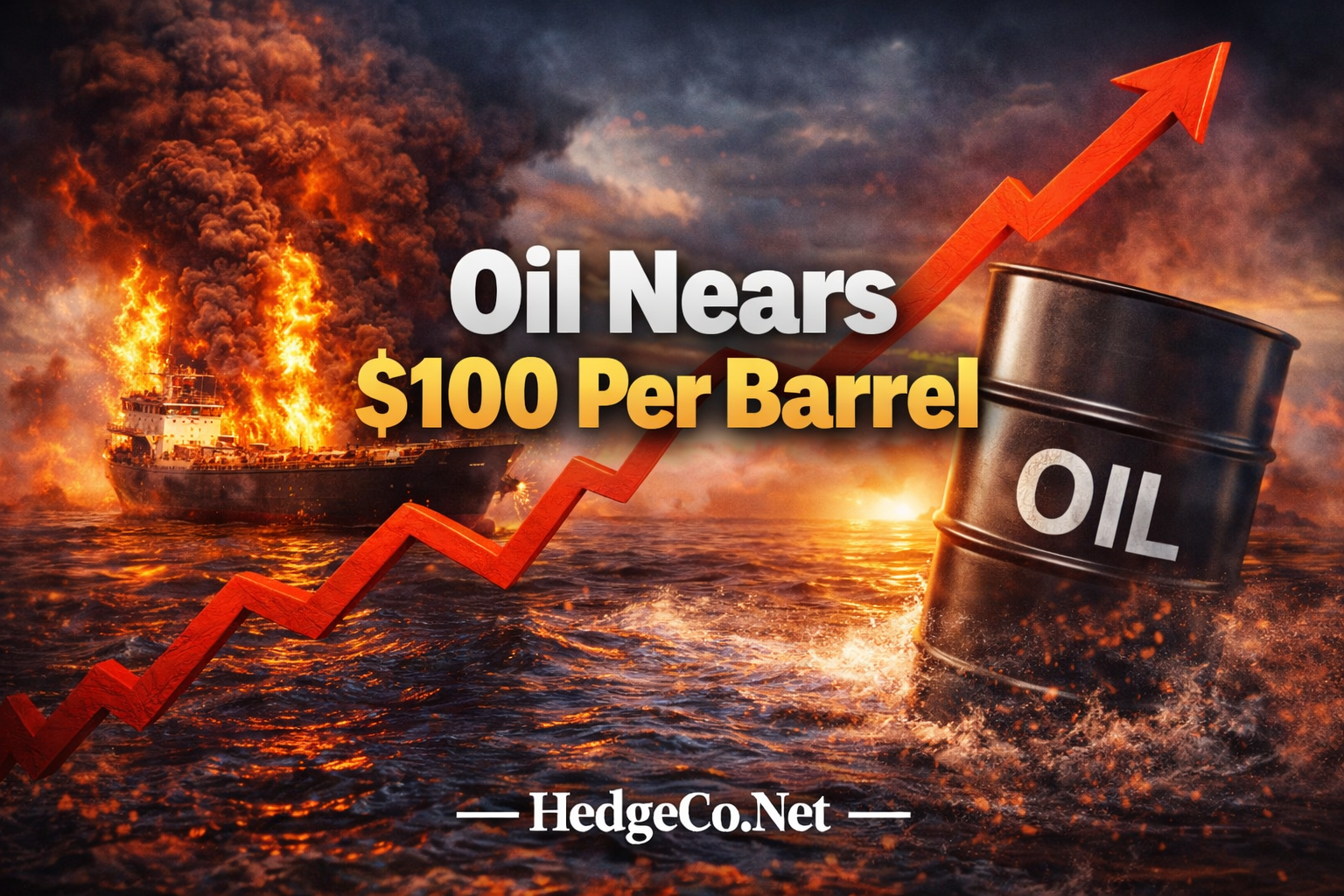
(HedgeCo.Net) Global financial markets were jolted today after reports emerged that multiple oil tankers were set ablaze in Iraqi waters, triggering fears of a major escalation in Middle East tensions and sending crude oil prices sharply higher.
The developing crisis is centered around the strategically vital Strait of Hormuz, the narrow waterway that serves as the world’s most important oil transit corridor. As geopolitical tensions intensified and Iranian leadership signaled that pressure on regional shipping routes could continue, global crude prices surged nearly 7% in a single trading session, pushing benchmark oil prices dangerously close to the $100-per-barrel threshold.
The sudden spike has triggered widespread volatility across financial markets, with transportation stocks plunging while energy producers surged.
The developments highlight the persistent vulnerability of global energy markets to geopolitical shocks—and the enormous economic consequences that can follow when disruptions threaten the flow of oil through critical maritime chokepoints.
Why the Strait of Hormuz Matters
Few geographic locations carry as much importance for the global energy system as the Strait of Hormuz.
Located between Iran and Oman, the narrow channel connects the Persian Gulf to the Arabian Sea and serves as the primary export route for oil produced by several major energy exporters.
Roughly one-fifth of the world’s total oil supply passes through the Strait of Hormuz each day.
Major producers relying on the corridor include:
• Saudi Arabia
• Iraq
• Kuwait
• the United Arab Emirates
• Iran
Because the strait narrows to only about 21 miles at its tightest point, it represents a critical bottleneck for global energy flows.
Any disruption to shipping through the region can quickly send shockwaves through oil markets.
That vulnerability has been exposed repeatedly over the past several decades during periods of geopolitical tension in the Middle East.
Tanker Attacks Ignite Market Panic
According to early reports circulating among global shipping operators, several commercial oil tankers were targeted by incendiary attacks while navigating waters near Iraqi export routes.
While details remain limited, maritime monitoring groups indicated that the attacks forced several vessels to alter their routes and raised concerns about the security of tanker traffic across the northern Persian Gulf.
Insurance costs for shipping through the region immediately surged.
Some tanker operators reportedly began reconsidering planned routes through the Strait of Hormuz as risk premiums increased dramatically.
The combination of shipping disruption fears and escalating geopolitical rhetoric sparked a rapid reaction across commodity markets.
Crude oil futures surged within hours of the first reports.
Oil Prices Surge Toward $100
Global crude benchmarks responded immediately to the geopolitical shock.
Prices for international crude grades climbed sharply as traders priced in the possibility of supply disruptions.
Several factors amplified the market reaction:
• fears of restricted tanker traffic
• rising shipping insurance costs
• potential retaliation or escalation from regional actors
These concerns drove oil prices sharply higher during the trading session, pushing the market toward the psychologically important $100-per-barrel level.
Energy analysts note that the oil market had already been tightening due to steady global demand and constrained production growth.
As a result, geopolitical disruptions have a particularly powerful impact on price dynamics.
Even small reductions in available supply can trigger large price movements when inventories are relatively limited.
Transportation Stocks Take the Hit
While energy companies benefited from rising oil prices, other sectors of the market faced significant pressure.
Airline and cruise stocks experienced their worst daily performance in nearly a year as investors reacted to the prospect of sharply higher fuel costs.
Fuel expenses represent one of the largest operating costs for airlines and cruise operators.
When oil prices surge, profit margins across the travel sector can shrink rapidly.
Several major airline stocks declined sharply during the trading session as investors reassessed earnings expectations.
Cruise companies also suffered losses as investors anticipated increased operating expenses.
The transportation sector’s reaction highlights how energy price shocks ripple across the broader economy.
Energy Producers Surge
In stark contrast, energy companies emerged as the biggest winners of the day.
Shares of major oil producers surged as investors anticipated higher revenues driven by rising crude prices.
Among the largest gainers were U.S.-based energy giants such as:
• Occidental Petroleum
• ConocoPhillips
These companies, which generate substantial revenue from oil production, typically benefit when crude prices rise.
Higher oil prices can significantly boost cash flows for exploration and production companies.
Investors responded by pushing energy stocks higher even as broader equity markets struggled.
In fact, energy companies were among the only major gainers in the S&P 500 during the trading session.
Energy Markets Already Tight
The geopolitical shock arrives at a time when global oil markets were already facing structural supply constraints.
Several key factors have contributed to tighter market conditions in recent years.
First, investment in new oil production slowed dramatically following the price collapse of 2020.
Energy companies became more cautious about expanding production capacity, focusing instead on shareholder returns.
Second, global demand for oil has remained resilient despite the growth of renewable energy.
Rapid economic expansion across emerging markets has continued to drive energy consumption higher.
Finally, geopolitical tensions in several oil-producing regions have periodically threatened supply stability.
Together, these forces have created a market environment in which unexpected disruptions can produce outsized price movements.
Inflation Risks Re-Emerge
A sustained increase in oil prices could also complicate the global inflation outlook.
Energy costs play a significant role in determining the price of goods and services across the economy.
Higher oil prices can increase transportation costs, manufacturing expenses, and utility bills.
As a result, energy shocks often feed into broader inflationary pressures.
Central banks closely monitor oil prices because rising energy costs can influence monetary policy decisions.
If crude prices remain elevated, policymakers may face renewed challenges in managing inflation expectations.
Strategic Petroleum Reserves in Focus
In response to previous energy shocks, governments have occasionally released oil from strategic reserves to stabilize markets.
The United States maintains a large emergency oil stockpile known as the Strategic Petroleum Reserve.
While no immediate announcements have been made regarding potential reserve releases, analysts note that policymakers could consider such measures if energy prices continue climbing.
Strategic reserves are designed specifically to cushion the impact of supply disruptions caused by geopolitical crises.
However, reserve releases typically provide only temporary relief.
Long-term price stability ultimately depends on restoring normal supply flows.
Geopolitical Implications
Beyond financial markets, the tanker attacks carry significant geopolitical implications.
The Middle East has long been one of the most volatile regions affecting global energy security.
Any escalation involving shipping routes or regional military activity could further destabilize oil markets.
Diplomatic efforts may intensify in the coming days as global powers attempt to prevent a broader conflict.
Shipping security, naval patrols, and regional diplomacy will likely become critical factors in determining how the situation evolves.
What Investors Are Watching
Investors are closely monitoring several key developments that could shape the trajectory of oil markets in the coming weeks.
These include:
• the security of tanker routes through the Strait of Hormuz
• potential retaliation or escalation by regional actors
• shipping insurance premiums for oil transport
• diplomatic responses from major global powers
If shipping disruptions worsen, oil prices could move decisively above the $100 threshold.
On the other hand, successful diplomatic intervention could stabilize the situation and ease market fears.
The Broader Market Impact
Energy shocks often produce ripple effects across global financial markets.
Higher oil prices can influence currencies, inflation expectations, and interest rate forecasts.
Commodity markets may also experience increased volatility as traders adjust to shifting supply expectations.
For equity markets, sector performance often diverges sharply during energy crises.
Energy producers typically benefit from rising oil prices, while transportation and manufacturing sectors face increased cost pressures.
Understanding these dynamics is essential for investors navigating periods of geopolitical uncertainty.
Conclusion
The tanker attacks in Iraqi waters represent the latest reminder of how quickly geopolitical events can disrupt global energy markets.
With oil prices surging toward $100 per barrel and tensions surrounding the Strait of Hormuz escalating, investors are bracing for continued volatility.
While the full implications of the crisis remain uncertain, the immediate market reaction underscores the fragile balance underpinning the global energy system.
For financial markets, geopolitical risks remain one of the most powerful—and unpredictable—forces shaping commodity prices.