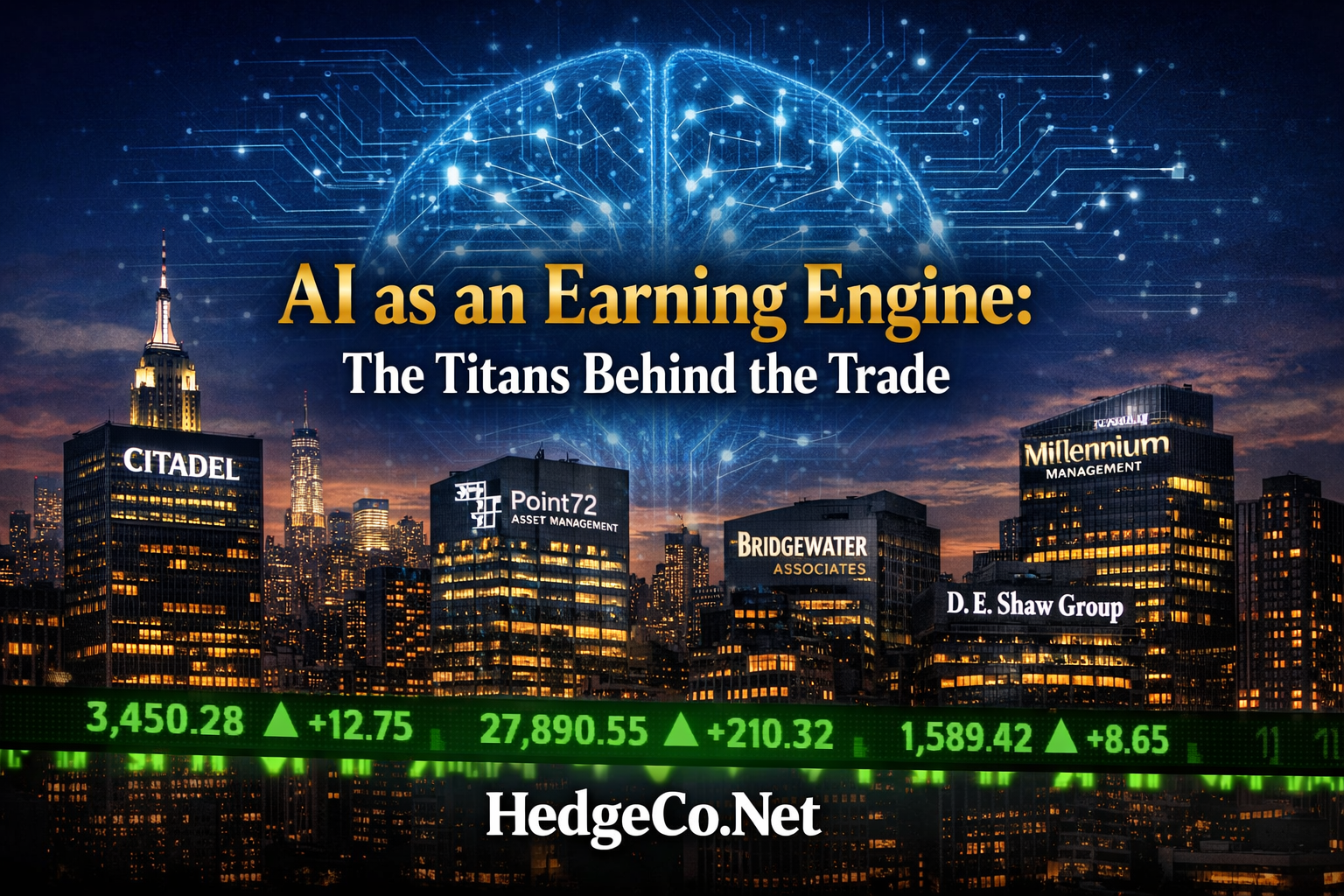
(HedgeCo.Net) The firms shaping this trade are among the most influential capital allocators in global markets:
- Citadel
- Point72 Asset Management
- Bridgewater Associates
- D. E. Shaw Group
- Millennium Management
Each operates differently—some through multi-manager platforms, others via systematic or macro frameworks—but they share one common conclusion: AI is reshaping earnings trajectories, capital spending cycles, and valuation hierarchies across sectors.
Why Big Tech—Again?
At first glance, the renewed embrace of mega-cap technology stocks may look like a return to familiar territory. Hedge funds have long traded the largest U.S. tech names. But today’s positioning is structurally different from the pre-2022 era.
1. AI as an Earnings Engine, Not Just a Story
The key shift is that AI is now embedded in revenue lines. Companies like:
- NVIDIA
- Microsoft
- Alphabet
- Amazon
- Meta Platforms
are no longer promising future AI monetization—they are reporting it.
NVIDIA’s data-center revenue growth, Microsoft’s AI-integrated cloud services, and Meta’s AI-driven ad optimization all demonstrate that AI is generating tangible cash flow. For hedge funds that prioritize earnings visibility and scalability, this transition from concept to monetization reduces narrative risk.
2. Capital Expenditure Super-Cycle
AI requires infrastructure: semiconductors, hyperscale data centers, power capacity, networking hardware, and cooling systems. Hedge funds increasingly view this as a multi-year capex super-cycle.
The logic is straightforward:
- AI model training requires exponential compute.
- Compute requires GPUs and advanced semiconductors.
- Those require fabs, energy, and physical infrastructure.
- Infrastructure spending feeds multiple supply chains.
This cascading capital flow creates layered investment opportunities—from chip designers to power grid modernization. Multi-strategy platforms are building portfolios that reflect this vertical integration.
The Macro Overlay: Why Now?
Hedge funds rarely operate in thematic isolation. The renewed conviction in AI is also macro-conditioned. After years of rate volatility, inflation spikes, and recession fears, markets have shifted toward a regime of selective growth. Large tech firms have fortified balance sheets, maintained pricing power, and demonstrated resilience amid tightening liquidity.
For macro-oriented firms like Bridgewater Associates, AI-driven productivity gains feed into broader economic modeling. If AI enhances labor efficiency and corporate margins, it alters inflation dynamics and productivity assumptions—two critical macro variables.
Meanwhile, multi-manager platforms like Citadel and Millennium Management view AI not only as a sector theme but as a volatility generator. Earnings beats, guidance revisions, and competitive shifts within AI-linked companies create dispersion—fuel for long-short equity strategies.
Hedge Fund Strategy Shifts: How the Trade Is Expressed
The “AI rotation” is not a uniform long-only bet. Instead, hedge funds are expressing conviction through multiple structures:
Long/Short Equity
Funds are:
- Going long AI infrastructure leaders.
- Shorting legacy tech firms with weaker AI integration.
- Rotating out of rate-sensitive cyclicals into structural growth plays.
The objective is to isolate relative AI advantage rather than pure beta exposure.
Options and Volatility Strategies
AI earnings seasons have produced outsized stock moves. Funds are increasingly trading volatility around:
- GPU demand guidance
- Cloud growth revisions
- Capex projections
Volatility desks within firms like D. E. Shaw Group are capitalizing on pricing inefficiencies tied to AI-related event risk.
Macro Cross-Asset Positioning
AI-driven demand impacts:
- Semiconductor supply chains
- Energy consumption
- Commodity inputs
- Treasury yields (via growth expectations)
This allows global macro funds to express AI conviction beyond equities.
The Competitive Imperative: Why Funds Can’t Ignore It
Large hedge funds compete intensely for both capital and talent. Underperformance relative to peers in an AI-led rally can trigger allocator pressure.
Institutional investors increasingly benchmark managers against AI-heavy indices. If hedge funds lag mega-cap tech during strong AI cycles, they risk:
- Capital outflows
- Performance fee compression
- Recruiting disadvantages
For platform funds, staying competitive in AI exposure has become existential.
Risk Management: The Concentration Problem
There is, however, a paradox.
As hedge funds crowd into Big Tech, market concentration intensifies. The largest technology names represent a growing share of index weight and hedge fund net exposure.
This creates risks:
- Correlated drawdowns.
- Regulatory intervention concerns.
- Valuation compression if growth expectations soften.
- AI monetization disappointment risk.
Elite funds mitigate this by:
- Pair-trading within subsectors.
- Actively hedging via index shorts.
- Using dynamic exposure management models.
Systematic managers adjust factor exposures in real time to avoid over-crowding.
AI Beyond the Obvious: Second-Order Trades
The most sophisticated hedge funds are already moving beyond the headline beneficiaries.
Energy & Power Infrastructure
AI data centers require massive electricity demand. Hedge funds are examining utilities, grid operators, and nuclear-related exposure.
Real Estate & Data Centers
AI build-out is increasing demand for specialized industrial and data-center real estate.
Supply Chain Materials
Semiconductor manufacturing depends on rare materials and advanced fabrication equipment.
By expanding beyond the obvious “AI winners,” hedge funds seek alpha in less crowded segments.
The Talent Dimension
AI is influencing not only portfolios but hiring decisions.
Funds are recruiting:
- Machine learning engineers
- Data scientists
- Alternative data specialists
- Semiconductor industry analysts
The integration of AI research teams within hedge funds has become standard practice. Competitive advantage increasingly depends on internal AI capabilities as much as external AI exposure.
The Retail Feedback Loop
Retail investors have also gravitated toward AI themes, amplifying price momentum. Hedge funds monitor retail flows closely.
In many cases, funds initiate positions before retail enthusiasm peaks—then adjust exposure as flows accelerate. The interplay between institutional positioning and retail momentum creates tactical opportunities.
Regulatory and Geopolitical Crosscurrents
AI’s strategic importance has attracted regulatory scrutiny and geopolitical tension.
Export controls on advanced semiconductors, antitrust investigations, and data privacy rules introduce headline risk. Hedge funds incorporate these variables into position sizing and scenario modeling.
Macro-aware managers track U.S.–China technology policy shifts closely, as they can alter supply chains and earnings outlooks rapidly.
Is This a Bubble?
The inevitable question arises: is hedge fund enthusiasm fueling an AI bubble? Professional managers argue the situation differs from past tech manias because:
- Revenue growth is visible.
- Profit margins are expanding.
- Free cash flow supports valuations.
- Balance sheets are strong.
However, valuation multiples in certain AI-linked segments remain elevated. Hedge funds are therefore balancing conviction with caution.
The most disciplined firms emphasize:
- Earnings quality.
- Competitive moats.
- Sustainable demand curves.
- Sensitivity to rate changes.
Performance Implications
AI exposure has materially influenced hedge fund returns. Funds that increased net long exposure to mega-cap tech during AI accelerations outperformed peers that remained defensively positioned.
Multi-strategy platforms, with flexibility across teams, have particularly benefited. Portfolio managers specializing in semiconductors, cloud computing, and AI software have become internal performance drivers.
In contrast, managers slow to adapt have faced performance pressure.
The Broader Market Impact
Hedge fund positioning in Big Tech does not operate in isolation. Their capital scale means:
- Earnings reactions are amplified.
- Liquidity shifts quickly during guidance revisions.
- Options markets reflect institutional expectations.
The concentration of hedge fund capital in AI-linked equities reinforces market leadership patterns.
What Could Change the Narrative?
Several factors could alter the trajectory:
- A slowdown in AI infrastructure spending.
- Margin compression due to competitive AI pricing.
- Regulatory constraints on data usage.
- A sharp macro downturn reducing enterprise tech budgets.
Hedge funds continuously model these scenarios. Exposure is dynamic—not static.
Looking Ahead: A Structural Reweighting
The shift into AI-linked Big Tech is unlikely to be temporary.
For hedge funds, AI represents:
- A productivity revolution.
- A corporate reinvestment cycle.
- A global competitiveness issue.
- A source of sustained volatility.
Even if positioning moderates tactically, strategic allocation toward AI-enabled companies appears embedded in portfolio construction frameworks.
Conclusion: The New Center of Gravity
The largest hedge funds in the United States are not chasing hype. They are recalibrating around a structural transformation. AI has become the new center of gravity in equity markets. It influences capex, earnings, macro models, volatility pricing, and geopolitical risk.
For firms like Citadel, Point72 Asset Management, Bridgewater Associates, D. E. Shaw Group, and Millennium Management, doubling down on Big Tech is less about momentum—and more about acknowledging a fundamental economic shift.
Whether the AI trade delivers uninterrupted gains remains uncertain. But one reality is clear: in today’s hedge fund landscape, underestimating AI is no longer an option. The capital has spoken—and it is flowing toward the algorithms.