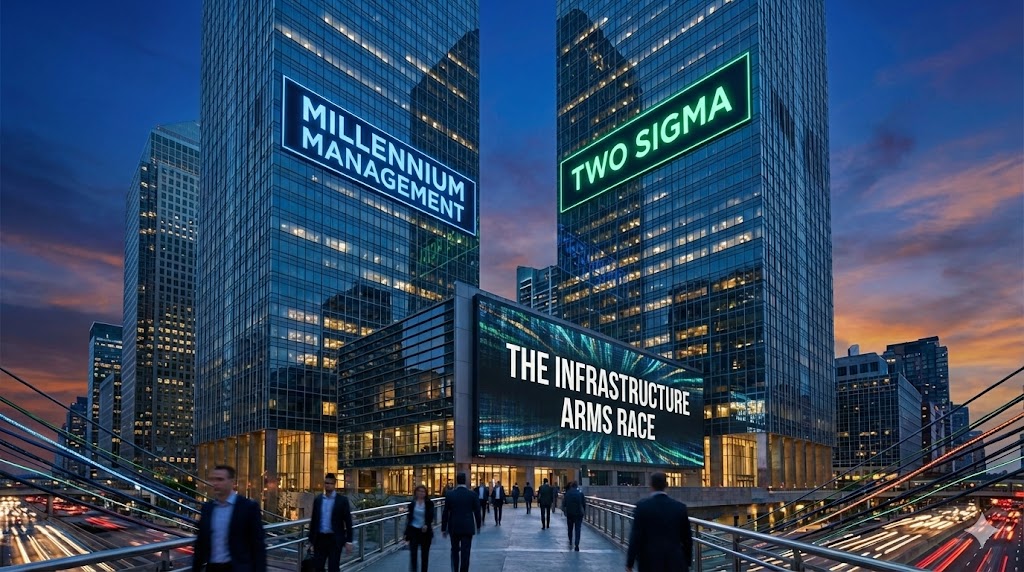
(HedgeCo.Net) If multi-strategy hedge funds are the defining trading institutions of this era, then large quant-driven firms are the defining systems institutions—built on code, data, and organizational stability. That’s why a different kind of headline is resonating right now: not a trade, but a governance and “people risk” story at one of the most important quant platforms in the U.S.
Bloomberg reported in early February on the internal and personal conflict surrounding Two Sigma, describing a founder-related feud and divorce drama that risks becoming a distraction for a major trading powerhouse.
Why this matters to the hedge fund ecosystem
For quant-oriented franchises, stability is part of the product. Investors allocate not just to a strategy, but to an operating system: teams, research process, tech stack, and continuity. Anything that suggests governance fragility can raise uncomfortable questions:
- Will top researchers leave?
- Will decision-making slow down?
- Will counterparties and talent view the platform as less durable?
This is why the story is trending: it hits an industry nerve. In 2026, “people risk” is arguably the most underpriced risk factor in hedge funds—because performance is portable, but culture and infrastructure are not.
The other half of the 2026 quant story: an infrastructure arms race
While Two Sigma’s headline is about governance stress, another big trend is about buildout—especially around AI, data, and the physical infrastructure that increasingly underpins modern trading and investing.
Millennium, for example, has been associated with moves that signal how competitive the infrastructure arms race is becoming: trade press reporting described Millennium hiring talent from Goldman Sachs to expand a data centers-related team. Separately, Bloomberg coverage described Millennium backing a commodities-focused spinout with about $1.5 billion, underscoring how big platforms incubate talent and strategies in a way that looks closer to a venture studio than a traditional hedge fund.
This combination—buildout + incubation—is a defining hedge fund behavior in 2026:
- Build the pipes (data, compute, execution, infrastructure).
- Incubate differentiated risk-takers inside the platform—then scale them, seed them, or spin them out while retaining economic alignment.
Why infrastructure is suddenly front-page
Two macro forces are pushing this:
1) AI is not just a “tech theme”—it’s a capital and power theme.
Bridgewater CIO commentary has highlighted that AI-driven capital spending can ripple into inflation through demand for chips, electricity, and related ecosystem inputs. If that’s right, then infrastructure scarcity becomes a macro driver—and hedge funds want exposure, data, and trading advantage in that regime.
2) Markets are more “flow-driven” than ever.
When price action is dominated by reallocations, hedging, and systematic flows, speed and data quality matter more. This is true for equities, but it’s also true for commodities, rates, and volatility products.
The takeaway: hedge funds are becoming “industrial organizations”
Put the Two Sigma governance story next to Millennium’s buildout behavior and the macro backdrop, and you see the deeper pattern:
- The biggest hedge funds are less like boutiques and more like industrial-scale organizations.
- Their advantage is increasingly operational—compute, talent supply chains, internal capital allocation, and institutional durability.
- Their biggest vulnerabilities are no longer just market calls, but organizational continuity—leadership stability, culture, and retention.
What to watch next
- Two Sigma talent signals: departures, hiring pace, and any formal governance updates will be closely watched because they affect allocator confidence.
- Millennium’s incubation model: whether more internal platforms get seeded/spun out, especially in commodities and infrastructure-linked strategies.
- AI-capex macro spillovers: if AI demand continues to pressure power and supply chains, hedge funds will increasingly treat “infrastructure” as a core macro input, not a side theme.
This is why it’s trending: in 2026, hedge funds aren’t just trading markets—they’re building systems. And the system only works if governance, talent, and infrastructure hold together under pressure.