
(HedgeCo.Net) Private credit is starting 2026 the way it ended 2025: with scale—and with a growing spotlight on what that scale means for returns, liquidity, and risk. Over the past 48 hours, two developments have crystallized the story investors are watching most closely today: (1) a major direct-lending fund close that underscores relentless demand for private yield, and (2) another insurer–asset manager partnership that reinforces how annuity balance sheets are becoming one of private credit’s most important funding engines.
The headline fundraiser is Monroe Capital, which announced it has raised $6.1 billion for its latest direct-lending strategy (Fund V and related vehicles). The raise is notable not just for the number, but for what it signals: even with elevated rates and tighter underwriting narratives, institutional allocators are still writing large checks for middle-market private credit—especially managers with established sourcing and workout capabilities. Monroe said the vehicle attracted more than 90 institutional investors across 18 countries, and includes a mix of core fund commitments, leverage, and separately managed accounts—an increasingly common structure as larger LPs push for tailored exposures and fee control. The Wall Street Journal+1
At the same time, TPG announced a strategic partnership with Jackson Financial that will initially involve at least $12 billion of Jackson capital managed by TPG, with a target to scale to $20 billion over the next decade. The arrangement also includes cross-ownership stakes—TPG investing $500 million for a 6.5% Jackson stake, while Jackson receives $150 million of TPG stock. This is the latest signal that “insurance as a distribution channel” is no longer just a theme—it’s becoming a defining business model for alternatives managers seeking durable, long-duration fee streams. The Wall Street Journal
Why it matters: private credit’s buyer base is changing
For much of the last decade, private credit growth was fueled by endowments, pensions, and sovereign wealth funds searching for yield and diversification. Today, the incremental marginal dollar increasingly comes from insurance partnerships, asset-based finance platforms, and structured origination channels designed to match liability profiles. This reshapes both underwriting incentives and product packaging.
Jackson’s partnership highlights another trend: rather than buying insurers outright (a path followed by other alternative giants), some firms are opting for capital partnerships that can scale faster, require less balance-sheet risk, and still deliver sticky fee revenue. The Wall Street Journal
The market’s other new message: “prove it” season is here
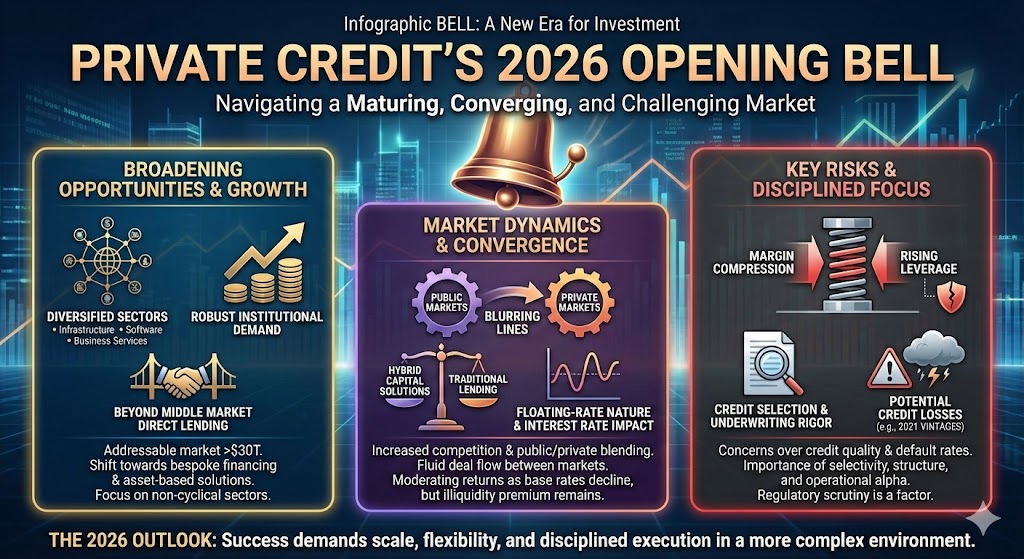
Even as fundraising surges, investor scrutiny is rising. Bloomberg flagged that public-market pricing and investor sentiment have started to reflect nervousness about valuation and confidence across parts of the private-credit complex—especially where portfolios are opaque, marks lag, or fee structures look aggressive relative to realized outcomes. Bloomberg
This doesn’t mean the private credit boom is ending. It does mean 2026 may be the year where the allocation conversation shifts from “how do I get exposure?” to “how do I get the right exposure?” Key diligence points increasingly include:
- Portfolio construction: sponsor-backed vs. non-sponsored, sector mix, concentration limits
- Documentation and covenant profile: whether managers regained protections after 2021–2022’s “covenant-lite creep”
- Workout infrastructure: internal restructuring teams, recovery track record, and loan modification discipline
- Liquidity and leverage: fund-level lines, duration mismatch, and the reality of redemption terms (where applicable)
- Valuation governance: third-party marks, audit depth, and how quickly stress shows up in valuations
What’s new “today” for allocators
In practical terms, today’s news is a playbook update for CIOs and investment committees:
- Fundraising strength remains real—Monroe’s $6.1B close shows the bid for private yield is still deep. The Wall Street Journal+1
- Insurers are doubling down—TPG/Jackson is a large-scale endorsement of credit strategies aligned to annuity liabilities. The Wall Street Journal
- The scrutiny cycle is accelerating—public signals and investor commentary are more focused on mark reliability and downside preparedness than at any point since the post-2020 credit rebound. Bloomberg
The net: private credit isn’t cooling off—it’s maturing. And in mature markets, the winners are rarely the loudest marketers. They’re the managers who can show, quarter after quarter, that their underwriting is resilient when growth slows, refinancings get harder, and covenant negotiations stop being theoretical.