Extreme Fear, Strategic Rotation: Inside Crypto’s Latest Risk-Off Regime
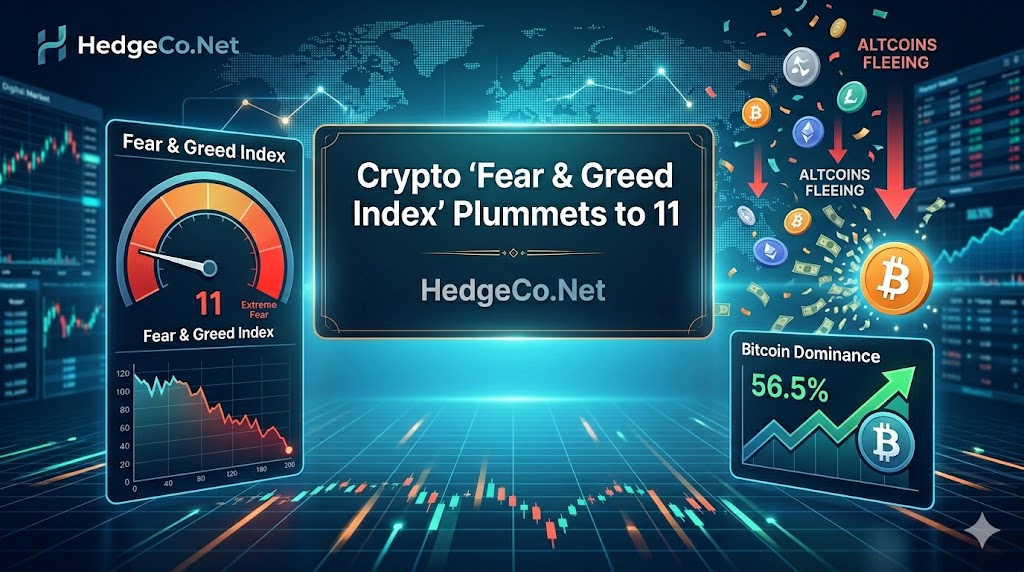
(HedgeCo.Net) — The cryptocurrency market has entered one of its most fragile psychological states in recent memory, with the widely followed “Fear & Greed Index” collapsing to a reading of 11—firmly in “Extreme Fear” territory. While such readings often coincide with heightened volatility and forced liquidations, they also provide a window into deeper structural dynamics unfolding beneath the surface of digital asset markets.
At the center of the current episode is a sharp divergence in capital flows. Even as broader crypto markets weaken, Bitcoin has seen its market dominance surge to 56.5%, signaling a pronounced rotation away from speculative altcoins and toward what investors increasingly view as the sector’s most resilient asset. This is not merely a short-term sentiment shift—it reflects a broader recalibration of risk across the crypto ecosystem.
Understanding the Fear & Greed Index

The Fear & Greed Index is designed to capture market sentiment by aggregating multiple data points, including volatility, trading volume, social media activity, and momentum indicators. Readings below 25 are generally considered indicative of extreme fear, often associated with capitulation events and heightened downside risk.
At a level of 11, the index suggests that investors are overwhelmingly risk-averse, with many reducing exposure or exiting positions entirely. Historically, such conditions have occurred during periods of significant market stress, including sharp corrections and liquidity shocks.
However, sentiment indicators alone do not tell the full story. To understand the current environment, it is necessary to examine the underlying drivers of this shift.
Flight to Quality: Bitcoin’s Resurgence
One of the most striking features of the current market is the rise in Bitcoin dominance. As capital exits higher-risk assets, it is increasingly consolidating in Bitcoin—a phenomenon often referred to as a “flight to quality.”
This dynamic mirrors behavior observed in traditional financial markets, where investors gravitate toward perceived safe havens during periods of uncertainty. In the crypto context, Bitcoin occupies a unique position. It is the most established digital asset, with the deepest liquidity, broadest institutional adoption, and most robust infrastructure.
The increase in dominance suggests that investors are not abandoning the asset class entirely, but rather repositioning within it.
This distinction is critical. It indicates that while risk appetite has diminished, the underlying thesis for digital assets remains intact for many participants.
Altcoin Fragility and Liquidity Stress
If Bitcoin represents stability within the crypto ecosystem, altcoins represent its most volatile frontier. During periods of market stress, these assets are often the first to experience significant declines.
Several factors contribute to this fragility:
- Lower liquidity: Many altcoins trade on thinner markets, making them more susceptible to large price swings.
- Higher leverage: Speculative positioning often amplifies both gains and losses.
- Narrative dependence: Valuations are frequently tied to evolving narratives, which can shift rapidly.
As sentiment deteriorates, these vulnerabilities are exposed, leading to sharp drawdowns and, in some cases, cascading liquidations.
The result is a self-reinforcing cycle: declining prices trigger liquidations, which in turn drive further declines.
Macro Overlay: Crypto as a Risk Asset
While crypto markets have their own internal dynamics, they are increasingly influenced by broader macroeconomic conditions. In particular, digital assets have become more correlated with traditional risk assets, such as equities and high-yield credit.
This correlation reflects the growing participation of institutional investors, who often allocate to crypto as part of a broader risk portfolio. As a result, shifts in macro sentiment—driven by factors such as interest rates, inflation, and geopolitical risk—can have a significant impact on crypto markets.
In the current environment, several macro headwinds are converging:
- Elevated interest rates, which reduce the attractiveness of risk assets
- Geopolitical tensions, which increase uncertainty
- Liquidity constraints, which limit capital flows
These factors are contributing to a broader risk-off environment, of which crypto is a part.
Institutional Positioning: Caution, Not Capitulation
Despite the current volatility, there is little evidence of widespread institutional capitulation. Instead, many large investors appear to be adopting a more cautious stance, reducing exposure to higher-risk assets while maintaining core positions in Bitcoin and, to a lesser extent, Ethereum.
This approach reflects a nuanced view of the market. Rather than exiting entirely, institutions are recalibrating their portfolios to reflect current conditions.
In some cases, this may involve:
- Increasing allocations to Bitcoin
- Reducing exposure to illiquid or speculative assets
- Holding higher levels of cash or stablecoins
Such positioning allows investors to remain engaged with the market while managing downside risk.
The Role of Derivatives and Leverage
Derivatives markets play a critical role in shaping crypto price dynamics, particularly during periods of stress. High levels of leverage can amplify price movements, as forced liquidations accelerate declines.
In recent weeks, there has been a notable increase in liquidation events, particularly in altcoin markets. This suggests that leverage was elevated prior to the downturn, contributing to the severity of the correction.
At the same time, open interest in Bitcoin futures has remained relatively stable, indicating that positioning in the flagship asset is more measured.
This divergence highlights the bifurcation within the market: speculative excess in certain segments, and relative stability in others.
Contrarian Signals: Opportunity in Fear?
Historically, extreme fear readings have often coincided with market bottoms or periods of consolidation. From a contrarian perspective, such conditions can present opportunities for long-term investors.
However, timing is critical.
While sentiment indicators can signal oversold conditions, they do not guarantee an immediate reversal. Markets can remain in a state of fear for extended periods, particularly if underlying macro or structural issues persist.
For investors, the key is to differentiate between short-term noise and long-term trends. This requires a disciplined approach, grounded in fundamental analysis and risk management.
Structural Evolution of the Crypto Market
The current episode also highlights the ongoing evolution of the crypto market. As the asset class matures, it is becoming more integrated with the broader financial system, with all the benefits and challenges that entails.
On one hand, increased institutional participation brings greater liquidity, stability, and legitimacy. On the other hand, it also introduces new correlations and sensitivities to macroeconomic factors.
This duality is shaping the next phase of crypto’s development.
Conclusion: Fear as a Feature, Not a Flaw
The plunge in the Fear & Greed Index to 11 is a stark reminder of the volatility inherent in crypto markets. Yet it is also a reflection of a market that is maturing—one that is increasingly influenced by institutional behavior, macro dynamics, and structural shifts.
For investors, the current environment presents both challenges and opportunities. Managing risk is paramount, but so is recognizing the potential for long-term value creation.
As capital continues to rotate within the ecosystem, the distinction between resilient assets and speculative ones is becoming more pronounced.
In this sense, fear is not merely a symptom of market stress—it is a mechanism through which the market recalibrates, redistributes capital, and ultimately evolves.