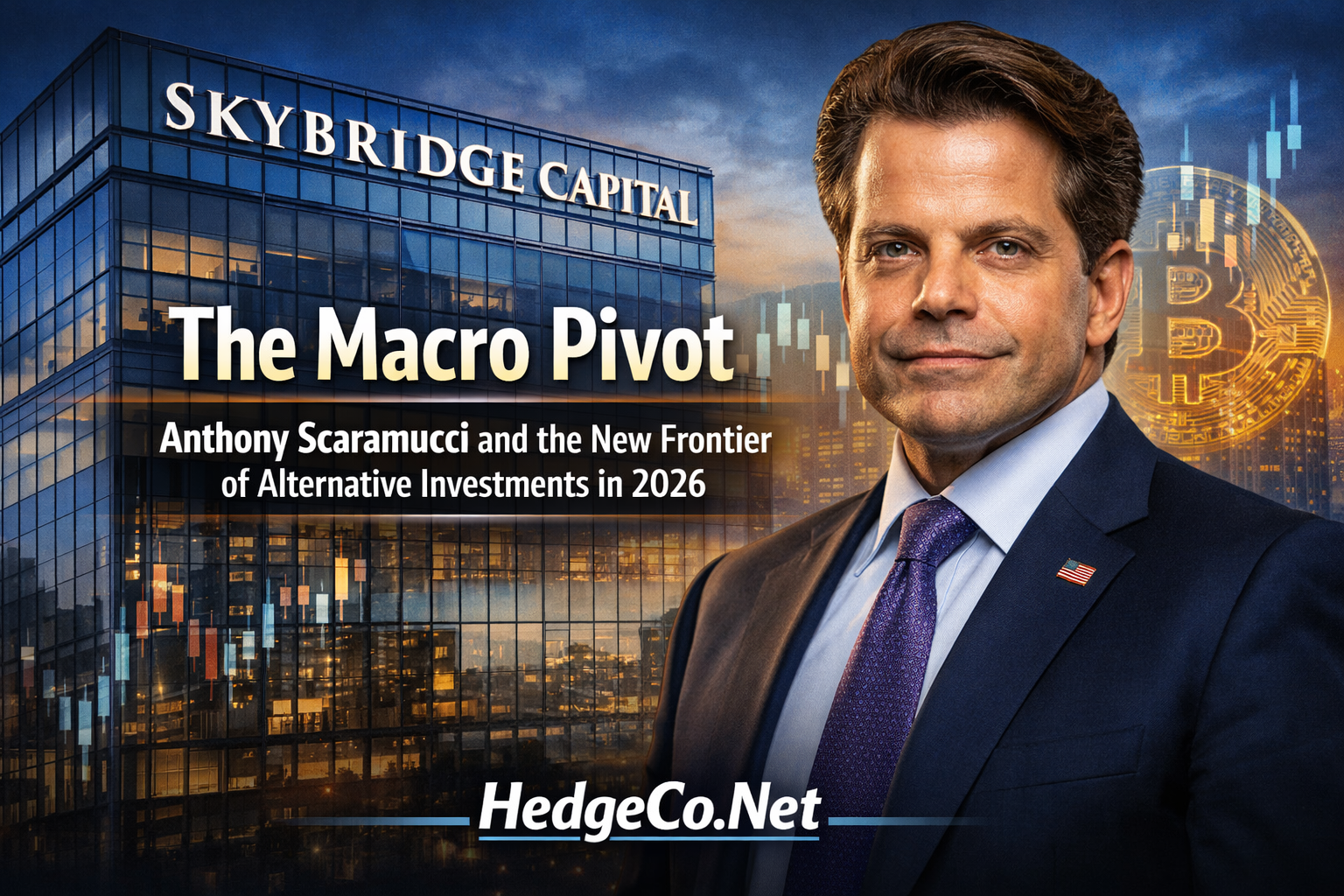
Global Investors and Macro Strategies:
(HedgeCo.Net) The alternative investment industry is undergoing one of its most consequential transformations since the aftermath of the 2008 global financial crisis. Structural macroeconomic changes—including higher interest rates, geopolitical fragmentation, accelerating technological innovation, and the institutionalization of digital assets—are reshaping the global investment landscape.
At the center of this evolving environment stands Anthony Scaramucci, founder and managing partner of SkyBridge Capital, whose investment philosophy increasingly reflects the intersection of macro strategy, digital assets, and global capital flows. Anthony Scaramucci built his career as a hedge fund allocator and entrepreneur before becoming one of the most outspoken advocates for institutional crypto adoption and macro-driven investing.
In recent years, SkyBridge has repositioned its portfolio toward macro strategies amid rising volatility and policy uncertainty. SkyBridge Capital shifted its opportunity fund allocation significantly toward macro trading as global economic conditions began generating stronger returns for macro strategies than for traditional directional equity or crypto-centric bets.
This white paper explores how Scaramucci’s evolving strategy reflects a broader “Macro Pivot” taking place across the alternative investment industry.
Key themes include:
- The resurgence of macro trading strategies
- Institutional adoption of digital assets
- Tokenization of traditional assets
- The convergence of hedge funds, venture capital, and crypto markets
- The emergence of a hybrid “digital macro” investment framework
Together, these trends represent what Scaramucci and many institutional investors now see as the new frontier of alternative investments.
1. Anthony Scaramucci: Architect of a Hybrid Investment Model
Anthony Scaramucci’s career trajectory mirrors the evolution of the hedge fund industry itself.
Beginning his career at Goldman Sachs in the late 1980s, Scaramucci developed expertise in wealth management and institutional investment advisory before launching his first investment firm, Oscar Capital Management.
In 2005 he founded SkyBridge Capital, a New York-based alternative investment manager specializing in hedge fund allocations and institutional investment strategies.
Over time, SkyBridge expanded beyond traditional hedge fund investing into:
- hedge fund seeding
- multi-manager allocations
- venture investments
- digital assets
- macro trading strategies
Scaramucci also launched the SALT Conference, one of the largest global gatherings of hedge fund managers, policymakers, and investors.
The SALT platform has become a key forum for discussions on:
- macroeconomic policy
- hedge fund innovation
- blockchain technology
- geopolitical investment risks
Through SALT, Scaramucci positioned himself as a bridge between traditional finance and emerging investment paradigms.
2. The Macro Pivot: Why Global Investors Are Re-embracing Macro Strategies
For much of the 2010s, macro investing struggled to outperform.
Ultra-low interest rates and central bank intervention compressed volatility across asset classes, limiting opportunities for macro traders.
But the environment changed dramatically after the pandemic.
Key structural forces reshaped markets:
- Rising global inflation
- Higher interest rates
- Geopolitical tensions
- Supply chain fragmentation
- Technological disruption
These forces restored macro volatility across:
- currencies
- interest rates
- commodities
- equities
Scaramucci has noted that macro strategies have begun outperforming because volatility creates opportunities for active traders.
As a result, SkyBridge increased its macro exposure while reducing its earlier concentration in digital assets.
This shift reflects a broader trend.
Across the hedge fund industry:
- global macro funds have seen strong inflows
- discretionary macro trading is resurging
- systematic macro strategies are expanding
The macro environment has once again become fertile ground for hedge fund alpha.
3. Digital Assets: From Speculation to Institutional Infrastructure
While macro investing has returned to prominence, Scaramucci remains one of the most prominent institutional advocates for cryptocurrency.
SkyBridge began investing heavily in digital assets in 2020 and launched the SkyBridge Bitcoin Fund to provide institutional exposure to the asset class.
Initially skeptical of Bitcoin, Scaramucci became convinced after studying its underlying economic model and global adoption trends.
Bitcoin’s appeal stems from several structural features:
- Fixed supply of 21 million coins
- Global liquidity
- Decentralized infrastructure
- Institutional adoption through ETFs
Scaramucci has repeatedly argued that Bitcoin represents a digital store of value in a world of expanding sovereign debt.
He has cited the “macro trajectory of debt” as a major reason for long-term optimism toward the asset.
This thesis resonates with institutional investors increasingly concerned about:
- currency debasement
- fiscal sustainability
- geopolitical fragmentation
Bitcoin and other digital assets are therefore becoming integrated into institutional portfolios as a form of macro hedge.
4. The Institutionalization of Crypto
One of the defining features of the current cycle is the growing participation of institutional investors in crypto markets.
Unlike the retail-driven bull markets of 2017 and 2021, the current wave is characterized by institutional infrastructure.
Key developments include:
- Bitcoin ETFs
- institutional custody solutions
- regulatory frameworks
- institutional liquidity providers
Scaramucci believes these developments could drive massive growth in digital asset adoption.
Global crypto wallet usage already numbers in the hundreds of millions and could approach half a billion users in the near future.
As institutional adoption expands, digital assets are transitioning from a speculative niche into a core component of the alternative investment ecosystem.
5. Tokenization: The Next Phase of Financial Infrastructure
Perhaps the most radical element of Scaramucci’s investment thesis concerns the tokenization of real-world assets.
Tokenization refers to the process of representing financial assets—such as stocks, bonds, or private funds—on blockchain networks.
Scaramucci has argued that eventually all financial assets may become tokenized and tradable on blockchain infrastructure.
This shift could produce profound changes in financial markets:
- 24-hour trading of assets
- global liquidity pools
- reduced settlement times
- fractional ownership
In partnership with digital-asset investors, Scaramucci has backed initiatives designed to tokenize assets on networks such as Avalanche.
Tokenization could ultimately reshape the architecture of global finance.
6. The Convergence of Macro and Digital Markets
The most interesting aspect of Scaramucci’s strategy is the convergence between macro trading and digital assets.
Historically, these two worlds were separate.
Macro traders focused on:
- currencies
- commodities
- bonds
- interest rates
Crypto investors focused on:
- blockchain networks
- token valuations
- decentralized finance
But these domains are increasingly merging.
Digital assets now respond to macro drivers such as:
- monetary policy
- liquidity cycles
- risk sentiment
- geopolitical risk
This convergence has created what some investors now call “digital macro.”
Digital macro strategies combine:
- macroeconomic analysis
- blockchain network data
- liquidity flows
- derivatives trading
The result is a hybrid investment framework.
7. Volatility as an Asset Class
Another emerging theme in the alternative investment industry is the idea of volatility itself becoming an asset class.
Scaramucci has emphasized that rising market volatility creates opportunities for macro traders and hedge funds.
Volatility can be monetized through:
- options strategies
- volatility arbitrage
- macro trading
- cross-asset correlations
As central bank policy becomes less predictable, volatility is likely to remain elevated.
This creates opportunities for:
- macro hedge funds
- quantitative strategies
- derivatives specialists
8. The Rise of the “Multi-Strategy Macro Platform”
The next generation of alternative investment firms may increasingly resemble multi-strategy macro platforms.
These firms combine several investment approaches under a single infrastructure:
- macro trading
- venture capital
- digital assets
- private markets
- quantitative strategies
This model allows firms to allocate capital dynamically across multiple opportunity sets.
Scaramucci’s SkyBridge Capital represents an early example of this hybrid platform.
9. Risks and Lessons From the Crypto Cycle
Scaramucci’s crypto journey has not been without controversy.
SkyBridge’s exposure to digital assets produced significant volatility during the 2022 crypto downturn, and the firm faced challenges following its association with FTX.
The experience highlighted key risks in emerging asset classes:
- regulatory uncertainty
- market volatility
- counterparty risk
- liquidity constraints
However, Scaramucci has acknowledged mistakes and adapted his strategy accordingly.
The lesson for investors is clear:
Emerging asset classes require disciplined risk management.
10. The Future of Alternative Investments
Looking forward, the alternative investment industry may be entering a new era defined by several structural trends.
These include:
1. Macro Dominance
Macro forces—including inflation, geopolitical competition, and energy transitions—will dominate financial markets.
2. Digital Asset Integration
Crypto assets will become integrated into institutional portfolios.
3. Tokenized Financial Markets
Blockchain infrastructure may reshape capital markets.
4. Institutional Liquidity
Large asset managers and pension funds will continue expanding allocations to alternatives.
5. Technology-Driven Investing
Artificial intelligence and data analytics will transform investment strategies.
In this environment, the most successful firms will be those capable of integrating multiple investment paradigms.
Conclusion: The New Frontier of Alternative Investments
Anthony Scaramucci’s investment evolution reflects a broader transformation underway in global finance.
The combination of macro volatility, digital assets, and technological innovation is reshaping the alternative investment industry.
What once were separate domains—hedge funds, venture capital, crypto markets, and macro trading—are now converging into a unified ecosystem.
For investors, this shift represents both opportunity and risk.
But one conclusion is increasingly clear:
The future of alternative investments will be defined not by a single asset class or strategy, but by the ability to navigate a rapidly changing macroeconomic landscape.
In that sense, the “Macro Pivot” is more than a tactical adjustment.
It represents the emergence of a new investment paradigm—one in which global macro forces, digital infrastructure, and institutional capital flows converge to shape the next generation of financial markets.
And at the intersection of those forces stands Anthony Scaramucci, whose evolving strategy offers a glimpse into the future architecture of alternative investing.