The Rise of Hedge-Fund BillionairesExecutive Summary:
(HedgeCo.Net) Over the past decade, the global hedge-fund industry has undergone a dramatic transformation. Once a relatively niche corner of the financial world dominated by a handful of aggressive traders and macro speculators, hedge funds today represent a massive institutional asset class controlling trillions of dollars in capital and generating unprecedented profits for investors and fund managers alike.
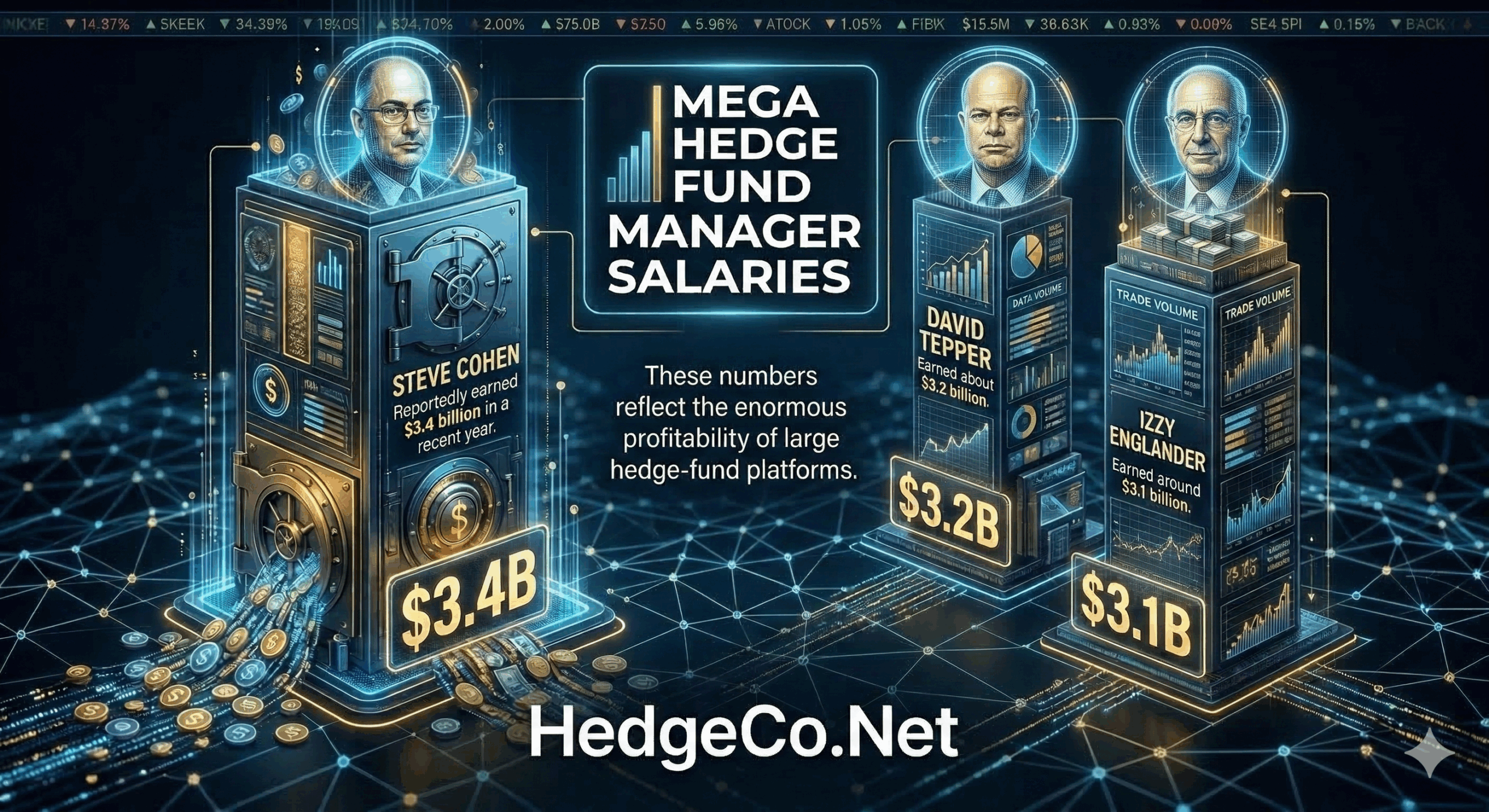
The data reveals a striking reality: hedge-fund managers are now among the highest-earning professionals in global finance. Individual hedge-fund founders regularly earn billions of dollars annually, driven by performance fees, capital appreciation, and ownership stakes in their firms. For example, Steve Cohen, founder of Point72, reportedly earned approximately $3.4 billion in a single year, topping global rankings of hedge-fund manager compensation.
Close behind are industry titans such as David Tepper of Appaloosa Management, who earned roughly $3.2 billion, and Israel Englander of Millennium Management, whose multi-strategy platform continues to produce consistent returns for institutional investors.
These massive personal earnings are not merely symbolic. They reflect the extraordinary profitability of the hedge-fund business model itself. According to industry surveys, the top 25 hedge-fund managers collectively generated more than $30 billion in compensation in a single year, demonstrating the immense wealth-creation power embedded within the sector.
At the same time, hedge-fund profits for investors have also reached historic levels. Some funds have generated record-breaking gains; for example, TCI Fund Management delivered $18.9 billion in profit for investors in 2025, the largest annual dollar gain ever recorded by a hedge fund.
This white paper explores the forces driving the “Hedge Fund Profit Explosion”, examining the structural evolution of hedge-fund economics, the rise of multi-strategy mega-platforms, technological innovation in quantitative trading, and the growing influence of hedge funds across global financial markets.
1. The Economics of Hedge-Fund Wealth Creation
At the core of hedge-fund profitability lies a unique fee structure that has historically distinguished the industry from traditional asset management.
Most hedge funds operate under the classic “2 and 20” model, which includes:
- Management fee: typically 2% of assets under management
- Performance fee: typically 20% of profits generated
While many funds have modified these terms in recent years, the fundamental structure remains intact.
For a hedge fund managing $50 billion in assets, even modest performance can generate extraordinary revenue.
Example:
| Metric | Example |
|---|---|
| Assets under management | $50 billion |
| Annual return | 10% |
| Total profits | $5 billion |
| Performance fee (20%) | $1 billion |
| Management fee (2%) | $1 billion |
Total annual revenue: $2 billion
This fee model explains why successful hedge-fund firms often generate profits comparable to large investment banks.
But the modern hedge-fund economy has evolved beyond the simple “2 and 20” structure.
Today’s hedge-fund profits increasingly reflect ownership economics, where founders maintain significant equity stakes in their firms. As assets grow, the value of these firms can reach tens of billions of dollars.
2. The Rise of Hedge-Fund Billionaires
Hedge-fund managers now rank among the wealthiest individuals in the world.
Industry leaders include:
- Steve Cohen – Point72
- Ken Griffin – Citadel
- David Tepper – Appaloosa
- Israel Englander – Millennium
- Ray Dalio – Bridgewater Associates
These individuals have accumulated fortunes not only through trading profits but also through ownership stakes in large investment platforms.
For example, Citadel’s founder Ken Griffin has built one of the most profitable hedge funds in history. Citadel has generated more than $74 billion in cumulative gains for investors, the largest total among hedge funds. This sustained profitability has elevated hedge-fund managers to a new level of economic influence.
3. The Emergence of Hedge-Fund Mega Platforms
One of the most important structural developments in the industry has been the rise of multi-strategy hedge-fund platforms. These firms operate more like financial ecosystems than traditional funds.
Key examples include:
- Millennium Management
- Citadel
- Point72
- Balyasny Asset Management
- Schonfeld Strategic Advisors
Rather than relying on a single investment strategy, these firms deploy hundreds of independent trading teams known as “pods.” Each pod operates with:
- its own capital allocation
- risk limits
- strategy specialization
Strategies include:
- equity long/short
- global macro
- quantitative trading
- commodities
- volatility arbitrage
- credit trading
This diversified structure allows multi-strategy funds to produce stable returns across market cycles. In effect, these firms operate like mini hedge-fund economies, internally allocating capital among hundreds of investment teams.
4. The Explosion of Assets Under Management
The hedge-fund industry’s profit growth is closely tied to the dramatic expansion of assets under management. The largest hedge funds now control tens of billions of dollars each. Some of the biggest firms include:
| Firm | Approximate AUM |
|---|---|
| Bridgewater Associates | ~$78 billion |
| Millennium Management | ~$77 billion |
| Elliott Management | ~$76 billion |
| Citadel | ~$67 billion |
| D. E. Shaw | ~$60 billion |
These firms represent the core of the global hedge-fund ecosystem. The scale of these organizations gives them enormous market influence. Large hedge funds frequently:
- move billions of dollars across asset classes
- influence corporate governance
- shape global macro trading flows
5. Record Investor Profits
While hedge-fund manager compensation attracts headlines, the industry’s profitability for investors has also been remarkable. In recent years:
- Equity hedge funds have delivered strong double-digit returns.
- Multi-strategy funds have generated stable gains even in volatile markets.
- Global macro funds have profited from geopolitical uncertainty.
For example, Bridgewater’s flagship Pure Alpha fund produced a 33% return in 2025, its strongest performance in decades. Such returns translate into massive dollar profits when applied to large capital bases.
6. Technology and the Quantitative Revolution
A key driver of hedge-fund profitability has been the rise of quantitative trading and data-driven investment models. Modern hedge funds increasingly resemble technology companies.
Major firms employ:
- thousands of engineers
- machine-learning researchers
- data scientists
- quantitative analysts
Quantitative firms such as:
- Renaissance Technologies
- Two Sigma
- D. E. Shaw
- AQR Capital Management
use advanced algorithms to analyze massive datasets and execute high-frequency trades.
These technologies allow hedge funds to identify patterns in:
- market microstructure
- macroeconomic signals
- alternative data
The result is an increasingly sophisticated form of financial engineering.
7. The Role of Market Volatility
Periods of volatility often provide fertile ground for hedge-fund profits. Events such as:
- geopolitical conflicts
- inflation shocks
- central-bank policy changes
- commodity disruptions
create opportunities for hedge funds to exploit price dislocations. Recent years have provided precisely this environment. For example:
- AI-driven stock market rallies
- trade tensions affecting currencies and bonds
- commodity volatility linked to geopolitical risks
These dynamics have allowed hedge funds to capture alpha across multiple asset classes.
8. The Expansion into Private Markets
Another driver of hedge-fund profit growth has been the expansion into private investments. Historically, hedge funds focused on liquid public markets. Today, many funds are investing in:
- private credit
- venture capital
- structured lending
- infrastructure assets
This shift reflects the broader evolution of the alternative-investment industry.
Private markets often offer:
- higher yields
- less competition
- greater structural inefficiencies
These characteristics create opportunities for hedge funds to generate additional returns.
9. The Talent Arms Race
The hedge-fund industry is also experiencing an unprecedented talent war. Top portfolio managers now command enormous compensation packages. At multi-strategy firms:
- signing bonuses can exceed $10 million
- revenue-sharing arrangements are common
- star traders may receive multi-year guarantees
The competition for talent reflects the immense value that skilled traders can generate.
A successful portfolio manager overseeing billions of dollars in capital can produce hundreds of millions in annual profits.
10. The Future of Hedge-Fund Profitability
Looking ahead, several structural trends suggest that hedge-fund profits may continue to grow.
1. Artificial Intelligence
AI is transforming trading strategies, research capabilities, and risk management.
2. Institutional Capital Flows
Pension funds, sovereign wealth funds, and endowments continue to increase allocations to hedge funds.
3. Market Complexity
As financial markets become more complex, active trading strategies become more valuable.
4. Technological Edge
Firms investing heavily in data infrastructure and algorithmic trading may gain structural advantages.
Conclusion
The ongoing Hedge Fund Profit Explosion reflects a convergence of structural forces:
- massive institutional capital inflows
- advanced quantitative technology
- diversified multi-strategy investment platforms
- increasing market volatility
Together, these forces have transformed hedge funds into one of the most profitable segments of the global financial system.
Today’s largest hedge-fund firms resemble financial super-platforms, combining elements of investment banks, technology companies, and trading firms.
Their founders—once viewed as niche traders—now rank among the most powerful figures in global finance.
If current trends continue, hedge funds may play an even greater role in shaping global markets over the next decade.
The hedge-fund profit explosion is not merely a temporary boom.
It represents the emergence of a new financial architecture, where technology, capital, and trading expertise combine to create unprecedented wealth.