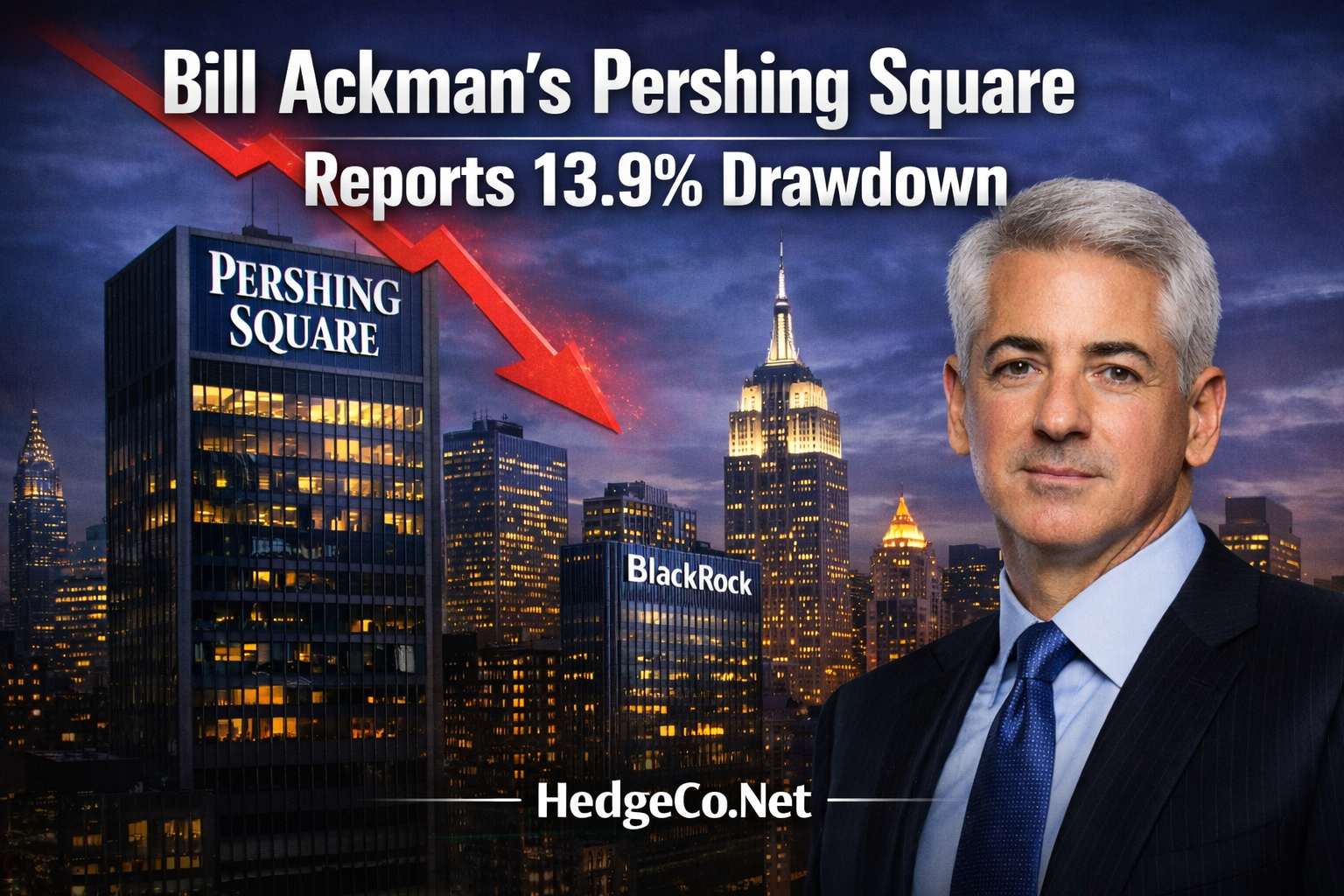
(HedgeCo.Net) Few investors command the attention of global markets quite like Bill Ackman. The founder of Pershing Square Capital Management has built a reputation over two decades as one of Wall Street’s most influential activist investors—combining concentrated portfolios with bold public campaigns designed to unlock shareholder value. Yet even the most prominent hedge fund managers face difficult market environments, and recent data from Pershing Square Holdings (PSH) shows the firm navigating one of its more challenging periods in recent years.
Weekly net asset value updates indicate that Pershing Square Holdings is down 13.9% year-to-date, reflecting a combination of macroeconomic volatility, sector-specific drawdowns, and market rotation away from some of the firm’s core holdings.
Despite the setback, Ackman’s firm is signaling confidence in its long-term strategy through an aggressive share repurchase program, buying back PSH shares at a notable discount to net asset value.
A Rare Period of Underperformance
Pershing Square is known for its high-conviction, concentrated investment strategy, typically holding fewer than a dozen core positions. While this approach has historically delivered strong long-term returns, it can also amplify short-term volatility when large positions move against the portfolio.
Market observers note that several of Pershing Square’s holdings have experienced pressure during the recent quarter as investors reposition portfolios amid rising interest rates, shifting growth expectations, and macroeconomic uncertainty.
In particular, sectors that previously benefited from low interest rates—such as consumer discretionary and growth-oriented businesses—have seen multiple compression as borrowing costs rise.
For concentrated hedge funds, this kind of environment can produce larger drawdowns than more diversified portfolios.
The Share Buyback Strategy
Rather than retreating in the face of declining share prices, Pershing Square has doubled down on its share repurchase program, buying back PSH shares in the open market.
This strategy reflects Ackman’s long-standing view that repurchasing shares when they trade at a discount to intrinsic value creates meaningful long-term shareholder value.
Historically, Pershing Square Holdings has often traded below net asset value due to its structure as a publicly traded investment vehicle. When that discount widens significantly, the firm has frequently stepped in as a buyer of its own shares.
From Ackman’s perspective, this effectively allows investors to acquire exposure to the firm’s portfolio at a discounted valuation.
The approach mirrors tactics used by several other publicly listed investment companies, where share buybacks are deployed as a mechanism to narrow discounts to NAV.
Pershing Square’s Investment Philosophy
Ackman’s investment strategy has evolved significantly since Pershing Square’s founding in 2004. Early in the firm’s history, the portfolio frequently included activist campaigns aimed at forcing corporate restructuring or management change.
High-profile examples included positions in companies such as:
- Canadian Pacific Railway
- Chipotle Mexican Grill
- Allergan
- Valeant Pharmaceuticals
While some campaigns generated enormous returns, others—including the firm’s infamous Herbalife short position—proved costly.
In recent years, Pershing Square has shifted toward a more “activist-friendly” approach, focusing on high-quality companies where management teams are aligned with long-term shareholder value creation.
This strategy reflects Ackman’s view that collaboration with management often produces better outcomes than confrontation.
Market Context
The recent drawdown also reflects broader shifts in global financial markets.
The hedge fund industry is currently navigating several powerful macroeconomic forces:
- Persistent inflation
- Elevated interest rates
- Credit market tightening
- Rising geopolitical risks
These conditions have created a more volatile investment environment where even top-performing hedge funds are experiencing larger swings in performance.
For Pershing Square, the combination of concentrated positions and macro-driven market rotations has produced a temporary setback.
However, long-time investors note that Ackman has historically demonstrated an ability to recover from drawdowns and deliver strong long-term performance.
Long-Term Track Record
Despite the current decline, Pershing Square’s long-term performance remains impressive.
Over the past decade, the firm has generated substantial returns through a combination of activist investing, concentrated stock selection, and opportunistic macro positioning.
One of the most notable examples occurred during the COVID-19 market crash in 2020, when Ackman executed a famous credit hedge that reportedly generated billions in profits for the fund.
That trade not only protected Pershing Square’s portfolio but also provided capital to deploy into equities near the market bottom.
It remains one of the most successful macro hedges in hedge fund history.
What Investors Are Watching
As the year progresses, investors will be closely watching several factors that could determine whether Pershing Square rebounds from its current drawdown:
- Performance of core portfolio holdings
- Potential new activist campaigns
- Continued share buyback activity
- Broader macroeconomic conditions
Ackman himself has repeatedly emphasized that Pershing Square’s strategy is designed for long-term value creation rather than short-term market timing. If history is any guide, periods of underperformance have often preceded some of the firm’s strongest investment opportunities.